Home › Footprints on the Sands of Time › Footprints on the Sands of Time: Palæontology
Footprints on the Sands of Time: Palæontology
Another branch of geology, namely Palæontology, with which we are about to deal in the present work, tells us of the longlost tribes of plants and animals which, ages and ages ago, found a home on the earth. To many minds this branch of geology, which is simply the natural history of the past, is the most fascinating, with which view we fully sympathise. Putting aside the study of fossil plants (which is a small branch of the subject), we may say of Palæontology, that it interprets to us the world's "lost creations." In this branch of geology the records are not so much the rocks themselves as the fossil skeletons they so often contain.
In some cases, as we shall presently show, the rocks contain additional evidences of very considerable value, as throwing light on the habits of the creatures, or on their natural surroundings; but bones, shells, and other hard parts of animals, are the foundation on which the science of Palæontology is founded. And here, again, we find the same principle at work-viz. that the past must be read in the light of the present. However many ages ago it it was, whether millions or billions of years ago, that these primæval inhabitants of the world enjoyed their existence, the same unbroken laws of nature-the visible expressions of a Divine and All-powerful Will-were at work, fulfilling His purposes as now. Flesh and blood were then what they are now, and fulfilled the same functions. Bones grew then as they grow nowadays. To those bones were attached muscles which expanded and contracted just as muscles do now. Wings were used for flying, fins and paddles for swimming, legs for walking, teeth for masticating food, just as they are now. In fact these primitive inhabitants of the antique world, however different in bodily shape from those we see around us now, lived under the same universal laws of Physiology as we ourselves do.
Palæontology, then, is the science which, in the light of Comparative Anatomy and Physiology, rehabilitates the world's ancient inhabitants, clothing their dry bones with flesh, and enabling us in imagination to see them as they were when they walked this earth. It will be our endeavour in the present work to present to our readers a certain number of these antique animals -birds, beasts, and fishes, whose mortal remains have been buried up and preserved, often with singular completeness, in the rocks of the earth's crust.
But although fossil bones and skeletons are the chief material at our command for this purpose, yet the series of stratified rocks contains here and there other kinds of evidence, valuable in their way, such as footmarks, tracks, burrows, coprolites, or droppings, and even ripple-marks and the impressions of rain-drops. It is with these evidences that we propose to deal in the present chapter. Let us see what can be learned from such humble and apparently insignificant records, of some of the creatures that once trod this earth.
The intelligent observer who has strolled along the strand of the seashore at low water, must have often seen the surface of the exposed sands deeply rippled by the waves of the ebbing tide, and have noticed the trails of molluscs, and the meandering furrows and ridges produced by worms, or annelides, and the tracks of crabs, and sometimes the footprints of birds and of dogs or other quadrupeds that have walked over sand or mud while it was yet plastic and sufficiently firm to retain the markings impressed upon it. Under certain conditions these apparently evanescent characters are indelibly fixed on the stratum, and in rocks of immense antiquity successive layers of sandstone and shale, through a thickness of many hundred feet, are found deeply furrowed with the ripples of the waves that flowed over them, pitted by the rain that has fallen upon them, and impressed with the footmarks of bipeds and quadrupeds that traversed the sands whilst the surface was in a moist and yielding state. Even on some of the most ancient of rocks, such as those of the Cambrian system, jelly-fish have left indelible impressions of their soft round bodies!
Speaking of the wonderfully enduring nature of certain impressions known to geologists, the sagacious Dean Buckland said, in an address to the Geological Society: "The historian or the antiquary may have traversed the fields of ancient or of modern battles, and may have pursued the line of march of triumphant conquerors, whose armies trampled down the most mighty kingdoms of the world. The winds and storms have utterly obliterated the ephemeral impressions in their course. Not a track remains of a single foot or a single hoof of all the countless millions of men and beasts whose progress spread desolation over the earth. But the reptiles that crawled upon the half-finished 1 surface of our infant planet have left memorials of their passage, enduring and indelible. Centuries and thousands of years have rolled away, between the time in which these footsteps were impressed by tortoises upon the sands of their native Scotland and the hour when they were again laid bare and exposed to our curious and admiring eyes. Yet we behold them stamped upon the rock, distinct as the track of the passing animal upon the recent. snow; as if to show that thousands of years are but as nothing amidst eternity, and, as it were, in mockery of the fleeting perishable course of the mightiest potentates among mankind." 2 Every form of animal life that, writhing, crawling, walking, running, hopping, or leaping, could leave a track, depression, or footprint behind it, might thereby leave similar lasting evidence of its existence and also, to some extent, of its nature. The 1 This expression is a survival from the teaching in vogue fifty years ago. The world was not in an unfinished state during the period of the New Red Sandstone. 2 Bridgewater Treatise, vol. i. p. 251. interpretation of such evidences of ancient life has exercised the sagacity of naturalists since Dr. Duncan, in 1828, first inferred the existence of tortoises in certain sandstones in Dumfriesshire from the impressions left on them. The vast number and variety of such impressions has raised up a distinct branch of Palæontology, to which the name Ichnology 1 has been given.
We will now give a brief account of the results which have been arrived at in this branch of inquiry. To begin with one of the lowest forms of animal life-the worms. The class Annelida comprises the so-called ringed worms, including the leeches and earth-worms, and the sea-worms. As might have been expected, earth-worms are unknown in the geological record; for their soft bodies were not likely to be preserved even in the most favourable kinds of deposits. But in some cases the hard jaws of marine worms have escaped destruction. Fossil worm-jaws are abundantly found in some parts of the Cambrian, Silurian, and Carboniferous systems (see Appendix I.). The so-called "Conodonts" are believed by many authorities to be the jaws of worms; and such remains are also found in strata of the Mesozoic and Tertiary eras. Besides these rather mysterious little bodies, which some have taken to be the teeth of primitive fishes such as our modern Hagfish, a good many worm-like markings are found in muddy and sandy sediments all through the stratified series. In many cases the true nature of these remains is still a matter of doubt. The visitor to the Natural History Museum at South Kensington will find in Gallery No. XI. a very fine and large collection of fossil tracks and footmarks of all kinds (Wall-cases Nos. 8-12). Some of these are probably vegetable remains; but others are certainly the tracks of molluscs or of crustaceans. Long burrows of marine worms occur plentifully in some rocks of Cambrian and Silurian 1 Greek-ichnos, footstep; logos, discourse. age, and have been figured under the names Scolithus, Histioderma, and Arenicolites. They are nearly straight, and descend vertically through the rock. Such are abundant in that ancient formation the Potsdam Sandstone of North America; in the Clinton formation, also of that country; and in the Stiperstones of Shropshire. Even in the Pre-Cambrian rocks of the west of Sutherlandshire there have been discovered of late years some long dark lines which are believed to be the burrows of marine worms pulled out to great lengths by the "shearing," or pulling-out process to which these rocks have been long ago subjected. For the full and complete interpretation of many of the curious markings known to geologists, a more accurate knowledge of the markings made by living animals will doubtless be necessary.
Various worms of the present day, such as the common lugworm, are known to form long, wandering, tortuous channels in the sand of the seashore, a little distance below the surface. These worms feed on particles of organic matter scattered through the sand or mud, through which it eats its way. Such burrows cross and intersect each other in various ways, and as the worm proceeds on its course, they become filled up in the rear by the sand which has passed through its body. This is how worm-casts seen on the seashore at the present day are made. It appears, in the light of more recent researches, that many markings found in some of the more ancient (Palæozoic) rocks, and which have been formerly described as "fucoids," i.e. seaweeds, under such names as Palæochorda, are in reality the filled-up burrows of marine worms. These have now been re-christened Planolites. But there are some who consider them to be tracks made on the surface, not burrows.
A great many true trails, or tracks of worms, etc., that is markings made by the animal dragging its soft body over the surface of wet sand or mud, are found in the stratified rocks. But, in the present state of knowledge, it is very difficult to distinguish between those formed by worms and others made by molluscs or even crustaceans. The fossil known as Nereites, from Silurian slates at Wurtzbach, is probably the track of a worm. On the other hand, some of the tracks attributed to worms may have been really made by gastropod molluscs, such as whelks. One fossil track, known as Crossopodia, resembles the track made by a living Purpura lapillus, a well-known sea-shell. It is only in those strata which are very favourable to the preservation of organic remains that we can expect to find any trace or impression of the actual body of such a frail and perishable thing as a worm; but, incredible as it may seem, fossils of this nature occur in that most wonderful formation-the famous Solenhofen limestone, in which so many valuable treasures have been found; also in the Eocene slates of Monte Bolca (Italy). In these rare cases the form of the worm's body is actually seen, and the fossilised jaws occur in their natural position. Examples of these interesting specimens are beautifully rendered by chromolithography in the German monumental work Palæontographica.
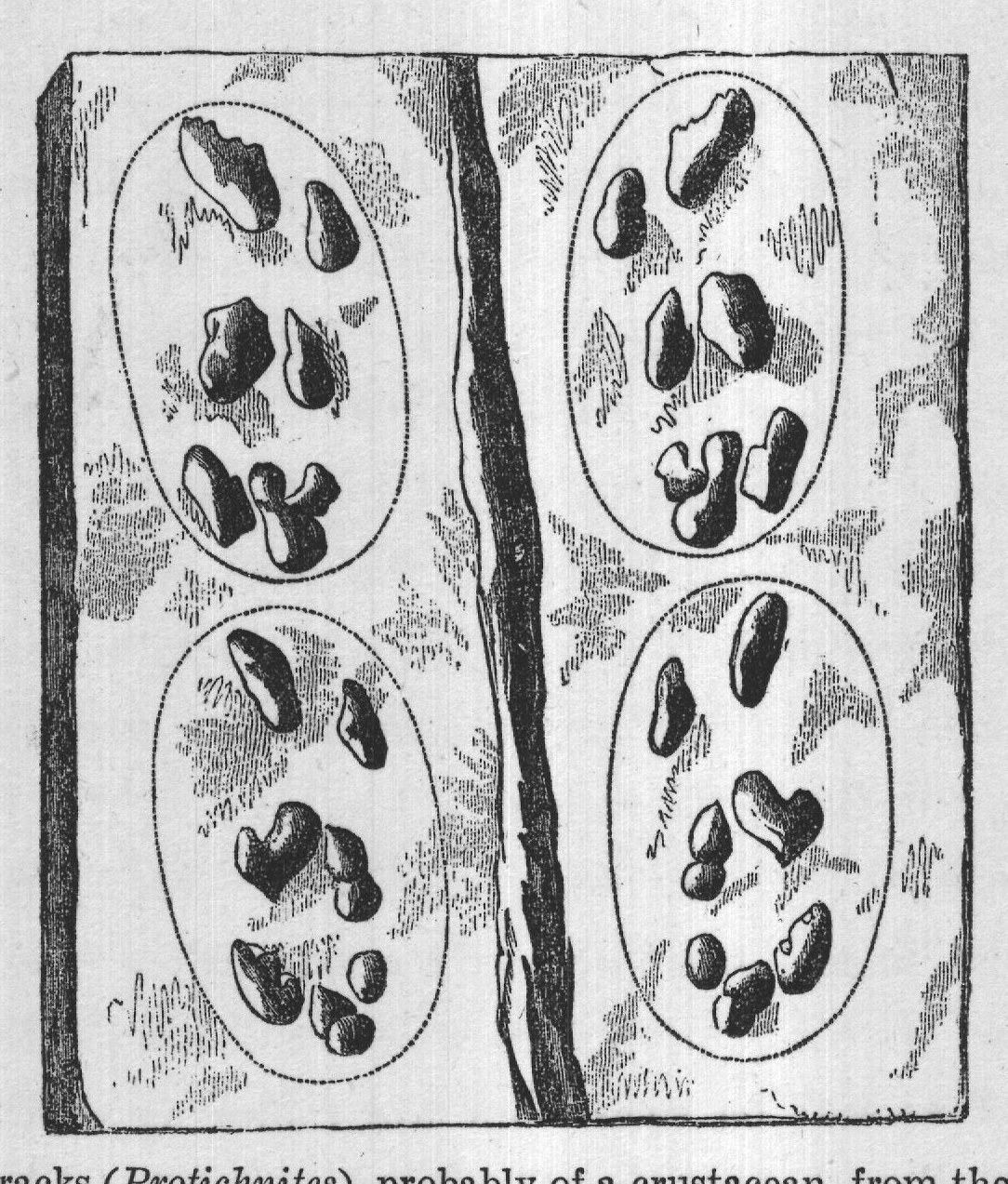
Several geologists, such as Poulett-Scrope, Strickland, Buckland, Salter, and others, have published the results of careful comparisons of tracks made by living animals on the sands of the seashore, or on flat surfaces of mud left exposed by the drying up of a pond, or by other causes, but have not given drawings of the recent markings on which their conclusions are based. Professor Emmons and Professor T. McKenny Hughes, however, have figured some recent tracks in illustration of fossil ones. The former geologist came to the conclusion that certain imprints upon some very old rocks-the Taconic Shales of Maine and New York States were made by the soft fragile larvæ of insects which existed at an early period in the world's history. We now pass on to the consideration of certain impressions in the old Potsdam Sandstone of North America, which have been most carefully studied by the late Sir R. Owen. In the year 1851, Logan exhibited before the Geological Society of London a small slab of sandstone showing some footprints, and a plaster cast from a longer surface of similar description. The original, weighing upwards of a ton, is in the Museum at Montreal connected with the McGill University The locality where it was found is on the left bank of the River St. Louis, at the village of Beauharnois, on the south side of the St. Lawrence, about twenty miles above the city of Montreal. Owen, in his first paper, came to the conclusion that the tracks were those of a tortoise. But further research caused him to alter this opinion. We only mention that to show how much care is required even on the part of the best naturalists to read the meanings of fossil tracks. A portion of the impressions now under consideration is shown in Fig. 1. They consist of a series of well-defined impressions continued in regular succession for four feet, and more; but only clearly for four feet. In this four feet there are thirty successive groups of footprints on each side of a furrow. The number of prints is not the same in each group. Where they are best marked, as in our figure, we see three prints in one group, two in the next and two in the third, followed by a repetition of the three prints (in our illustration each of the three groups is enclosed in an oval). These three groups (of 3-2-2 impressions) are distinctly repeated in succession along the whole series of tracks on both sides of the furrow. It will be noticed that in each pair of impressions the innermost pair are of equal size, but of the outer ones each is a little bigger than the last. An important point is that there are no marks of toes or nails. Their edges are not sharply defined, but are rounded off, and there is a slight variation in the form and depth of the corresponding impressions on each side of the furrow. But the reader will see from the figure that they do correspond with each other. Thus, take the three tracks at the bottom of the lower group on the right side of the furrow; the innermost of this group of three may ہے FIG. 1.-Tracks (Protichnites), probably of a crustacean, from the Potsdam Sandstone, North America. (After Owen.) easily be identified with the innermost track of the group of three on the left side of the furrow. And so with the two groups of three belonging to the two upper sets of impressions, each of which is enclosed in an oval.