Home › Footprints on the Sands of Time › Footprints on the Sands of Time: Connecticut
Footprints on the Sands of Time: Connecticut
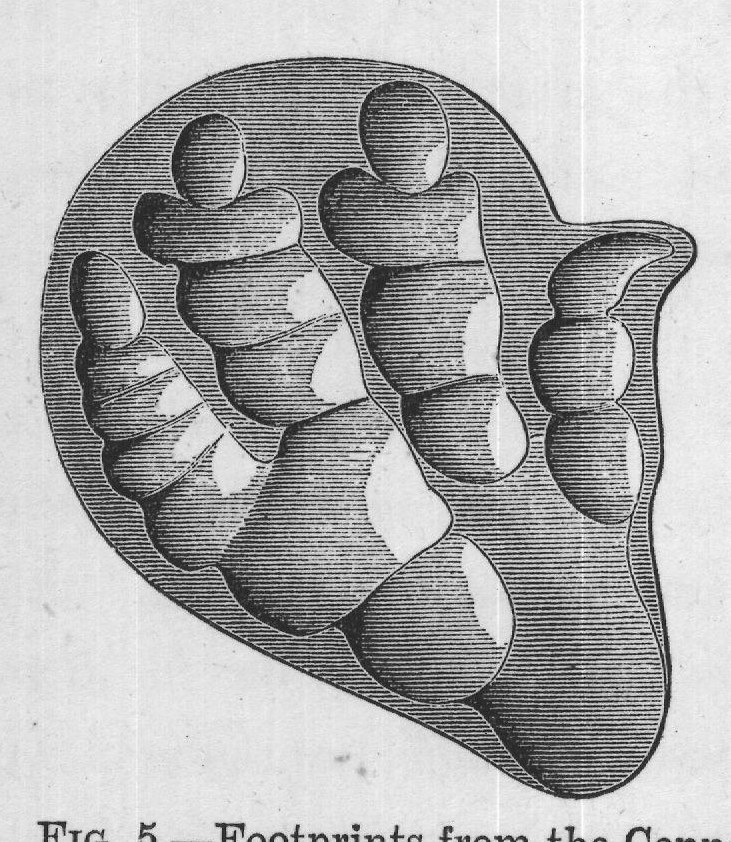
Those impressions which Hitchcock believed to have been made by birds show a regular increase in the number of joints FIG. 5. Footprints from the Connecticut Sandstone. The three tracks in the middle show the mark left by the tail, probably of a Dinosaur (After Hitchcock.) of the toes; the inner toe having two, the middle one three, and the outer one four joints. Now, it happens, by a remarkable coincidence, that in the case of birds the inner toes have three, the middle toes four, and the outer toes five joints, but the last two joints in each case make but one division of the track, so that their tracks correspond with those we are considering. The discovery that some Dinosaurs have but three toes that were used (functional toes), and that they had the same number of joints in their toes as birds, has naturally led scientific men to the opinion that probably all the tracks above described were made, not by birds, but by Dinosaurs. It may be pointed out in defence of this opinion, that, although the two classes of Birds and Reptiles are now widely separated, yet in certain former geological periods there was no such gulf as now divides them. At the time when the Connecticut Sandstone tracks were made on the shores of a narrow inland sea, there must have been in existence animals which, if we saw them now, might sorely puzzle us to decide whether to call them reptilian birds, or bird-like reptiles.
During the Jura-Trias period there was in the region of the Connecticut Valley a shallow sea, connected by a narrow outlet with the ocean. Into this the tides flowed and ebbed, leaving extensive flats of mud or sand, ribbed with ripple-marks. A passing shower pitted the soft mud, and the sun, coming out again from the breaking clouds, dried and cracked it. Our Dinosaurs and other creatures sauntered or ran near the margin of the shore. The tide came in again, carrying with it fine sediments, gently covered the tracks, and preserved them for ever. This occurred constantly for many ages, about the time when the Triassic period came to a close. 1 In the year 1882, reports were published of the discovery of large footprints-supposed to be human-in a certain sandstone, near Carson, Nevada, U.S., of which a brief account was given in our former work. These are probably the tracks made by a big extinct sloth of the Pleistocene period. The wonderful series of footprints of reptiles, birds, and mammals discovered by M. Desnoyers, in certain Eocene strata near Paris, cannot be described here. 1 Extinct Monsters, p. 185 (2nd edit.).
E