Home › Ancient Salamanders › Ancient Salamanders: Labyrinthodonts
Ancient Salamanders: Labyrinthodonts
But, if these facts tend to connect the Labyrinthodonts with fishes below, there are others which tend to connect them with the reptiles above. Sir Richard Owen, by a bold piece of reasoning, arrived at the conclusion that certain huge and somewhat frog-like skulls, previously discovered in German Triassic rocks, belonged to Labyrinthodonts. This was an important step; but then the question arose, What kind of creature made the tracks found in these strata, both in Germany and England? This question cannot be answered with any certainty, as we have stated on p. 41. But we know that Anomodont reptiles and Dinosaurs abounded. Like the reptiles of to-day, modern amphibians have no fixed type of external form. Some suggest a likeness to turtles and tortoises; others suggest in shape the true snakes; another group, represented by newts and salamanders, suggests a resemblance to the lizards; and lastly, those which keep their gills through life suggest certain finless fishes, such as the congereels and the lampreys. It was just the same in the old days, when amphibians flourished more abundantly than now; they struck out in many directions-some taking on a long snakelike form (see Plate VII. and Fig. 23), others being short and with larger limbs, while in the matter of size there were great differences.
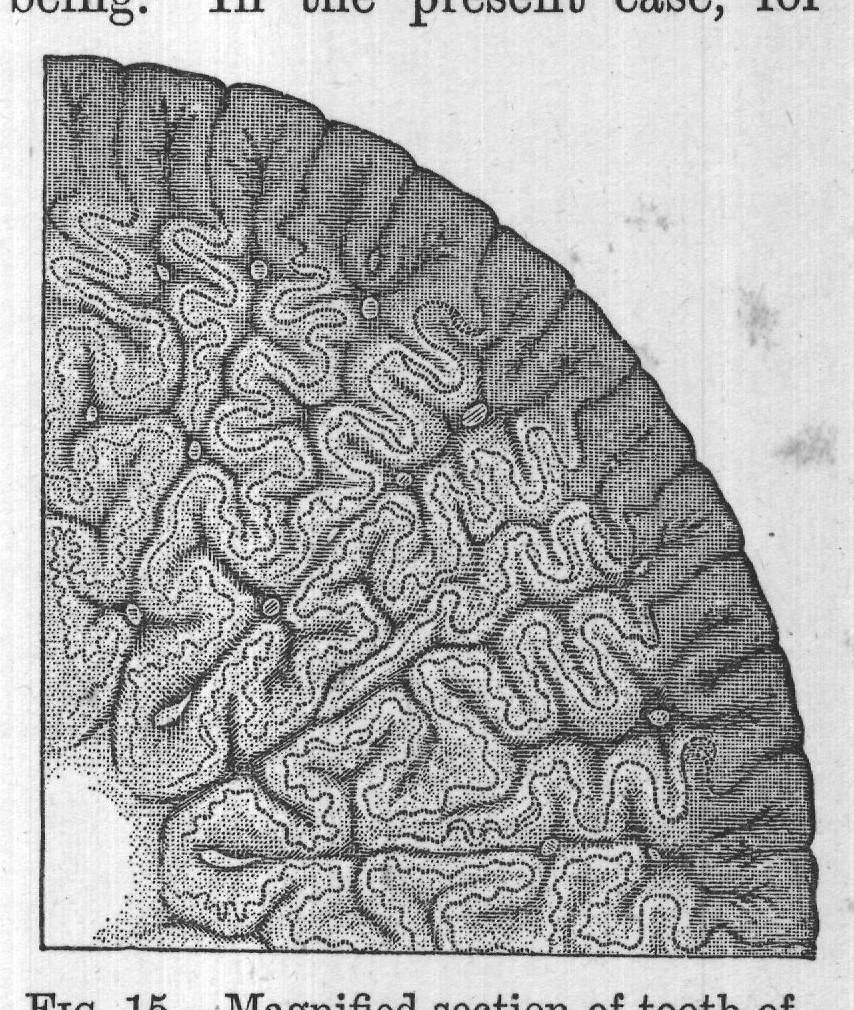
As far as present knowledge goes, it seems to indicate that the reptilian class in early days was less advanced than in the later phases of the Secondary era (i.e. during the Jurassic and Cretaceous periods); and so we can understand that amphibians to some extent played the part of reptiles in those remote ages of the coal-forests and the New Red Sandstone. Their very diversity shows that they were in a flourishing condition, and probably had a pretty wide field to themselves, without too many enemies. A certain amount of competition with other creatures, no doubt, they had to submit to; but with fishes they could hold their own. Later on came a much more severe form of competition from highly developed reptiles, such as Dinosaurs, and that was too much for them (according to Darwinian teaching). As the reptile class rose, amphibians, of course, came off second best, and the geological record tells us that, ever since, they have remained in the background of the theatre of life. It will be well, before proceeding to describe some of the better-known types of Labyrinthodonts, to say a word about the general characters by which they may be distinguished. Of the internal structure of the teeth we have already spoken; but although the same complexity of folding does not apply to some of the smaller forms, the name by which they are known is very appropriate to the group as a whole. In Plate IX. the reader will find a restoration of a typical labyrinthodont the Mastodonsaurus, of which the skull is shown in Fig. 16. There was a marked difference in size between the hind limbs and fore limbs, as shown in the above Plate. There are five digits to each limb, and no claws.