Home › Ancient Birds › Ancient Birds: Marsh's
Ancient Birds: Marsh's
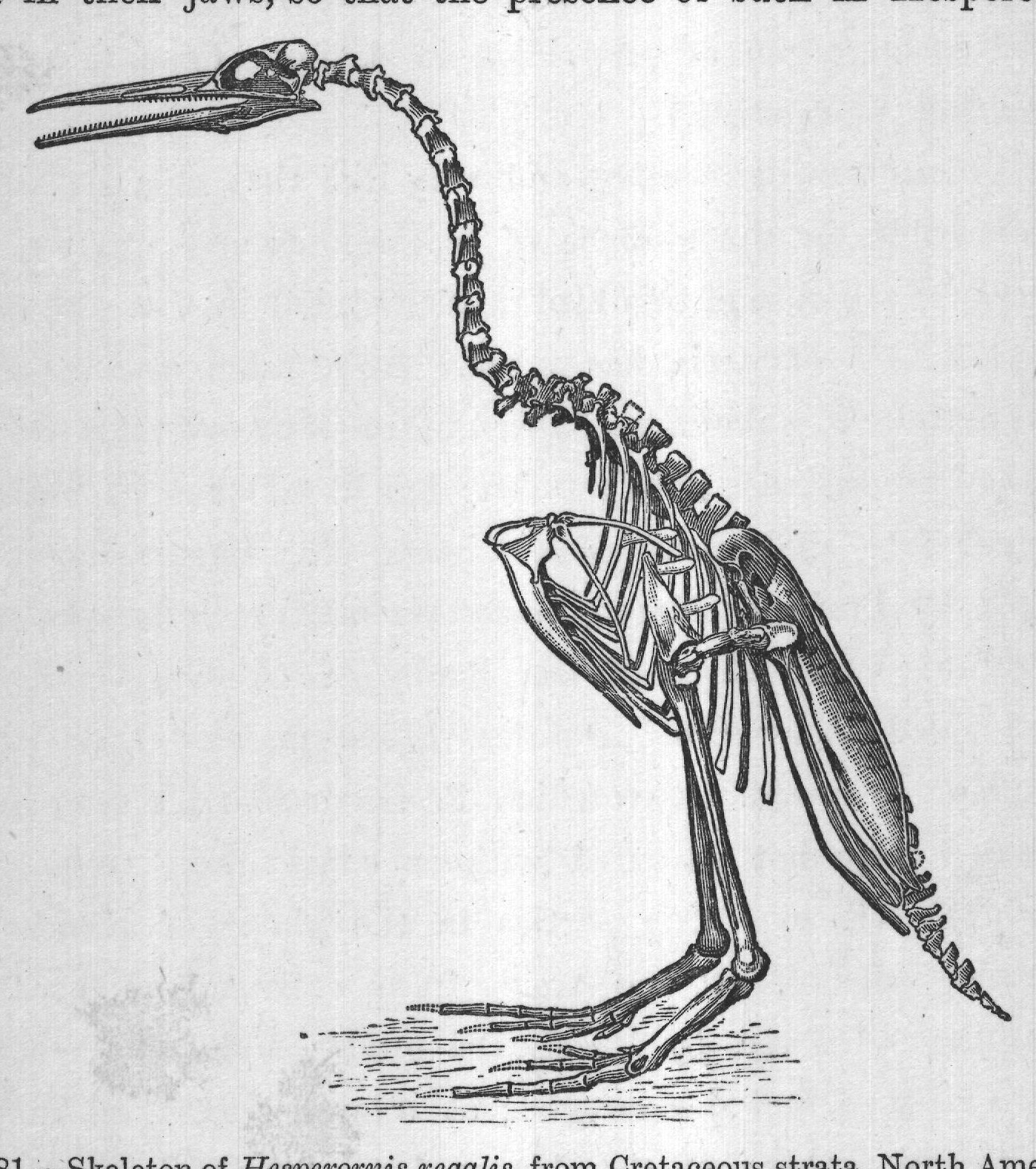
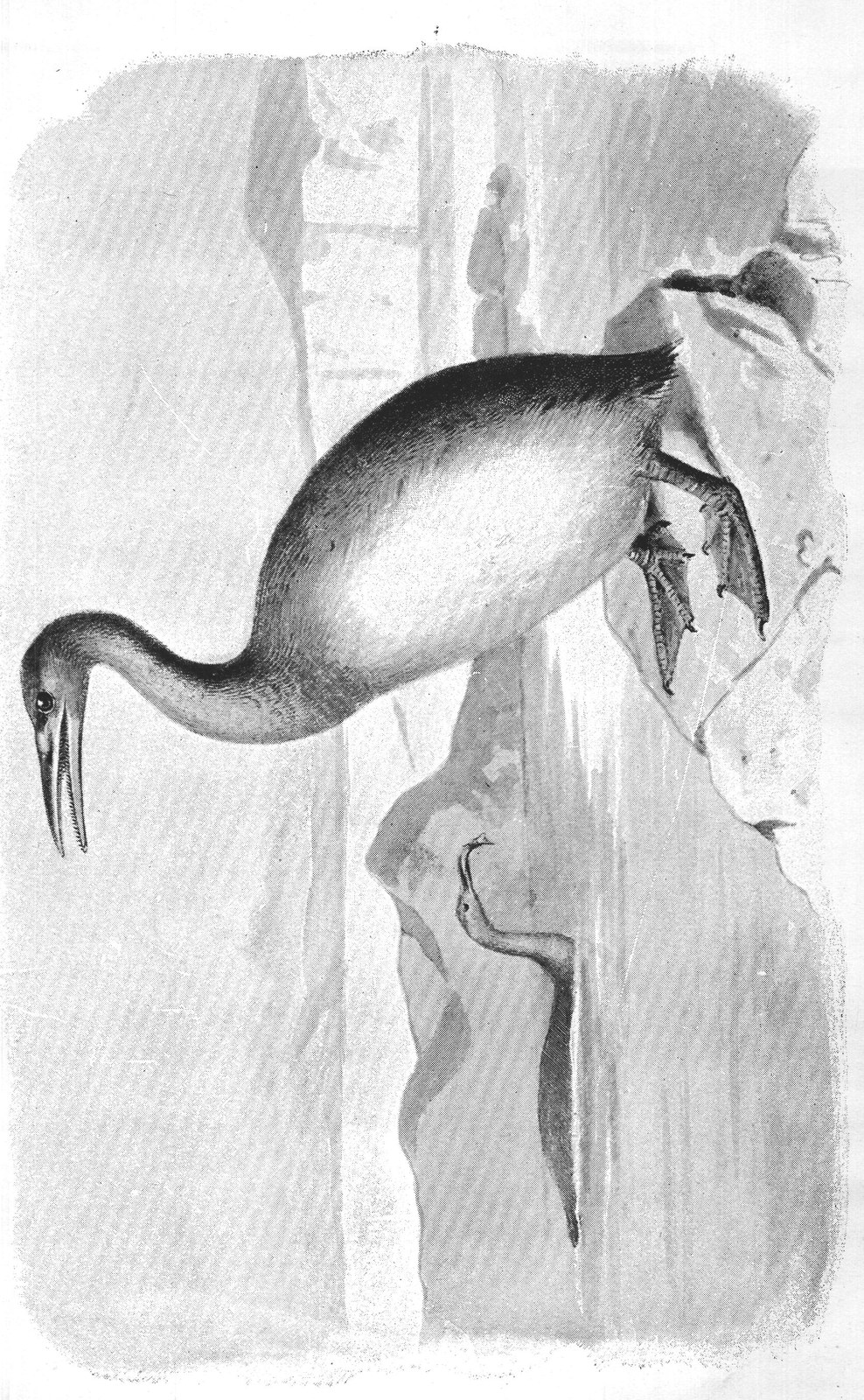
A GIGANTIC DIVER, HESPERORNIS REGALIS. FROM NORTH AMERICA. CRETACEOUS PERIOD. Height 6 feet. the end of the toes must have been between five and six feet (see Plate XXXIV.). Its habits are clearly indicated by the skeletons described by Professor Marsh in his splendid monograph on The Extinct Toothed Birds of North America. No living birds possess teeth in their jaws, so that the presence of such in Hesperornis FIG. 81. Skeleton of Hesperornis regalis, from Cretaceous strata, North America. (After Marsh.) and other birds of the Cretaceous period at once separates them from those of the present day. It cannot be doubted that this antique diver was carnivorous; it probably devoured fishes. The teeth were set in a groove, and old ones were replaced by young ones growing up from inside the fang. The breast-bone (sternum) was entirely without a keel. The single thin wing-bone (humerus) indicates that its wings were "rudimentary," and quite useless either for flying or swimming (see Fig. 81). Modern penguins use their wings with great effect while swimming under water, but the Hesperornis was compensated for the want of wings by its broad tail, which was much expanded horizontally, and doubtless served as an organ of propulsion in diving. (The tail in our restoration is too small.) The brain was diminutive, and very like that of a reptile. It is impossible, in the absence of feathers, to say exactly what appearance the skin of this bird presented, but in the restoration, Plate XXXIV., our artist has to some extent taken a modern diver as his model. The skeleton of this bird presents several interesting points of resemblance with reptiles; but it will not be necessary to enter into anatomical details here. The remains were discovered by Professor Marsh, in certain marine Cretaceous strata along the eastern slope of the Rocky Mountains, which have also yielded mosasauroid reptiles, Pliosaurs, and Pterodactyls. The valuable specimens on which Professor Marsh's descriptions are based were not procured without considerable trouble and hardship. His exploring parties in the plains of Kansas and Colorado suffered, at one time, from extreme heat, causing sunstroke and fever, by which the guides and explorers alike were weakened and discouraged; at other times, from extreme cold, to say nothing of the danger from hostile Indians. But fortunately, the latter enemies to science were kept in check by escorts of soldiers.
Hesperornis, as we have seen, was an admirable diver; while the long neck, with its capabilities of rapid flexure, and the long slender jaws armed with sharp recurved teeth, formed together a perfect instrument for the capture and retention of the most agile fish. As the lower jaws were united in front only by cartilage, as in the serpents, and had on each side a joint which admitted of some motion, the power of swallowing was doubtless equal to almost any emergency.
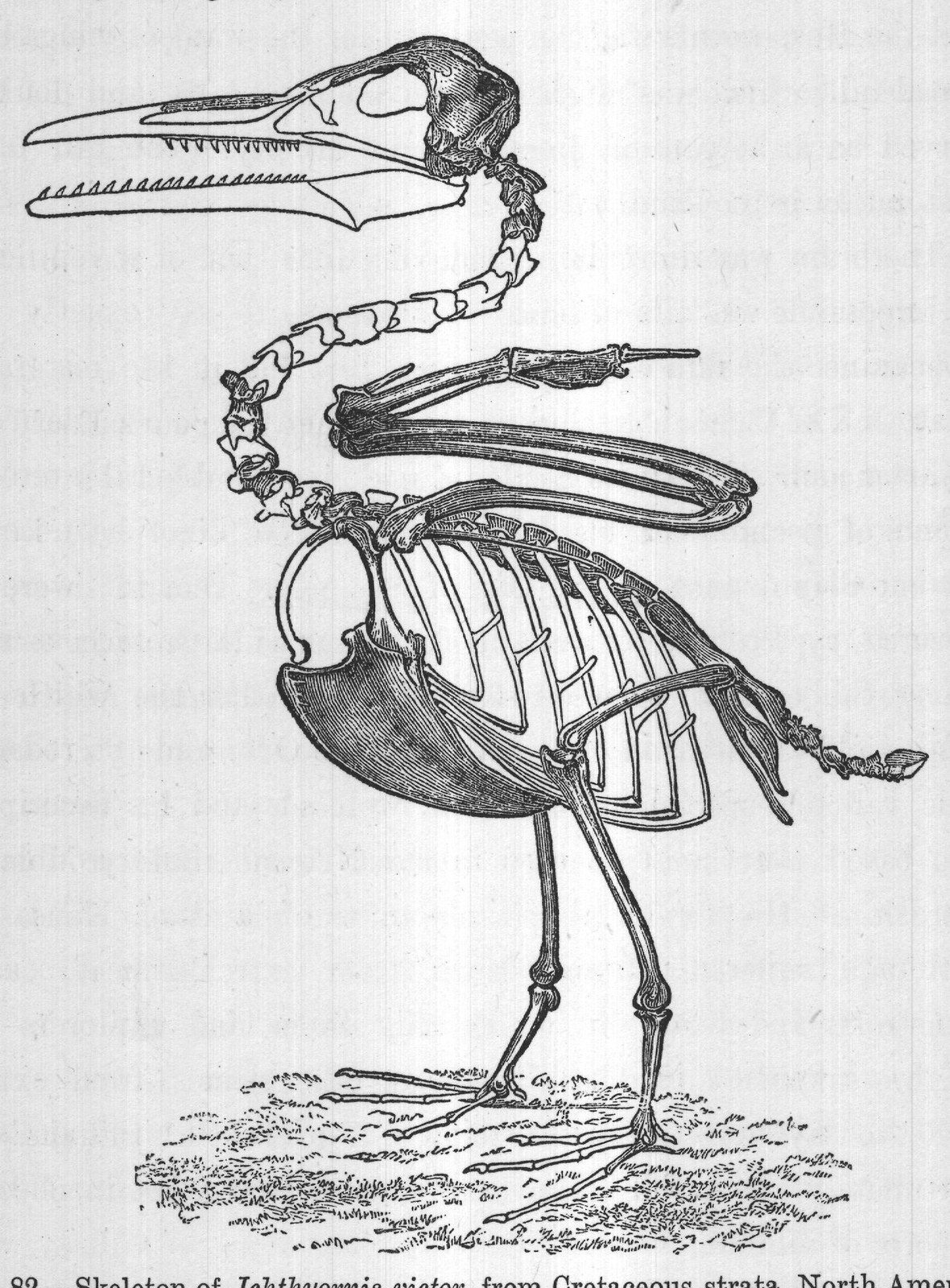
N ラー چہ - FIG. 82. Skeleton of Ichthyornis victor, from Cretaceous strata, North America. (After Marsh.) Another bird discovered by Professor Marsh in the same region, also with strangely blended characters, is the Ichthyornis (Fig. 82). Unlike the big diver above described, it had well-developed wings and a strongly keeled sternum for the attachment of muscles with which to work its wing. It was about the size of a rock-pigeon. The jaws were armed with teeth placed in distinct sockets, as in some extinct reptiles. The wing bones show that it possessed considerable powers of flight. Here we may note that the Cretaceous birds at present known (some twenty species or more) were apparently all aquatic forms, which, of course, are most likely to be preserved in marine deposits, while the Jurassic Archæopteryx was a land bird.
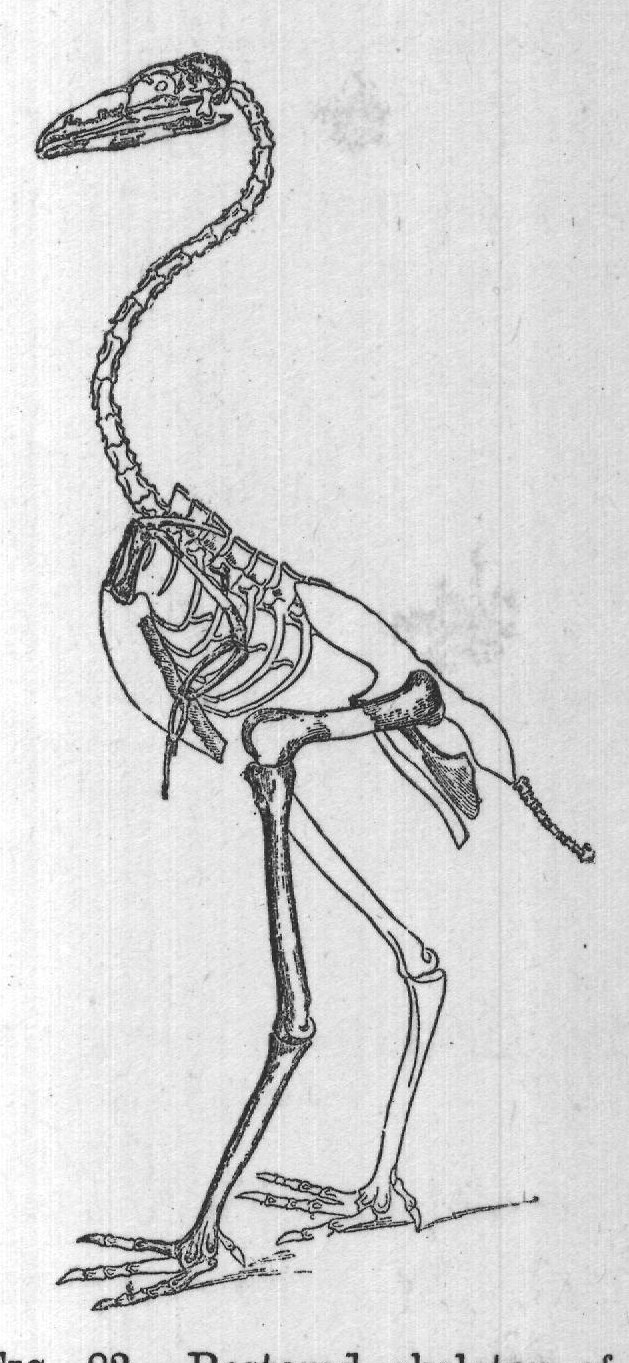
Remains of Cretaceous birds were first found in the Upper Greensand of Cambridge, and on these bones the genus Enaliornis has been founded. In its head and neck it resembled the divers. Several portions of fossil birds have been discovered in the London Clay deposit of the Isle of Sheppey. One of these, the Dasornis, represented by a single skull, was as large as an ostrich, and probably closely related to that bird. Another, the Argillornis, rivalled the albatross in size. A third, the Odontopteryx (toothed bird), has a powerful serrated bill, well adapted for seizing its fishy prey. In the same case in the Natural History Museum may be seen casts of the limb-bones of a large bird, the Gastornis parisiensis, from Eocene strata near Paris; also casts of two leg-bones of another equally large bird, allied to the above, discovered in the Eocene strata near Croydon, viz. Gastornis Klaasseni. A restoration of the French bird's skeleton is shown in Fig. 83. The genus must have been as large as an ostrich, but more robust, with some signs of affinity with geese, as well as to ratite birds such as the ostrich. Many other orders of birds are more or less represented by fossil remains from Tertiary strata, but in most cases not so perfectly as to warrant description here. For instance, the Pliocene strata of the Sivalik hills have yielded bones of PLATE, XXXV.
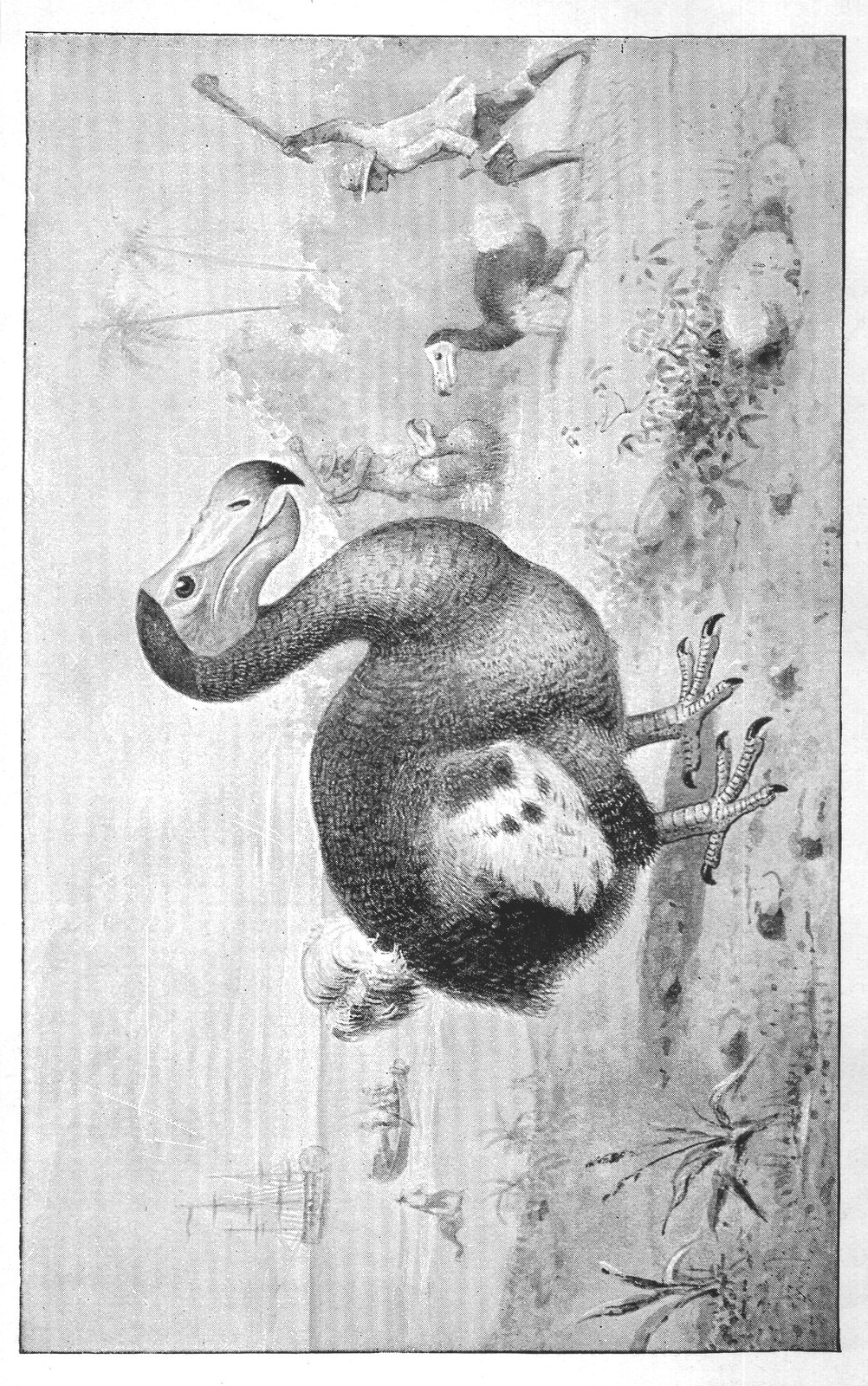
THE DODO, DIDUS INEPTUS. ISLAND OF MAURITIUS.
Exterminated in the seventeenth century. giant storks. Leaving these, we now pass on to say a few words about the Dodo, and some other birds that lived in historic times.
Every one has heard of that singular bird, now totally extinct, the Didus ineptus (or Dodo), which formerly inhabited the islands of Mauritius and Bourbon (see Plate XXXV.). The last record of its appearance dates from the year 1681. It was a large and heavy bird, bigger than a swan, and entirely unlike the pigeons, with which, however, it seems clearly to be allied. Its wings were so small as to be quite useless for flight. The legs were short and stout, with four toes on each foot, and the tail was extremely short, carrying a tuft of soft plumes. The beak was decidedly hooked, as in birds of prey.
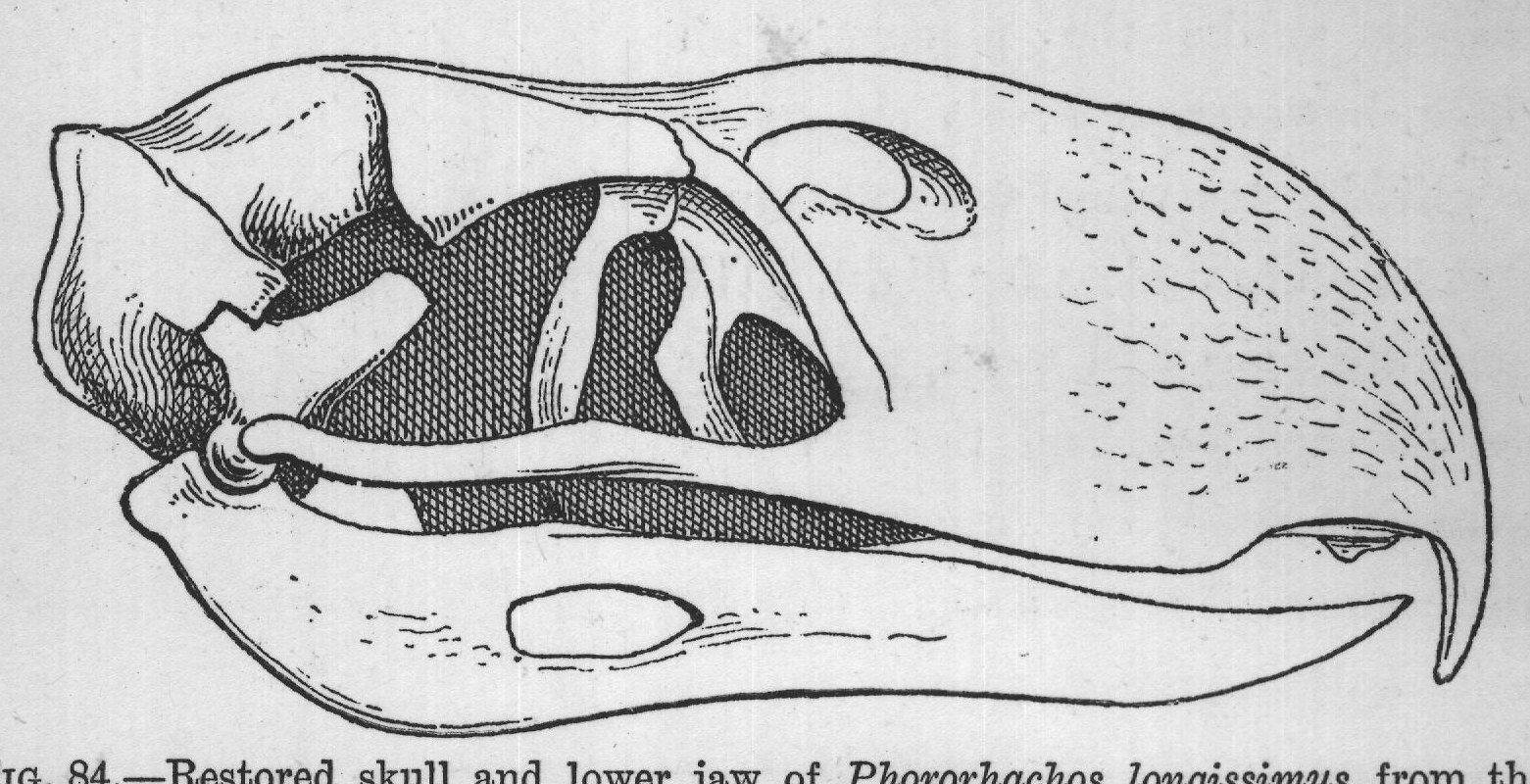
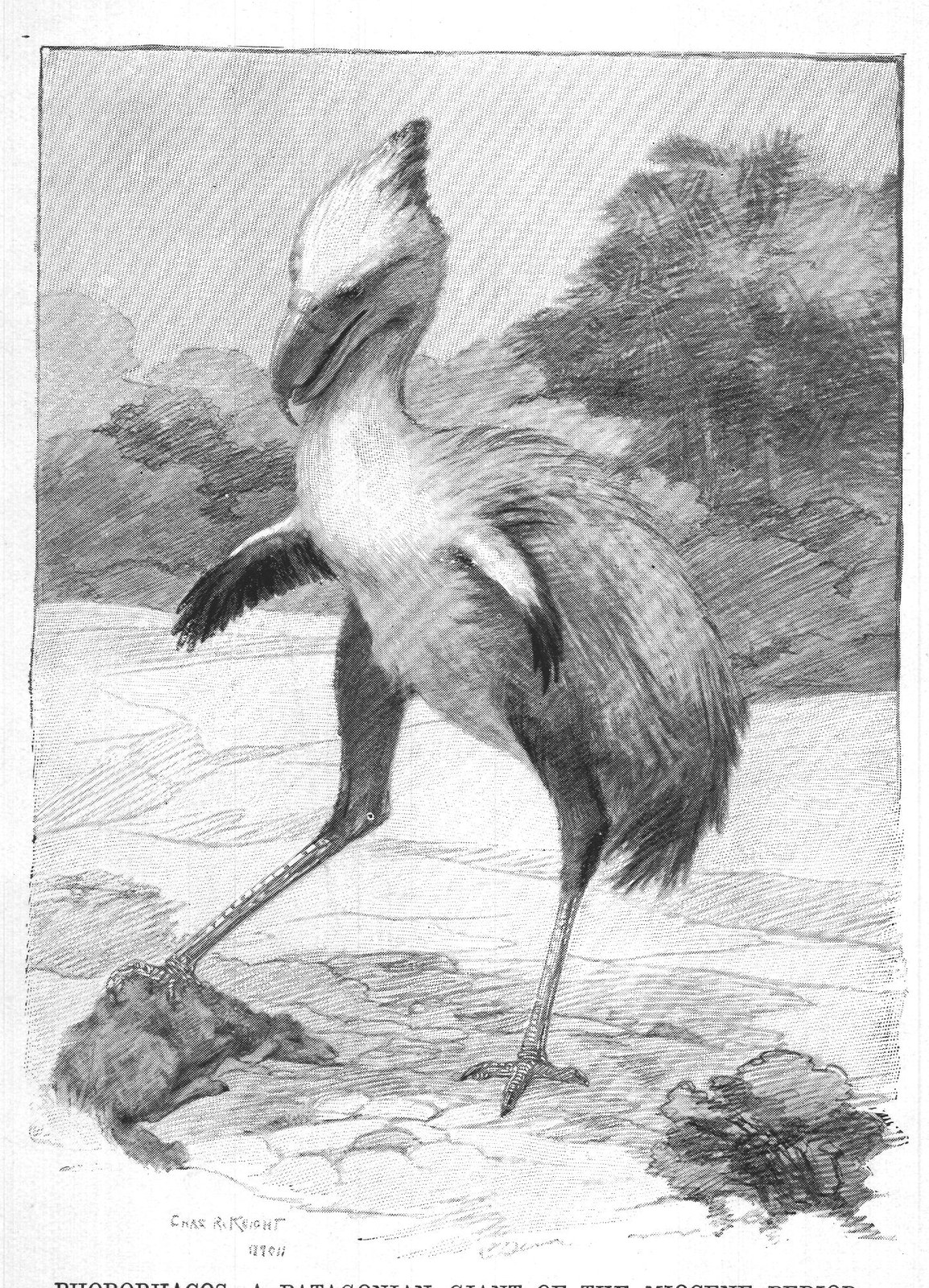
Visitors to the Natural History Museum will see, in the same case with the remains of the gigantic Æpyornis from Madagascar, some of the bones of this remarkable bird, FIG. 83. Restored skeleton of a large bird, Gastornis Edwardsii, together with a portrait from an old from Eocene strata near Paris and painting. The Oxford Museum once Rheims. (After M. le Docteur Lemoine.) Height over 7 feet. possessed a complete stuffed specimen, but now, alas! only the head and one foot remain. In the reports of numerous voyagers who visited the islands of Mauritius, Bourbon, and Rodriguez, from the end of the fifteenth century to the middle of the seventeenth, we have many accounts of the appearance and habits of this bird, evidently sketched from life. Some of the descriptions are very quaint; as, for example, the graphic sketch of old Sir Thomas Herbert, who saw the bird in his travels in the year 1634. In a second island of the Mascarene group, viz. that known as Rodriguez, early explorers found the Solitaire (Pezophaps solitaria), a near relative of the Dodo, with longer legs and neck.¹ From Patagonian strata (perhaps of Miocene age) we have a skull and lower jaw of a huge carinate bird, the Phororhachos (see Fig. 84). The skull is twenty-three inches long and seven FIG. 84. Restored skull and lower jaw of Phororhachos longissimus, from the Santa Cruz Formation of Patagonia ; 1/6 natural size. inches deep. These measurements far exceed those of any living bird. No quite complete skull is known, but enough to justify the construction of a model skull and lower jaw as seen in our figure. Possibly this feathered giant was carnivorous, as his pointed beak rather suggests. He probably stood some seven feet high, but his relationships are doubtful at present. In Plate XXXVI. we have a restoration by Mr. Charles Knight showing very small wings which would be useless for flight.
Of all the monsters that ever lived on the face of the earth, the 1 See the writer's Creatures of Other Days, p. 166.
CHAS RAKUGHT PHORORHACOS, A PATAGONIAN GIANT OF THE MIOCENE PERIOD. From a drawing by Charles R. Knight.
From "Animals of the Past," by Prof. F. A. Lucas, by permission of Messrs. Doubleday, PLATE XXXVI.