Home › Ancient Birds › Ancient Birds: Archæopteryx
Ancient Birds: Archæopteryx
Palæontologists are not without evidence bearing on this subject; so perhaps we cannot do better than state briefly what that evidence is, in order to show how near, or how far, we are from a final answer to our question. Though no one can yet say what the very first bird-type was like, we can, at all events, describe the oldest known fossil bird. This is the famous Archæopteryx.¹ Time was and that within the memory of living geologistswhen no fossil birds were known in rocks older than the Tertiary deposits; but the discovery of Archæopteryx has changed all that, and we now trace back the bird line to the middle of the great Secondary or Mesozoic Era. This bird was found in the Solenhofen limestone of Bavaria, which is supposed to represent the lower part of our English Kimmeridge clay. First, only the impression of a single feather was known, to which the late 1 Greek-Archios, ancient; pterux, wing.
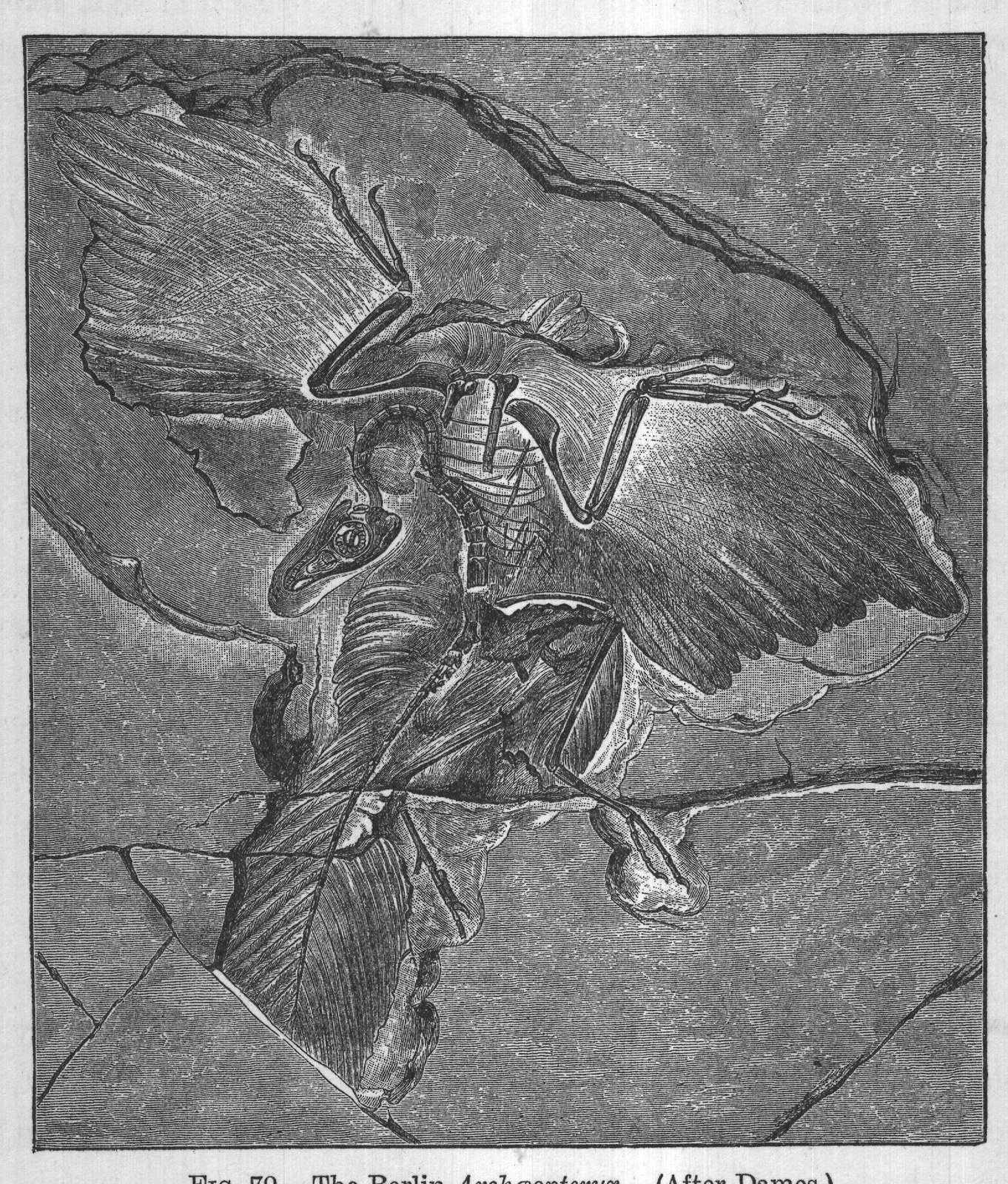
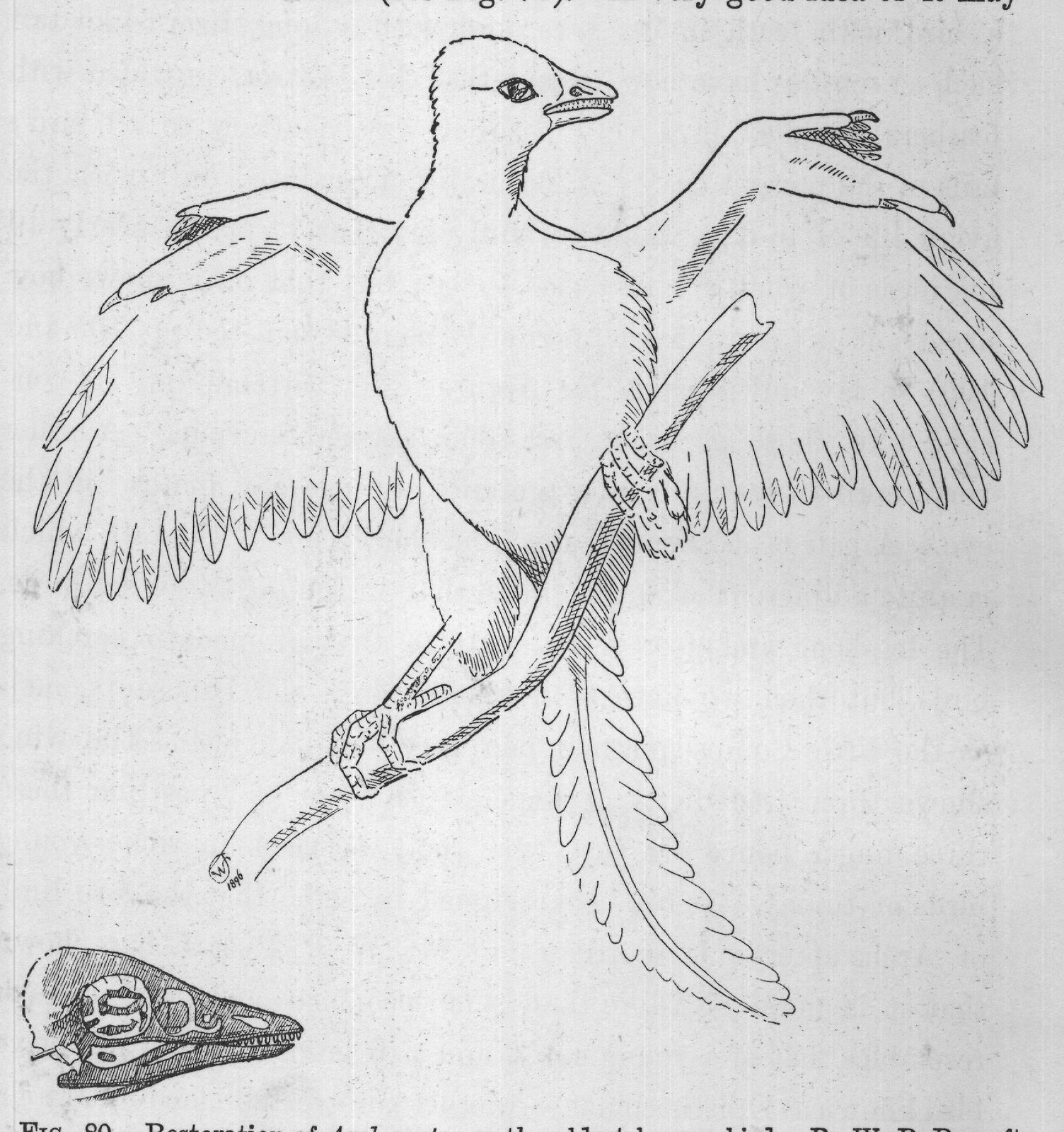
Professor H. von Meyer gave the name Archæopteryx lithographica (because this stone is much used by lithographers). Later on came the discovery of a magnificent and almost complete speci- FIG. 79.-The Berlin Archæopteryx. (After Dames.) From the Solenhofen Limestone. men, with beautiful impressions of the feathers. This was named by Owen A. macrura, on account of its long tail. The specimen is to be seen in the Natural History Museum; it was only acquired for the nation by the strenuous efforts and liberality of the late Sir R. Owen (see preface). More recently a still finer specimen, with the head complete, has turned up, and this is now in the Berlin Museum (see Fig. 79). A very good idea of it may 1896 = ע FIG. 80.-Restoration of Archæopteryx, the oldest known bird. By W. P. Pycraft. Skull of same. be gathered from the fine drawing presented by the late Professor Dames, which is to be seen at the Natural History Museum, also a cast. Some of those who first studied the creature's anatomy took it for a reptile; and they may well have been puzzled by its curiously "mixed" characters. It is certainly one of the most anomalous types of ancient life that has ever been discovered. Palæontologists are now agreed that it was a bird; for it had feathers and claws, as birds have. But what can we say to a bird with teeth in its jaws, and with a long, lizard-like tail such as reptiles have now, except that this tail was provided with feathers attached in a very peculiar way, contrary to all bird's tails of the present day? A naturalist acquainted only with the avian life of to-day, would certainly say that it upsets nearly all his ideas of what a bird ought to be; but that only shows how useless it is (as we have previously pointed out, see pp. 105 and 199) to lay down rules for Nature. Its vertebræ are bi-concave, like those of fishes and some extinct Saurians. Another very reptilian feature is the presence of "sclerotic plates" in the eye. A pair of feathers sprang from each joint in the tail, which is quite a different arrangement to that in the tail of living birds. The leg-bone and foot are similar to that of modern perching birds, but then we have seen that some of the Dinosaurs, such as the little Compsognathus, had very bird-like feet. The wing shows three free digits or fingers. In form and position these three finger bones are just what may be seen in some young birds of to-day. It has been claimed by some that the fore limb of Archæopteryx is reptilian, but Mr. W. P. Pycraft has shown that it is more bird-like than some people thought, for it much resembles that of a young chick, and still more that of a primitive bird known as Opisthocomus. Another point, established by Marsh, is that the bones of the pelvis are separate-not united, as in modern birds. In the London specimen (where the skull is lost) there remains a cast of what is supposed (perhaps wrongly) to be the brain cavity. Were it not for the feathers, perhaps no one would at first have thought of calling it a bird. It combines the features, or characters, of birds and reptiles in a most remarkable way. In size it was about as large as a rook. Are we to call it a Pterodactyl with feathers? That would be to dub it a reptile; and since the leading authorities agree in calling it a bird, we must abide by their decision. Names, however, are sometimes misleading; the main fact we have to remember is, that in former ages some classes of animals which are now sharply marked off from each other were by no means so separated. A good deal of discussion has arisen with regard to the true interpretation of the Berlin specimen, as far as the wing is concerned. The question is, how the feathers were attached; and there can be but little doubt, that in this respect the drawing from which Fig. 79 is taken is wrong. Look at the impressions of the long "primary" feathers, and you will see that at first they curve towards the three fingers, but then turn downwards and bend towards the two bones of the fore-arm. This is due to a mistake, and the first curve of the feathers, as seen in the left-hand corner, should have been continued. But in other respects Fig. 79 gives a fair idea of the Berlin specimen. One cannot help wondering whether this very ancient bird could sing; but, although doubtless the gift of song was not in those Jurassic days so marvellously perfected as it is now, yet we would fain believe that Archæopteryx at least tried to sing. If, as seems probable, it lived among trees, one would think that some means of communication with its fellows was almost a necessity; besides, even lizards and some amphibians make a kind of music of which the song of birds seems to be a development. The next evidences of former bird life are met with in the Cretaceous rocks, and here we find the Hesperornis. This bird was a gigantic diver, and its length from the point of the bill to PLATE XXXIV.