Home › Ancient Birds › Ancient Birds: Dinornis
Ancient Birds: Dinornis
Dinornis parvus (the dwarf Moa) was only three feet high. 1 Memoir on The Extinct Wingless Birds of New Zealand. London, 1878. The beautiful drawing by Mr. Smit (Plate XXXVII.) is from a photograph in this valuable work representing the late Sir Richard Owen standing in academic robes by the side of a specimen of the skeleton of the great Dinornis maximus.
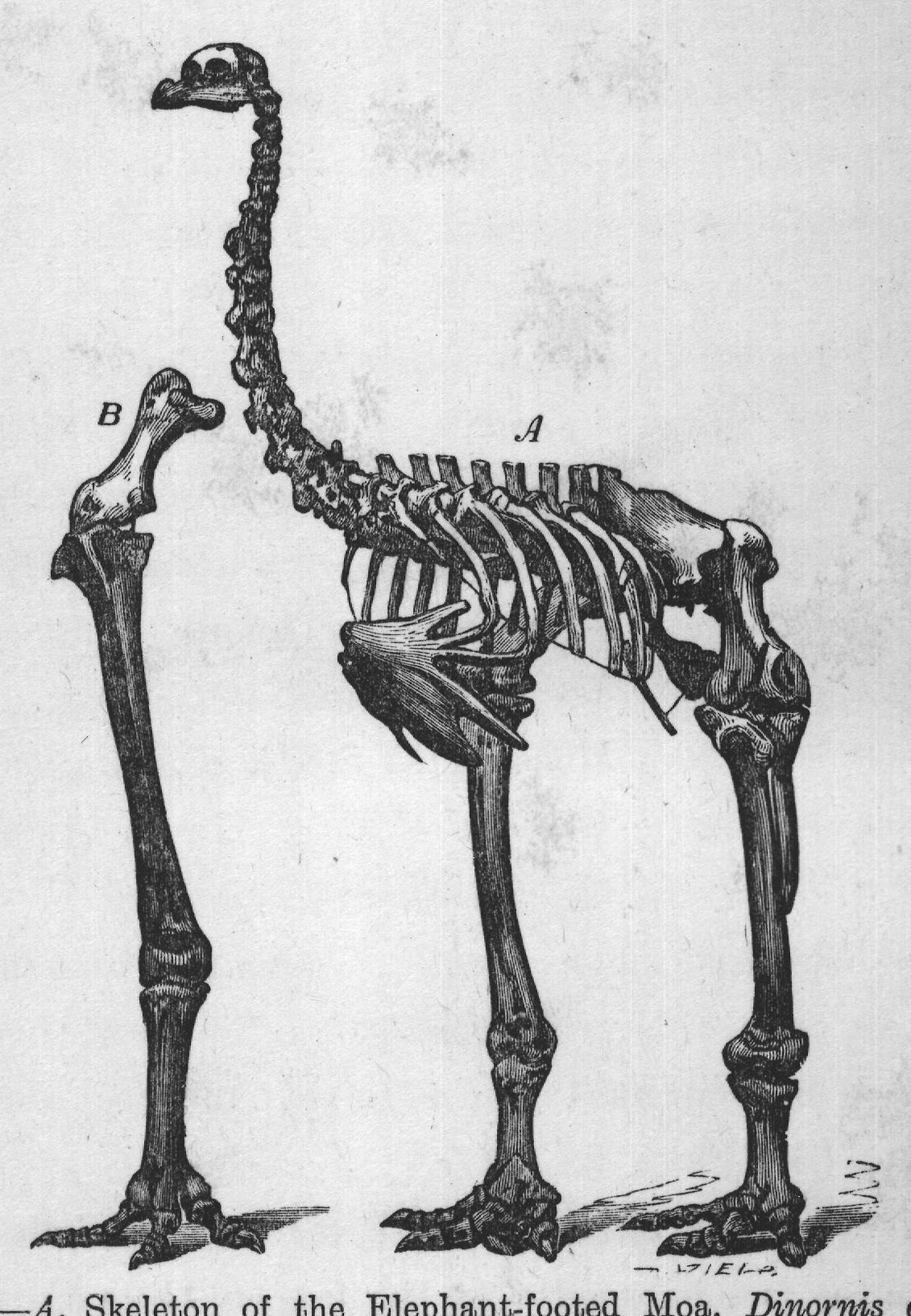
Q In 1882 was obtained, from a cave in Otago, the head, neck, two legs, and feet of a Moa (D. didinus), having the skin, still preserved in a dried state, covering the bones, and some few feathers of a reddish hue still attached to the leg. The ring of the windpipe may be seen in situ, the sclerotic plates of the B A 171EP FIG. 85.-A. Skeleton of the Elephant-footed Moa, Dinornis elephantopus, from New Zealand. B. Leg-bones of Dinornis giganteus, representing a bird over 12 feet high. eye, and the sheaths of the claws. One foot also shows the hind claw still attached.
From traditions and other circumstances it is supposed that the present natives of New Zealand came there not more than about PLATE XXXVIII.
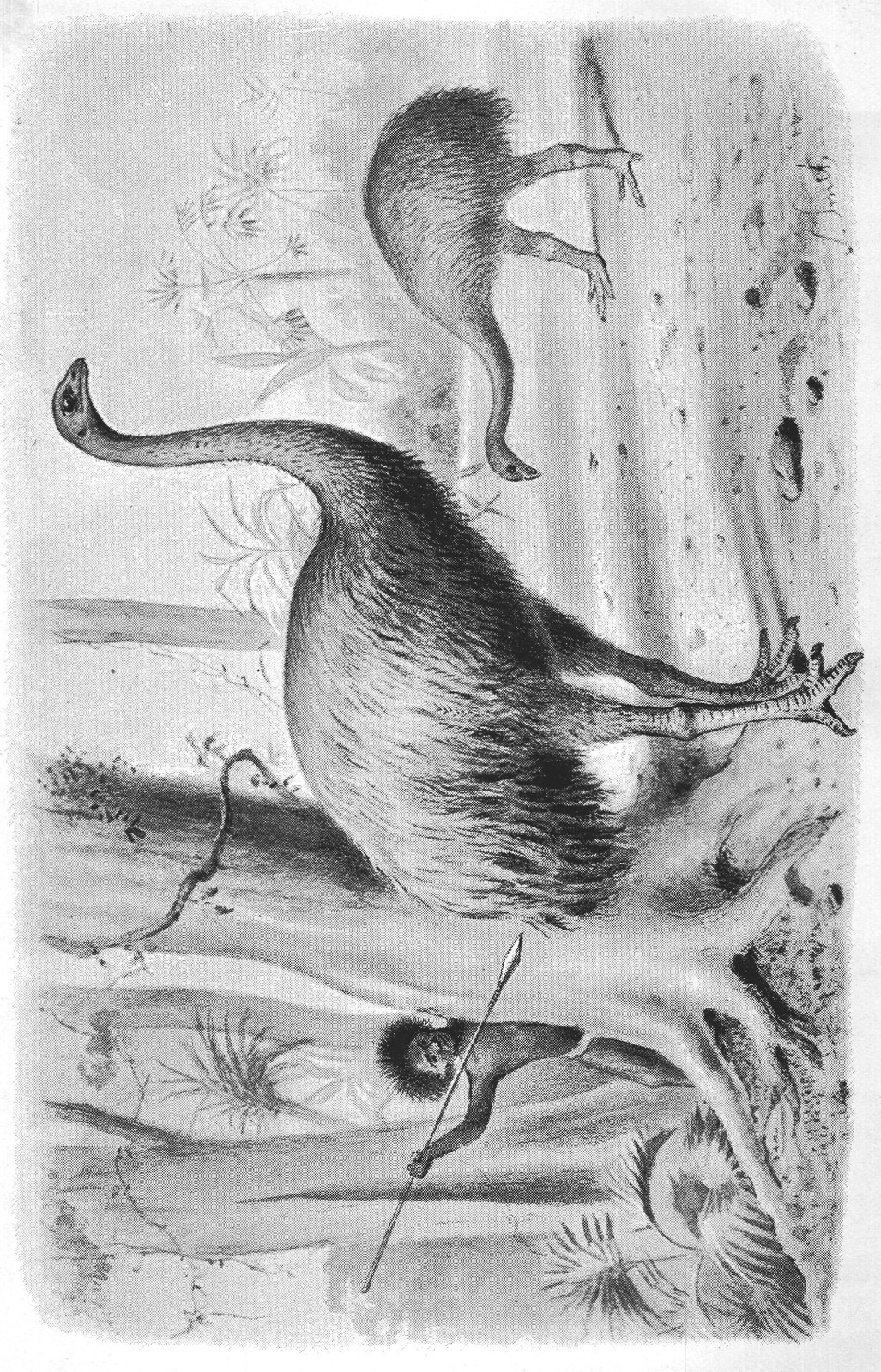
MOAS FROM NEW ZEALAND.
Dinornis giganteus.
Height 12 feet.
D. elephantopus.
A small species. six hundred years ago, and there is reason to believe that the ancient Maoris, when they landed, feasted on Moa as long as any remained. Their extermination probably only dates back to about the period at which the islands were thrice visited by Captain Cook, 1769-1778. The Moa is mixed up with their songs and stories, and they even have a tradition of caravans being attacked by them. Still, some people believe that they were killed off by the race which inhabited New Zealand before the Maoris came. But they must have been there up to a time not far removed from the present. It is even said that the "runs" made by them were visible on the sides of the hills up to a few years ago; and possibly they may still be visible. The charred bones and egg-shells have been found mixed with charcoal where the native ovens were formerly made, and their eggs are said to have been found in Maori graves. Mr. Hutton considers that in the North Island they were exterminated three or four centuries ago, while in the South Island they may have lingered a century longer. (See Plate XXXVIII.) The nearest ally of the Moa is the small Apteryx, or Kiwi, of New Zealand, specimens of which may be seen at the Natural History Museum, at the end of the long gallery devoted to living birds. This bird, however, has a long pointed bill for probing in the soft mud for worms, whereas the bill of the Moa was short like that of an ostrich.
Another difference between the two is that, while the Kiwi still retains the rudiments of wing-bones, the Moa had hardly a vestige of such.
In Australia the remains have been found of a bird probably related to the Cassowaries, but at present imperfectly known. To this type of struthious, or running bird, the name Dromornis has been given.
Now, it is a remarkable fact that remains of another giant bird and its eggs have been found on the opposite side of the great Indian Ocean, namely, in the island of Madagascar, the existence of which was first revealed by its eggs, found sunk in the swamps, but of which some imperfect bones were afterwards discovered. One of these eggs was so enormous that its diameter was nearly fourteen inches, and was reckoned to be as big as three ostrich eggs, or 148 hen's eggs! This means a cubic content of more than two gallons! The natives search for the eggs by probing in the soft mud of the swamps with long iron rods. A large specimen of an egg of this bird will fetch a good price. What the dimensions of Æpyornis were it is impossible to say, and it would be unsafe to venture a calculation from the size of the egg. The reader who wishes to see some of the remains of this huge bird may be referred to the Natural History Museum. In Wall case No. II., Gallery 2, may be seen a tibia and plaster casts of other bones; also two entire eggs, many broken pieces, and one plaster cast of an egg found in certain surface deposits in Madagascar. In the same case may be seen bones of the Dodo from the Isle of Mauritius. 1 It will thus be seen that we have three distinct groups of giant land birds--the Moas, the Dromornis, and the Æpyornis, occupying areas at present widely separated by the ocean. This raises the difficult but very interesting question, how they got there; and the same applies to their living ancestors. The ostrich proper, Struthio camelus, inhabits Africa and Arabia; but there is evidence from history to show that it formerly existed in Beluchistan and Central Asia. And, going still further 1 From the size of a femur and tibia of Æpyornis preserved in the Paris Museum, it could not have been less in stature than the Dinornis maximus of New Zealand. back, the geological record informs us that, in the Pliocene period, they inhabited what is now Northern India. In Australia we have the Cassowary (Casuarius) and the Emeu (Dromaius); in New Zealand, the Apteryx (or Kiwi). Now, as none of these birds can either fly or swim, it is impossible that they could have reached these regions separated as they now are; and it is hardly likely that they arose spontaneously in each district from totally different ancestors. But the doctrine of evolution affords a key to the problem, and tells us that they all sprang from a common ancestor, of the struthious type (probably inhabiting the great northern continental area), and gradually migrated south along land areas now submerged. In this way we get some idea of the vast changes that have taken place in the geography of the world during later geological periods. Perhaps they were compelled to move south, until they reached abodes free from carnivorous enemies. Having done so, they evidently flourished abundantly, especially in New Zealand, where there are so few mammals, only those recently introduced by man.
In North America Professor Cope has reported a large wingless fossil bird from the Eocene strata of New Mexico. In England we have two such-namely, the Dasornis, from the London Clay of Sheppey (Eocene period), and the Gastornis, from the Woolwich beds near Croydon, and from Paris (also Eocene). Lake Callabonna in Australia (see p. 310) has yielded the bones of some huge ratite birds, e.g. Genyornis, with very slender toes. It lived with the Diprotodon. In South America the living Rheas were preceded by such large birds as Brontornis, of which casts of limb-bones are to be seen in the Natural History Museum. The famous Sivalik strata of India have yielded remains of an ostrich, Struthio asiaticus, and these may be seen in the above Museum, with the skeleton of a modern ostrich, among the fossil birds. The Fayum of Egypt (see p. 262) has also yielded a portion of a limb-bone of some large struthious bird. It will thus be seen that big struthious birds have a long history, going far back into the Tertiary era, and that they once had a much wider geographical range than they have now. Doubtless, future discoveries will tend to fill up the gaps between all these various types, both living and extinct, and to connect them together in one chain of evolution. Possibly the bird evolved from an arboreal reptile.