Home › Ancient Birds › Ancient Birds: Zealand
Ancient Birds: Zealand
Page and Co., New York. giant birds were perhaps the most grotesque. An emu or a cassowary of the present day looks sufficiently strange by the side or ordinary birds; but "running birds" much larger than these flourished not so very long ago in New Zealand and Madagascar, and must at one time have inhabited areas now sunk below the ocean waves.
The history of the discovery of these remarkable and truly gigantic birds in New Zealand, and the famous researches of Professor Owen, by which their structures have been made known, must now engage our attention.
In the year 1839 Professor Owen exhibited, at a meeting of the Zoological Society, part of a thigh-bone, or femur, 6 inches in length, and 5½ inches in its smallest circumference, with both extremities broken off. This bone of an unknown struthious bird was placed in his hands for examination, by Mr. Rule, with the statement that it was found in New Zealand, where the natives have a tradition that it belonged to a bird now extinct, to which they give the name Moa. Similar bones, it was said, were found buried on the banks of the rivers.
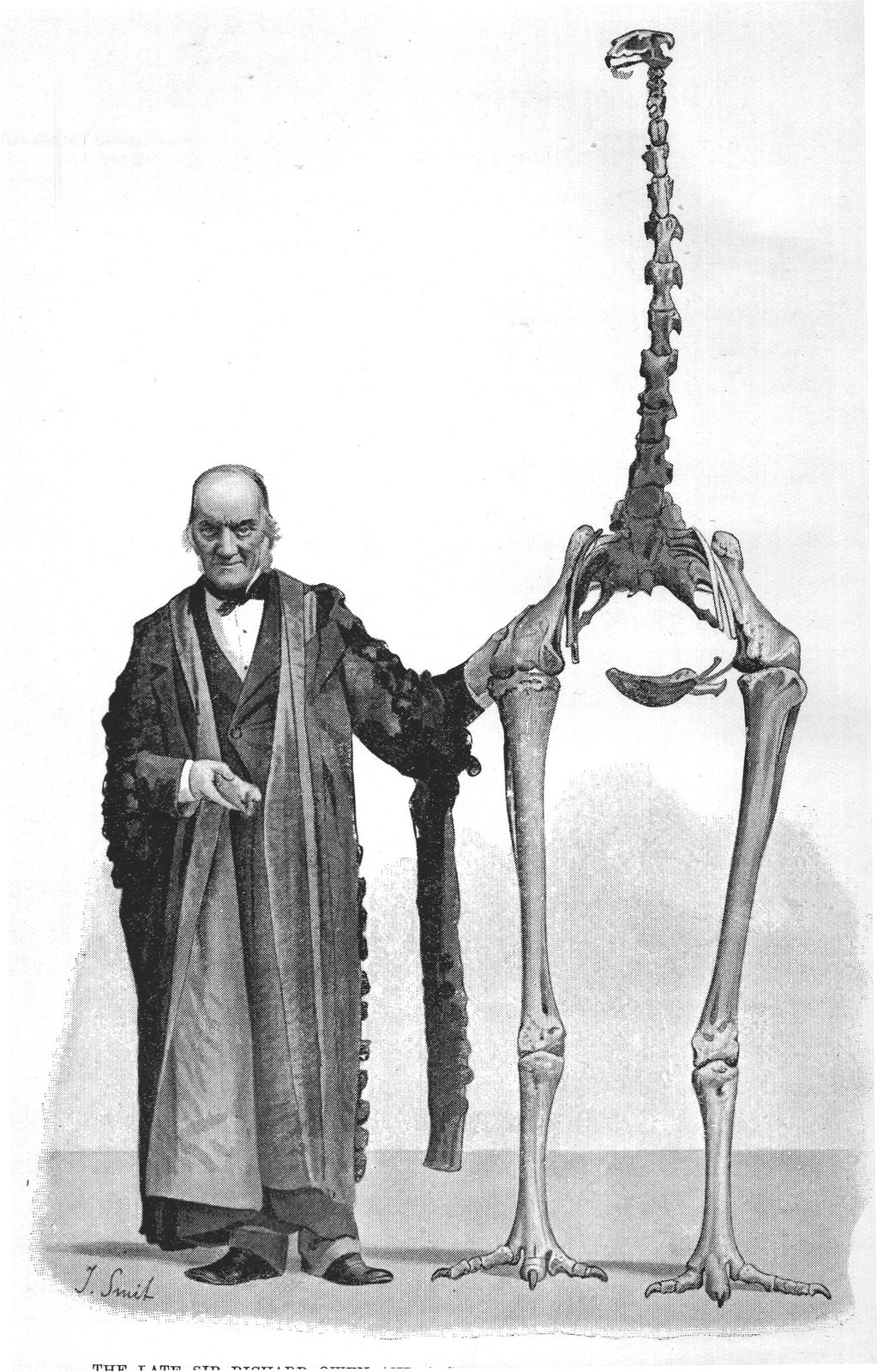
A minute description of this bone was given by the professor, who pointed out the peculiar interest of this discovery on account of the remarkable character of the existing fauna of New Zealand, which still includes one of the most extraordinary birds of the struthious order ("running birds"), viz. the Apteryx, and also because of the close analogy which the event indicated by the present relic offers to the extinction of the Dodo in the island of Mauritius. On the strength of this one fragment he ventured to assert that there once lived in New Zealand a bird as large as the ostrich, and of the same order. This conclusion, which some naturalists strongly opposed at the time, was more than confirmed by subsequent discoveries, which he anticipated; and, as we shall see, his estimate was a most moderate one, for the extinct bird turned out to be considerably larger than the ostrich. Later on he received from a friend in New Zealand news of the discovery of more bones. In 1843 a collection of bones of large birds was sent to Dr. Buckland, Dean of Westminster, by the Rev. William Williams, a zealous and successful Church missionary, long resident in New Zealand. The leg-bones sent to London greatly exceeded in bulk those of the largest horse. The leg-bone of a tall man is about 1 foot 4 inches in length, and the thigh of O'Brien, the Irish giant, whose skeleton, eight feet high, is mounted in the Museum of the Royal College of Surgeons, is not quite two feet. But some of the legbones (tibiæ) of Moas measure as much as thirty-nine inches. In 1846 and 1847 Mr. Walter Mantell, eldest son of Dr. Mantell, who had resided several years in New Zealand, explored every known locality within his reach in the North Island. He also went into the interior of the country and lived among the natives for the purpose of collecting specimens, and of ascertaining whether any of these gigantic birds were still in existence; resolving, if there appeared to be the least chance of success, to penetrate into the unfrequented regions, and obtain a live Moa. The information gathered from the natives offered no encouragement to follow up the pursuit, but tended to confirm the idea that this race of colossal bipeds was extinct. He succeeded, however, in obtaining a most interesting collection of the bones of Moa, belonging to birds of various species and genera, differing considerably in size. This collection was purchased by the trustees of the British Museum for £200. Another collection was made by Mr. Percy Earle from a submerged swamp, visible only at low water, situated on the south-eastern shore of the Middle Island. This collection also was purchased by the trustees for the sum of £130. J. Smit THE LATE SIR RICHARD OWEN AND A SKELETON OF MOA, DINORNIS MAXIMUS. (From a photograph.) PLATE XXXVII.
The total number of species of Moa once inhabiting New Zealand was probably at least fifteen, and, judging from the enormous accumulations of their bones found in some districts, they must have been extremely common, and probably went about in flocks. "Birds of a feather flock together."
Not only was the number of individuals very large, but they belonged (according to Mr. F. W. Hutton) to no less than seven genera, containing twenty-five different species, a remarkable fact which is unparalleled in any other part of the world. The species described by Professor Owen in his great work,¹ vary in size from 3 feet to 12 or even 14 feet in height, and differ greatly in their forms, some being tall and slender, and probably swift-footed like the ostrich, whilst others were short and had stout limbs, such as Dinornis elephantopus (Fig. 85), which was undoubtedly a bird of great strength, but very heavy-footed. Dinornis crassus also had stout limbs.
The Natural History Museum at South Kensington contains a valuable collection of remains of Moa. These skeletons may be seen in Gallery No. 2. In D. giganteus the leg-bone (see Fig. 85) attains the enormous length of three feet, and in an allied species it is even thirty-nine inches! The next bone below (cannon bone) is sometimes more than half the length of the legbone (tibia). (See Plate XXXVII.) A skeleton in one of the glass cases has a height of about 101 feet, and it is concluded that the largest birds did not stand less than 12 feet, and possibly were 14 feet high!