The Premier Mine
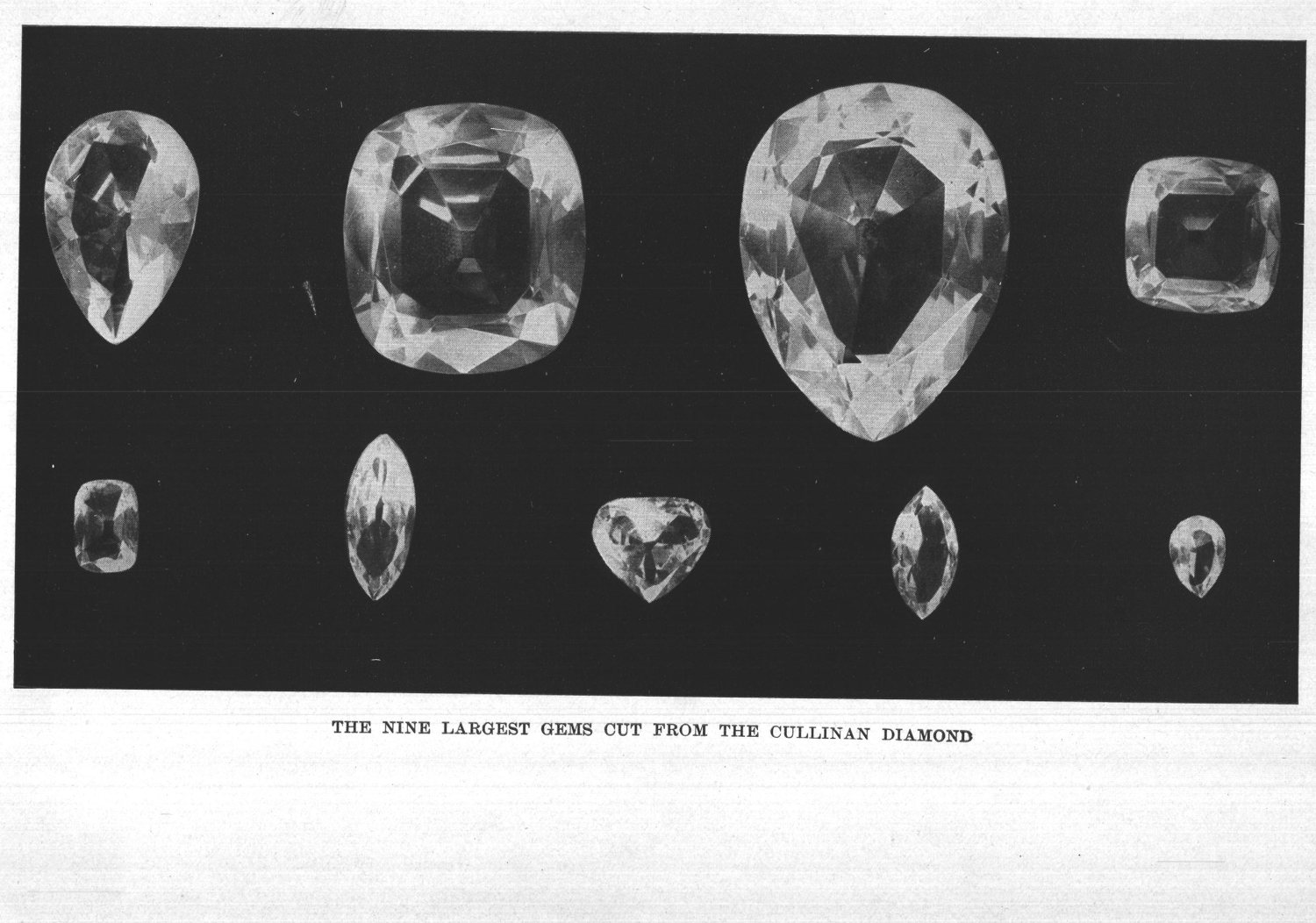
The first and second of these stones are by far the largest in existence. Even the second is much bigger than the largest previously known brilliant, viz., the Jubilee, weighing 239 carats, while beside either of them so famous a jewel as the Kohinoor sinks into comparative insignificance, since its weight, 102 3/4 carats, is little more than one third of that of the smaller, or one fifth that of the larger. Moreover, the stones are not more distinguished for size than for quality. All of them, from the biggest to the smallest, are absolutely without flaw and of the finest extra blue-white colour existing.
As regards the two largest, an innovation was made in the manner of cutting. Normally a brilliant has 58 facets. In view, however, of the immense size of the two largest Cullinan brilliants, it was determined to have an increased number, and to give the first 74 facets and the second 66. This decision has been abundantly vindicated by the results, for the stones exhibit the most marvellous brilliancy that diamonds can show. This fact is all the more remarkable and satisfactory because very large brilliants are apt to be somewhat dull and deficient in fire.
This monumental diamond was found January 27, 1905, on the brink of the open workings of mine No. 2 of the new (Transvaal) Premier mines, near Pretoria, South Africa, by the manager of the mines, Mr. Frederick Wells, an old employee of the Kimberley mines. While making his rounds of inspection Mr. Wells's eye caught a gleam in some debris and, investigating, he perceived that it was undoubtedly a large diamond; placing his find in the pocket of his sack coat he took it to the company's office and its importance was quickly realised. The stone was weighed and found to register exactly 3253 3/4 carats. Immediately the news was transmitted by telegraph and cable to all parts of the world that the world's greatest diamond had been discovered. The stone was christened "The Cullinan Diamond" after Mr. T. N. Cullinan, the chairman of the Premier (Transvaal) Diamond Company. At the instance of Premier Botha, the Transvaal Assembly presented the great diamond to King Edward VII. in recognition of his granting a constitution to the Transvaal Colony. As stated, the diamond, rough, weighed 3253 3/4 carats, and measured four by two and one-half by one to two inches. The stone had four cleavage planes, which led experts to surmise that other pieces of the same stone are still in the mines. To one who was not familiar with diamonds the great diamond nearly resembled a piece of ice.
The occurrence of this stone is interesting because it was in a locality that many experts regarded as a place of meagre possibilities, as compared with the steadily producing mines at Kimberley. Diamonds had, indeed, been found in both the alluvial along the Vaal River and in alluvial and in pipes at Rietfontein, near Pretoria. The properties of the Transvaal Mining Company, now the Montrose, were discovered in 1898, as were also those of the Schuller Company; both producing diamonds in profitable quantity, although not comparably with the mines at Kimberley. The Premier (Transvaal) Diamond Mining Company was registered on December 1, 1902, with a capital of pound80,000, so that it had been in existence but about two years when it gave the world its record diamond. The Boer War interfered with the development of the mines in the Transvaal. During the year 1899 four companies were registered. After the occupation of the Transvaal by the British, forty-eight companies were registered in the years 1902 and 1903 with an aggregate capital of nearly pound2,000,000 sterling.
The new Premier mines are discussed by Mr. Gardner F. Williams in his The Diamond Mines of South Africa, in which he expresses doubt that the rich alluvial diggings which resulted from the open works initiated there betokened rich diamond bearing pipes of blue ground. Although the reports of the company showed a large total yield for the number of loads of ground sent to the washing machines, it is pointed out that the ground sent was sorted ground, while that upon which Kimberley statistics are based was not. Mr. Williams stated:
The average value of the diamonds per carat for eleven months was 27s. 4d. The quality of the diamonds in the Pretoria District is poor, the percentage of bort and rubbish being abnormally great. Valued on the same basis, diamonds from the Pretoria District are worth only about fifty-four per cent. of those from De Beers and Kimberley mines.
It is always the unexpected that happens in diamond-seeking. The premises of Mr. Williams and the other experts, who may from personal interest have been subconsciously inclined to make comparisons between Kimberley and Transvaal mines unfavourable to the latter, however sound and scientific, held forth small encouragement to expect great things from the new Premier mines; which, after all, have produced a single gem that outshines anything that the Kimberley mines ever produced.