Cutting the Cullinan
The major event of gem history in the year 1908 was the cutting at Amsterdam of the great Cullinan diamond, destined to become the brightest jewel in the British crown. In this connection it may be here mentioned that said crown was already of great weight-thirty-nine ounces and five pennyweights-a handicap that His Majesty King Edward VII. probably does not relish on the rare state occasions when he must submit to having it rest upon his head, as, for example, when it becomes his annual royal duty and prerogative to formally open Parliament. The crown, which usually rests in the Tower of London, contained, prior to additions from the Cullinan Diamond, two thousand eight hundred and eighteen diamonds and two hundred and ninety-seven pearls, besides many other rare and exquisite jewels. Before its eclipse by the Cullinan Diamond, the chief gem ornamenting the crown was a ruby, valued according to an estimate at about $500,000; this famous gem is the one presented to the Black Prince by Spain, in the year 1367, and was worn by Henry V. in his helmet at the battle of Agincourt.
The royal regalia are safely deposited in a chamber of the Wakefield Tower in the Tower of London. The valuable addition resulting from the partitions of the Cullinan Diamond added nothing to the precautions against theft which previously existed. The crown jewels are thoroughly lighted and guarded by night and by day, never, for an instant, being exempt from the scrutiny of armed and uniformed sentries. The jewels are kept in a glass case within a double cage of steel, and cleaned semi-annually under the supervision of high officers of the British realm. The Cullinan Diamonds were on November 1, 1908, delivered to their Majesties, King Edward and Queen Alexandra, at Windsor Castle by Mr. Joseph Asscher of the Amsterdam firm which successfully cut the famous stone. Two secret service men of the Holland government, accompanied by several Scotland Yard detectives, guarded Mr. Asscher's every movement against the possible attacks of thieves. In the following month the Cullinans were conveyed to the Tower by a closely guarded royal messenger in a motor car, and placed with the regalia beside a model of the Kohinoor. Since then the British public and visitors from all parts of the world have curiously viewed the famous gems.
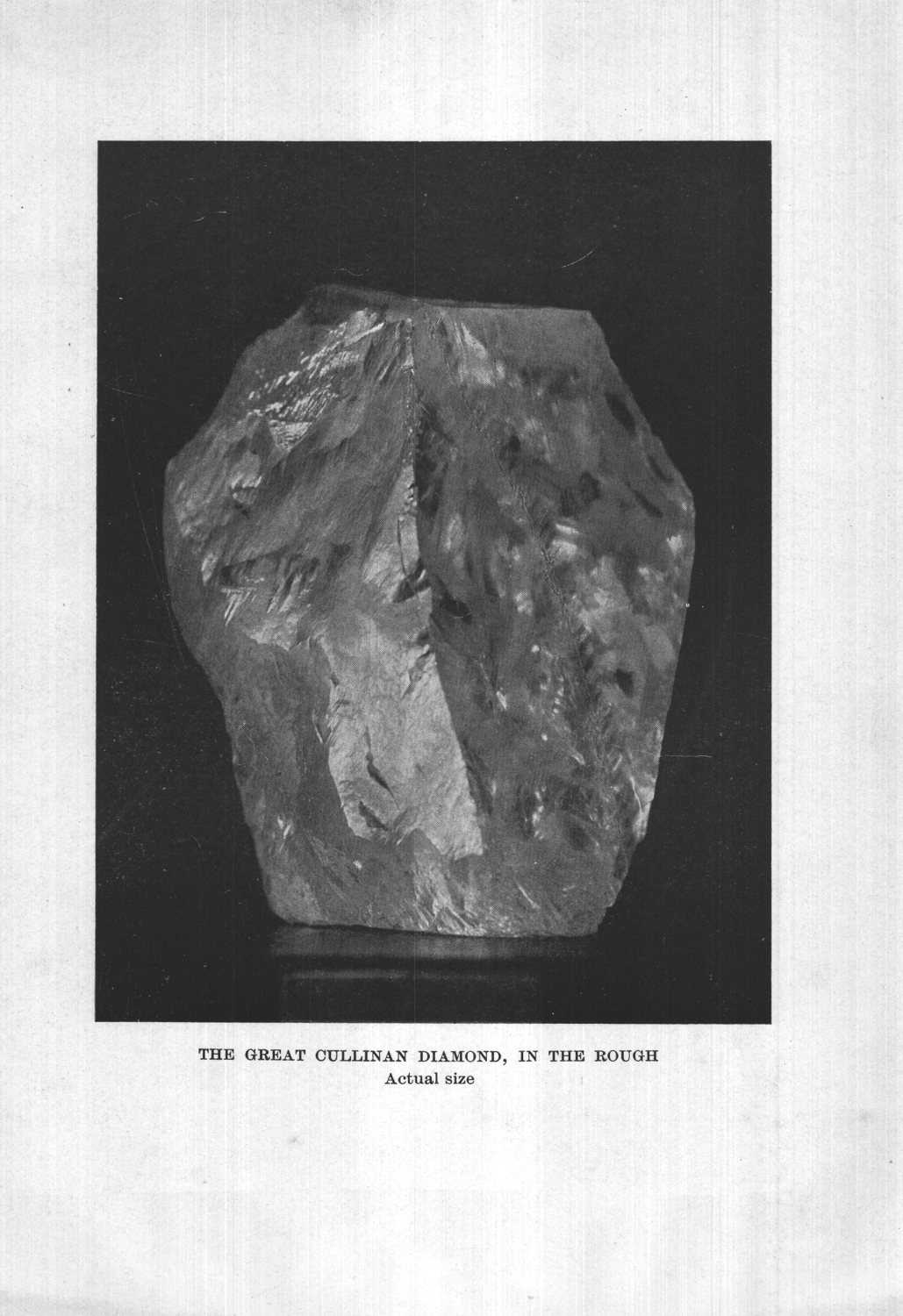
There was disappointment among the diamond cutters and in the gem trade in England when it was decided to send the Cullinan Diamond to Amsterdam to be cut; the great distinction was conferred upon the house of J. Asscher & Co., of Amsterdam and Paris, whose "fabriek," or factory is in the Tulp Straat or "Tol-straat," as it is sometimes written, of Holland's capital. The stone was delivered to the Amsterdam firm in January, 1908, where for nine months it was kept in the vault, of which the walls of concrete and steel are over two feet thick. On February 10th the stone was split by Mr. Joseph Asscher under the supervision of Messrs. M. J. Levy & Nephews, precious stone experts, retained to additionally assure the best scientific methods in the operations in which so vast a sum in values was involved. The stone was first cleft in two pieces by Mr. Asscher in such a way that a defective spot in the diamond was exactly in the centre, leaving a part of it on each piece of the stone. Subsequently the larger of these two pieces was split.
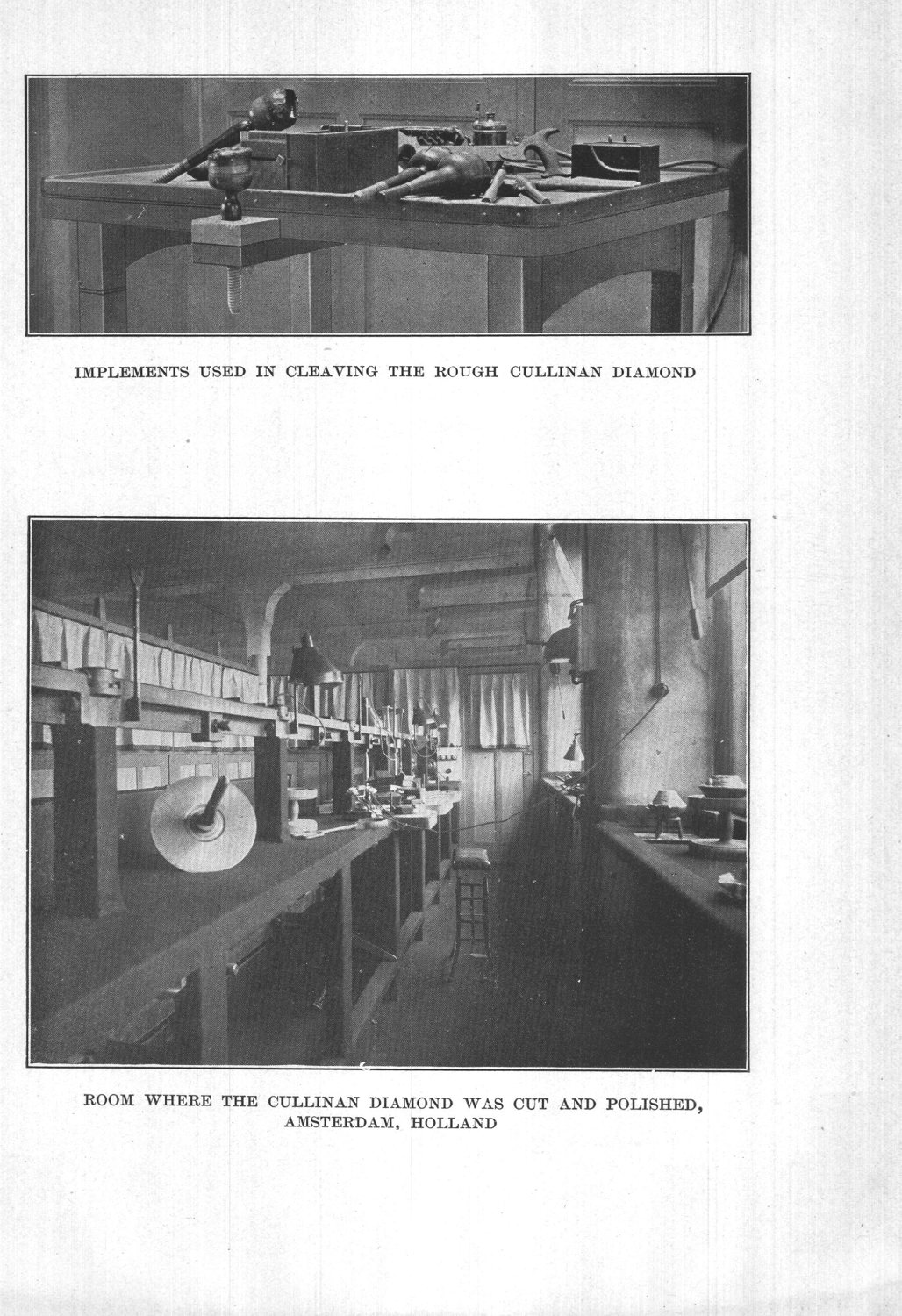
The United States consul at Amsterdam, Mr. Henry H. Morgan, forwarded to Washington the best account of the splitting operation that the author has read. After emphasising the delicacy of the work Mr. Morgan described the making of an incision in the stone with a diamond-cutting saw at the point where the stone was to be cleaved and, following the line of cleavage, to a depth of nearly three quarters of an inch. Before the operator were crystal models, cleaved to represent the effect upon the diamond so far as could be indicated in such a manner. In the incision made by the diamond saw a specially made steel knife, comb shaped, without a handle, was inserted; then, while the supervisors and several members of the house of Asscher intently and breathlessly looked on, Mr. Asscher struck the blade on its back with a steel rod and, with the success of the operation still in doubt, all saw the steel knife break against the adamant; again the stroke and with a chorus of sighs of relief the diamond fell in two parts, divided exactly as the expert had planned. The two parts weighed, respectively, 1040 1/2 carats and 1977 1/2 carats. The larger piece was successfully divided late in February, after which the grinding and polishing continued until November. The London Times on November 10, 1908, published the first authentic description of the finished Cullinan Diamonds as follows:
In the original state the Cullinan Diamond weighed 3253 3/4 English carats, or over 1 1/3 pounds avoirdupois. It is now divided as follows: (1) a pendeloque or drop brilliant, weighing 516 1/2 carats, dimensions, 2.322 inches long and 1.791 inches broad; (2) a square brilliant, weighing 309 3/18 carats, 1.771 inches long by 1.594 broad; (3) a pendeloque, weighing 92 carats; (4) a square brilliant, 62 carats; (5) a heart-shaped brilliant, 18 3/8 carats; (6) a marquise brilliant, 11 1/4 carats; (7) a marquise brilliant, 8 9/16 carats; (8) a square brilliant, 6 5/8 carats; (9) a pendeloque, 4 9/32 carats; (10) 96 brilliants, weighing 7 3/8 carats; and (11) a quantity of unpolished "ends," weighing 9 carats.