Discovery in South Africa
The world's diamond markets to-day are almost entirely supplied by the diggings in South Africa, where the discovery of diamonds was so recent as 1867. Children are accredited with the finding of the diamond in South Africa. A Boer farmer, Daniel Jacobs, had a farm near the present town of Barkly West on the Vaal River. On the river's strand were many glittering and coloured pebbles, the only playthings the Jacobs children could get; these pebbles included carnelian, agates and many varieties of quartz, semi-precious stones of some value if cut and marketed in far-off Europe. Among the pebbles which a little son of the Boer farmer brought into the house was a small white stone which sparkled so in the sun that the vrou of the Boer farmer noticed it, although she did not care sufficiently to pick it up, and only mentioned it to a neighbour, Schalk van Niekirk, who asked to see it. The little white pebble had been thrown out, but the children found it in the dust of the yard. Van Niekirk wiped the dust from the stone and found it so interesting that he offered to buy it, which occasioned some mirth, and it was given to him. With a vague instinct that the stone was unusual and had some value, Van Niekirk subsequently asked a travelling trader, John Reilly, to see if he could find out what it was and if anybody would give any money for it. Several merchants in Hopetown and in Colesberg examined it, said it was pretty, and one thought it might be a topaz, but none would give a penny for it. Reilly might have thrown it away but for a casual exhibition of the pebble to Lorenzo Boyes, a Civil Commissioner at Colesberg, who, experimenting, found that the pebble would scratch glass, and seriously said he thought it was a diamond. A local apothecary, Dr. Kirsh, of Colesberg, hearing the discussion and examining the stone, bet Commissioner Boyes a hat that the stone was only a topaz. The stone was then sent for determination to the leading mineralogist of the Cape Colony, Dr. W. Guybon Atherstone, at Grahamstown, and it was so lightly valued that, to save a higher postage rate, it was mailed to Grahams-town in an unsealed envelope. The expert reported to Mr. Boyes: "I congratulate you on the stone you have sent me. It is a veritable diamond, weighs twenty-one and a quarter carats, and is worth five hundred pounds. It has spoiled all the jewellers' files in Grahamstown, and where that came from there must be lots more. Can I send it to Mr. Southey, Colonial Secretary?"
Upon Dr. Atherstone's report Sir Philip Wodehouse, the Governor at the Cape, bought the rough diamond at Dr. Atherstone's valuation, and the diamond was sent to the Paris Exposition, where it created interest, but no great sensation. Thus a child's find was destined to revolutionise the world's diamond trade, alter the map and the history of South Africa, and place the regulation of the price of the diamond in the hands of a London syndicate.
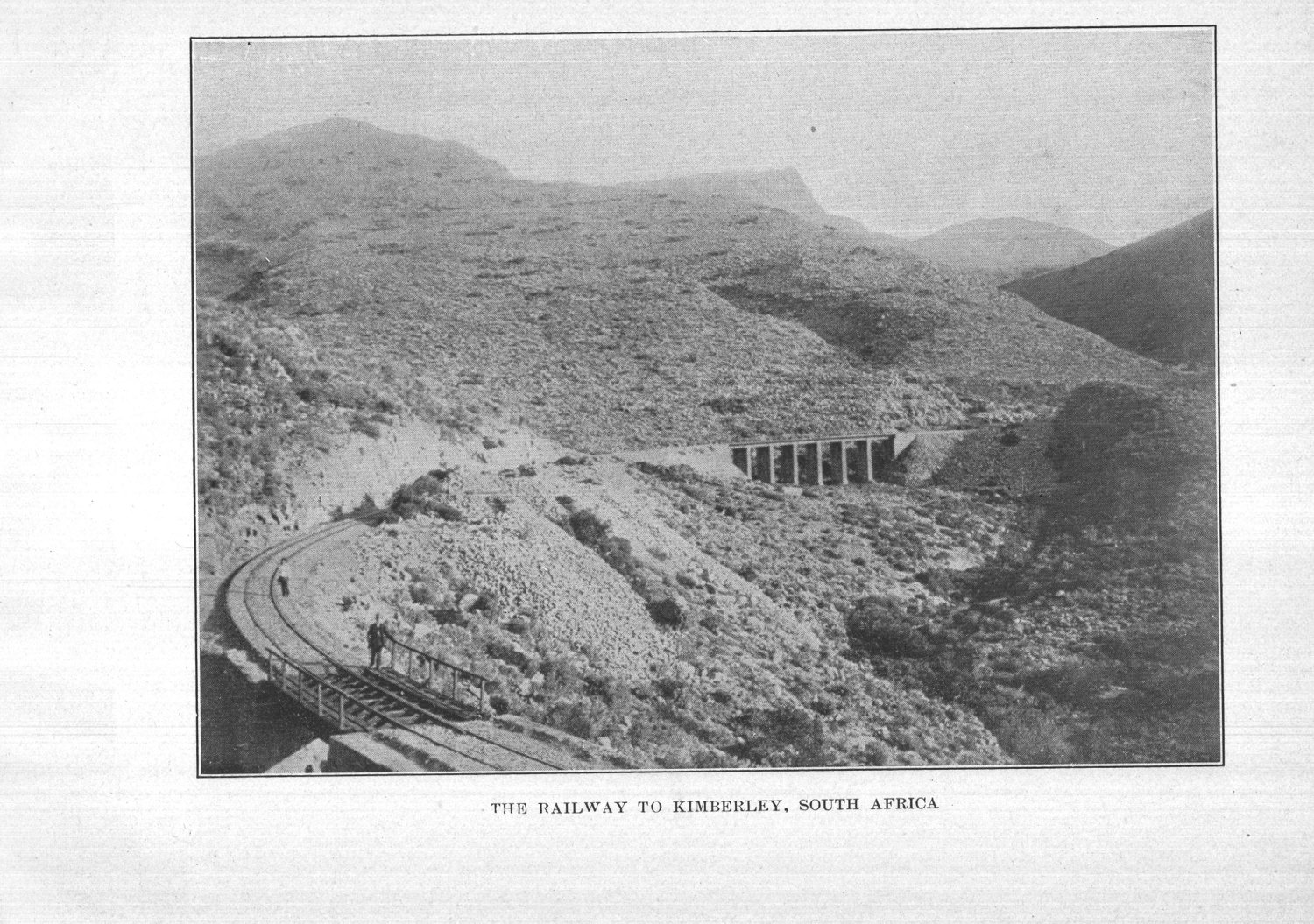
The news of the discovery set Boer farmers in the Vaal valley to some desultory turning over of river gravel in a search for another precious "blinke klippe" (bright stone); but it was ten months before a second diamond was found, and this was on a spot thirty miles away, on the bank of the river below the junction of the Vaal and Orange rivers. In 1868 a few more small diamonds were picked up, and then, in March, 1869, a magnificent white diamond weighing 83.5 carats was picked up by a Griqua shepherd boy on the farm Zendfontein, near the Orange River. Schalk van Niekirk made this poor South African native a local Croesus by trading for the stone five hundred sheep, ten oxen, and a horse; the thrifty Boer sold the diamond for nearly $55,000 to Lilienfeld Brothers of Hopetown, and Earl Dudley later bought this gem, now the famous "Star of South Africa," for nearly $125,000.
After this, diamond-hunting became more than a pastime in South Africa. The first-systematic digging and sifting of the alluvial ground of the Vaal valley was in November, 1869, by an organised party of prospectors from Maritzburg in Natal, initiated by Major Francis of the British Army, then stationed at Maritzburg, and led by Captain Rolleston. The systematic prospecting was begun at Hebron, where the party was joined by two experienced Australian gold diggers named Glenie and King, and also by a trader, named Parker, who, like the Australians, had already been attracted to the locality by the reports of the diamonds found. These prospectors shovelled the river gravel into cradles and pursued the methods of placer washing in vogue in America and Australia. They toiled for many days without sight of a diamond or a grain of gold dust; they then followed the river twenty miles down to Klip-drift, opposite the Mission Station at Pniel; there on January 7, 1870, they found in one of their cradles the first small diamond, the reward of expert methods in the new field. Then came the swarm of diamond hunters.