Jagersfontein and Kimberley
While the horde of gem seekers toiled and suffered hardships on the Vaal, De Klerk, a Boer overseer on Jagersfontein, the farm of Jacoba Magdalena Cecilia Visser, in a pretty green valley near the settlement of Fauresmith, in the Orange Free State, observed garnets in the course of a little stream, and, having heard that the diggers on the Vaal believed the presence of garnets to be an indication of the probable proximity of diamonds, began prospecting one day in August, 1870, and, sifting the gravel in an ordinary wire sieve, at the depth of six feet he found a fine diamond of fifty carats. Soon after, in September, a still more remarkable discovery of diamonds was made at Dutoitspan, on the farm of Dorstfontein, about twenty miles south-east of Pniel; here diamond seeking merged into diamond mining, the diggers penetrating the ground many feet and finding the best stones below the surface. Because of the character of the rotten rock encountered here, the miners made open cuts instead of sinking shafts. The army of diamond seekers spread over the adjoining ground, and early in the year 1871 diamonds were found at Bulfontein, and early in May on De Beers's farm; in July, diamond miners were digging a well for water and, seventy-six feet below the surface, a well-digger was amazed to see a magnificent diamond, which proved afterward to weigh eighty-seven carats, sparkling on the wall of the well. This location was then called—because of the great massing of prospectors there-New Rush or Colesberg Kopje; this was the beginning of the now world-famous Kimberley mine and the South African mining metropolis of Kimberley.
From this event until 1904, the whole history of South African diamond mining has been ably and thoroughly covered in the copiously illustrated and valuable book of Gardner F. Williams, M.A., entitled The Diamond Mines of South Africa. Mr. Williams was long the general manager of the De Beers Consolidated Mines, Ltd., and by experience and known capacity is the recognised authority upon this important subject in the realm of gem history.
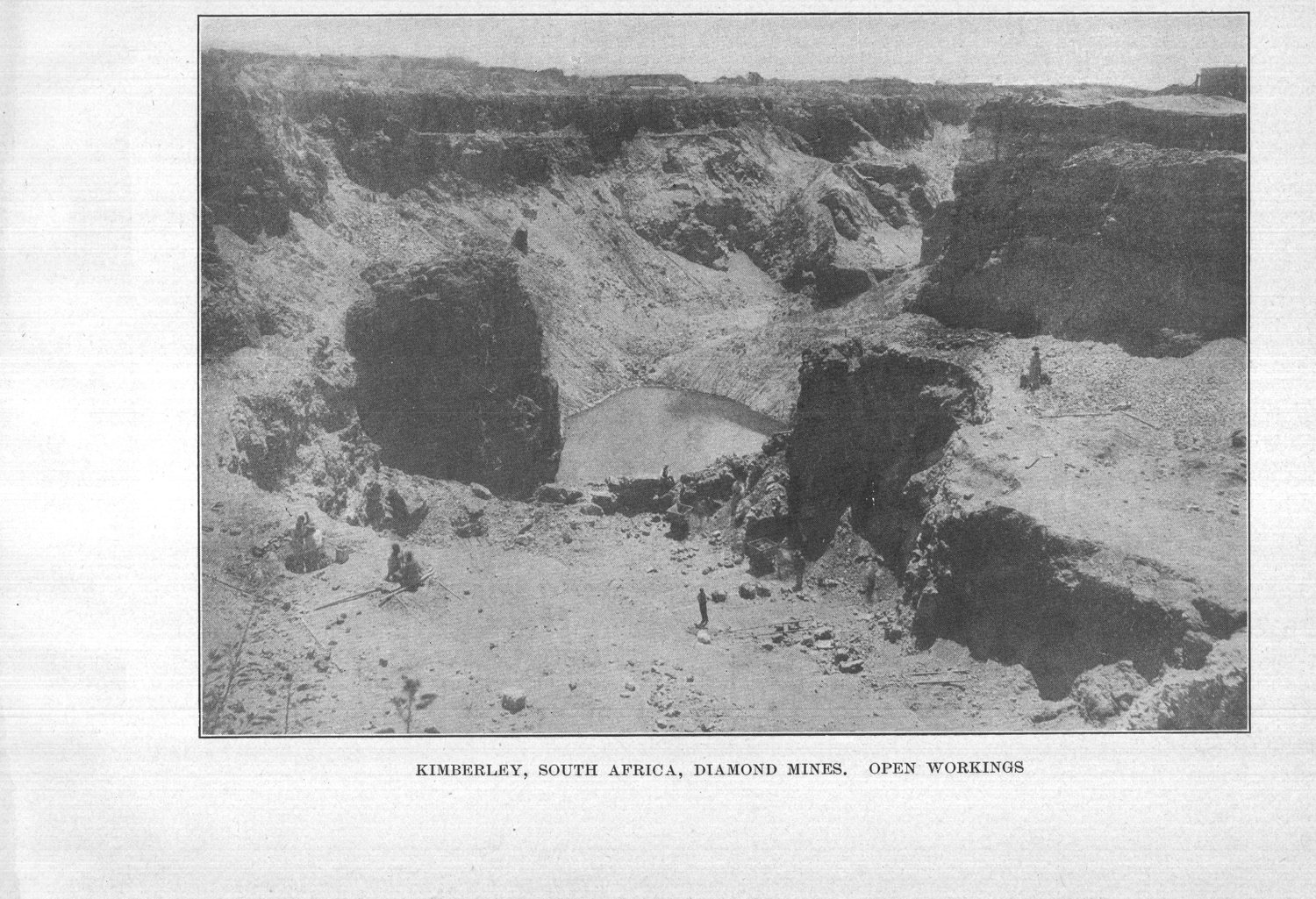
A description of the financiering which reconciled warring interests and heterogeneous human elements, to which was added a genius for management which, through science in chemistry, mineralogy, mechanics, and business system, attained the highest degree of economic production and marketing, is not the least fascinating chapter in the wonderful story of the diamond in South Africa. The history of the contest between Briton and Boer, and all else that grew out of the discovery of diamonds on the Vaal, cannot be told here; but the modern methods of extracting the rough diamonds from the blue ground in which they have rested encased for ages is pertinent and worthy of some space in even so compact a book as the present.