Home › What Worms Do › What Worms Do: Stonehenge
What Worms Do: Stonehenge
At Stonehenge, some of the outer Druidical stones are now prostrate, having fallen at a remote but unknown period; and these have become buried to a moderate depth in the ground. They are surrounded by sloping borders of turf, on which recent castings were seen. Close to one of these fallen stones, which was 17 feet long, 6 feet broad, and 28½ inches thick, a hole was dug; and here the vegetable mould was at least 94 inches in thickness. At this depth a flint was found, and a little higher up on one side of the hole a fragment of glass. The base of the stone lay about 9½ inches beneath the level of the surrounding ground, and its upper surface 19 inches above the ground.
A hole was also dug close to a second huge stone, which in falling had broken into two pieces; and this must have happened long ago, judging from the weathered aspect of the fractured ends. The base was buried to a depth of 10 inches, as was ascertained by driving an iron skewer horizontally into the ground beneath it. The vegetable mould forming the turfcovered sloping border round the stone, on which many castings had recently been ejected, was 10 inches in thickness; and most of this mould must have been brought up by worms from beneath its base. At a distance of 8 yards from the stone, the mould was only 5½ inches in thickness (with a piece of tobacco pipe at a depth of 4 inches), and this rested on broken flint and chalk which could not have easily yielded to the pressure or weight of the stone.
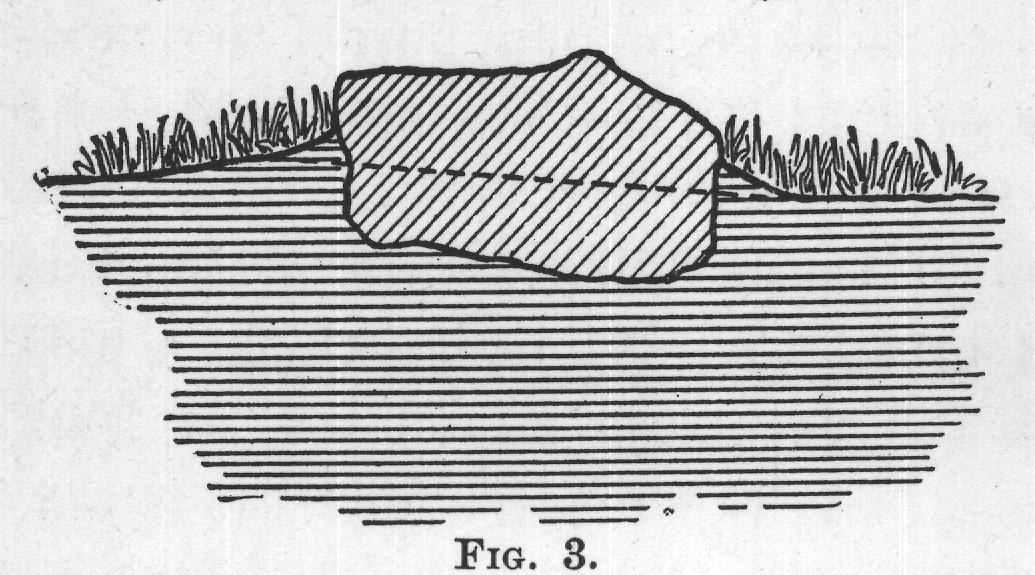
A straight rod was fixed horizontally (by the aid of a spirit-level) across a third fallen stone, which was 7 feet 9 inches long; and the contour of the projecting parts and of the adjoining ground, which was not quite level, was thus ascertained, as shown in the accompany- FIG. 3.
Section through one of the fallen Druidical stones at Stonehenge, showing how much it had sunk into the ground. ing diagram (Fig. 3) on a scale of inch to a foot.
The turf-covered border sloped up to the stone on one side to height of 4 inches, and on the opposite side a to only 2½ inches above the general level. A hole was dug on the eastern side, and the base of the stone was here found to lie at a depth of 4 inches beneath the general level of the ground, and of 8 inches beneath the top of the sloping turf-covered border.
Sufficient evidence has now been given showing that small objects left on the surface of the land where worms abound soon get buried, and that large stones sink slowly downwards through the same means.
Every step of the process could be followed, from the accidental deposition of a single casting on a small object lying loose on the surface, to its being entangled amidst the matted roots of the turf, and lastly to its being embedded in the mould at various depths beneath the surface. When the same field was re-examined after the interval of a few years, such objects were found at a greater depth than before. The straightness and regularity of the lines formed by the embedded objects, and their parallelism with the surface of the land, are the most striking features of the case; for this parallelism shows how equably the worms must have worked; the result being, partly the effect of the washing down of the fresh castings by rain. The specific gravity of the objects does not affect their rate of sinking, as could be seen by porous cinders, burnt marl, chalk and quartz pebbles, having all sunk to the same depth within the same time. Considering the nature of the sub-stratum, which at Leith Hill Place was sandy soil including many bits of rock, and at Stonehenge, chalk-rubble with broken flints; considering, also, the presence of the turf-covered sloping border of mould round the great fragments of stone at both these places, their sinking does not appear to have been sensibly aided by their weight, though this was considerable. On the number of worms which live within a given space.