Home › What Worms Do › What Worms Do: Knole
What Worms Do: Knole
The transformation in the appearance of this field, which had been effected beneath my eyes, was afterwards rendered the more striking, when I examined in Knole Park a dense forest of lofty beech-trees, beneath which nothing grew. Here the ground was thickly strewed with large, naked stones, and worm-castings were almost wholly absent. Obscure lines and irregularities on the surface indicated that the land had been cultivated some centuries ago. It is probable that a thick wood of young beech-trees sprung up so quickly, that time enough was not allowed for worms to cover up the stone with their castings, before the site became unfitted for their existence. Anyhow, the contrast between the state of the now miscalled " stony field," well stocked with worms, and the present state of the ground beneath the old beech-trees in Knole Park, where worms appeared to be absent, was striking.
A narrow path running across part of my lawn was paved in 1843 with small flag-stones, set edgeways; but worms threw up many castings, and weeds grew thickly between them. During several years the path was weeded and swept; but ultimately the weeds and worms prevailed, and the gardener ceased to sweep, merely moving off the weeds, as often as the lawn was mowed. The path soon became almost covered up, and after several years no trace of it was left. On removing, in 1877, the thin overlaying layer of turf, the small flag-stones, all in their proper places, were found covered by an inch of fine mould.
Two recently published accounts of substances strewed on the surface of pasture-land, having become buried through the action of worms, may be here noticed. The Rev. H. C. Key had a ditch cut in a field, over which coal-ashes had been spread, as it was believed, 18 years before, and on the clean-cut perpendicular sides of the ditch, at a depth of at least 7 inches, there could be seen, for a length of 60 yards, "a distinct, very even, narrow line of coal-ashes, mixed with small coal, perfectly parallel with the top-sward." This parallelism and the length of the section gives interest to the case. Secondly, Mr. Dancer states that crushed bones had been thickly strewed over a field, and "some years afterwards" "these were found "several inches below the surface, at a uniform depth." Worms appear to act in the same manner in New Zealand as in Europe; for Professor J. von Haast has described a section near the coast, consisting of mica-schist, "covered by 5 or 6 feet of loess, above which about 12 inches of vegetable soil had accumulated."
Between the loess and the mould there was a layer from 3 to 6 inches in thickness, consisting of "cores, implements, flakes, and chips, all manufactured from hard basaltic rock." It is, therefore, probable, that the aborigines, at some former period, had left these objects on the surface, and that they had afterwards been slowly covered up by the castings of worms.
Farmers in England are well aware that objects of all kinds, left on the surface of pasture-lands, after a time disappear, or, as they say, work themselves downwards. How powdered lime, cinders, and heavy stones, can work down, and at the same rate, through the matted roots of a grass-covered surface, is a question which has probably never occurred to them.
The sinking of great stones through the action of worms. - When a stone of large size and of irregular shape is left on the surface of the ground, it rests, of course, on the more protuberant parts; but worms soon fill up with their castings all the hollow spaces on the lower side; for, as Hensen remarks, they like the shelter of stones. As soon as the hollows are filled up, the worms eject the earth which they have swallowed beyond the circumference of the stones; and thus the surface of the ground is raised all round the stone. As the burrows excavated directly beneath the stone after a time collapse, the stone sinks a little. Hence it is, that boulders which at some ancient period have rolled down from a rocky mountain or cliff on to a meadow at its base, are always somewhat imbedded in the soil; and, when removed, leave an exact impression of their lower surfaces in the under-lying fine mould. If, however, a boulder is of such huge dimensions, that the earth beneath is kept dry, such earth will not be inhabited by worms, and the boulder will not sink into the ground.
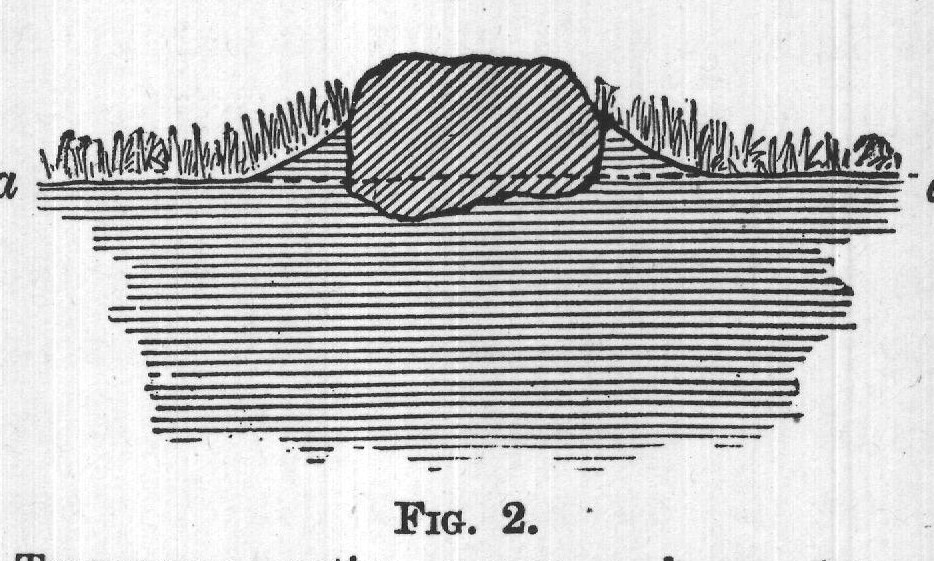
A lime-kiln formerly stood in a grass-field near Leith Hill Place, in Surrey, and was pulled down 35 years before my visit; all the loose rubbish had been carted away, excepting three large stones of quartzose sandstone, which it was thought might hereafter be of some use. An old workman remembered that they had been left on a bare surface of broken bricks and mortar, close to the foundations of the kiln; but the whole surrounding surface is now covered with turf and mould. The two largest of these stones had never since been moved; nor could this easily have been done, as, when I had them removed, it was the work of two men with levers. One of these stones, and not the largest, was 64 inches long, 17 inches broad, and from 9 to 10 inches in thickness. Its lower surface was somewhat protuberant in the middle; and this part still rested on broken bricks and mortar, showing the truth of the old workman's account. Beneath the brick rubbish the natural sandy soil, full of fragments of sandstone, was found; and this could have yielded very little, if at all, to the weight of the stone, as might have been expected if the sub-soil had been clay. The surface of the field, for a distance of about 9 inches round the stone, gradually sloped up to it, and close to the stone stood in most places about 4 inches above the surrounding ground. The base of the stone was buried from 1 to 2 inches beneath the general level, and the upper surface projected about 8 inches above this level, or about 4 inches above the sloping border of turf. After the removal of the stone it became evident that one of its pointed ends must at first have stood clear above the ground by some inches, but its upper surface was now on a level with the surrounding turf. When the stone was removed, an exact cast of its lower side, forming a shallow crateriform hollow, was left, the inner surface of which consisted of fine, black mould, excepting where the more protuberant parts rested on the brickrubbish. A trans- a verse section of this stone, together with its bed, drawn from measurements made after it had been displaced, is here given on a scale of inch to a foot FIG. 2.
Transverse section across a large stone, which had lain on a grass-field for thirty-five years. aa, general level of the field. The underlying brick of rubbish has not been represented. a (Fig. 2). The turf-covered border which sloped up to the stone, consisted of fine vegetable mould, in one part 7 inches in thickness. This evidently consisted of worm-castings, several of which had been recently ejected. The whole stone had sunk in the thirty-five years, as far as I could judge, about 1½ inch; and this must have been due to the brick-rubbish beneath the more protuberant parts having been undermined by worms. At this rate, the upper surface of the stone, if it had been left undisturbed, would have sunk to the general level of the field in 247 years; but before this could have occurred, some earth would have been washed down by heavy rain from the castings on the raised border of turf over the upper surface of the stone. The second stone was larger than the one just described, viz., 67 inches in length, 39 in breadth, and 15 in thickness. The lower surface was nearly flat, so that the worms must soon have been compelled to eject their castings beyond its circumference. The stone as a whole had sunk about 2 inches into the ground. At this rate it would have required 262 years for its upper surface to have sunk to the general level of the field. The upwardly sloping, turf-covered border round the stone was broader than in the last case, viz., from 14 to 16 inches; and why this should be so, I could see no reason. In most parts this border was not so high as in the last case, viz., from 2 to 2½ inches, but in one place it was as much as 51. Its average height close to the stone was probably about 3 inches, and it thinned out to nothing. If so, a layer of fine earth, 15 inches in breadth and 1½ inch in average thickness, of sufficient length to surround the whole of the much elongated slab, must have been brought up by the worms in chief part from beneath the stone in the course of 35 years. This amount would be amply sufficient to account for its having sunk about 2 inches into the ground; more especially if we bear in mind that a good deal of the finest earth would have been washed by heavy rain from the castings ejected on the sloping border down to the level of the field. Some fresh castings were seen close to the stone. Nevertheless, on digging a large hole to a depth of 18 inches where the stone had lain, only two worms and a few burrows were seen, although the soil was damp and seemed favorable for worms. There were some large colonies of ants beneath the stone, and possibly since their establishment the worms had decreased in number. The third stone was only about half as large as the others; and two strong boys could together have rolled it over. I have no doubt that it had been rolled over at a moderately recent time, for it now lay at some distance from the two other stones at the bottom of a little adjoining slope. It rested also on fine earth, instead of partly on brick-rubbish. In agreement with this conclusion, the raised surrounding border of turf was only 1 inch high in some parts, and 2 inches in other parts. There were no colonies of ants beneath this stone, and on digging a hole where it had lain, several burrows and worms were found.