Home › Birds in Their Relation to Agriculture › Birds in Their Relation to Agriculture: Vulture
Birds in Their Relation to Agriculture: Vulture
The food habits of both the Turkey Vulture and Carrion Crow, or Black Vulture, are of such a nature that the destruction of these birds should be prohibited. In fact, in many of the states this is done by law.
They live almost exclusively upon carrion or decomposing animal matter, and in this manner aid in the prevention of diseases that might result from the presence of such filth. They may, however, be the cause of indirectly spreading hog cholera where animals that have died from this disease are left unburied or unburned. The Cuckoos are among the few birds that habitually feed upon hairy caterpillars, such as the various "tentmaking" species. They also destroy large numbers of other caterpillars, and do not Alobject to beetles and other insects which they find among the foliage of trees. though shy birds they are frequently seen in cities, where they do their share in protecting the shade trees from the ravages of insect defoliators.
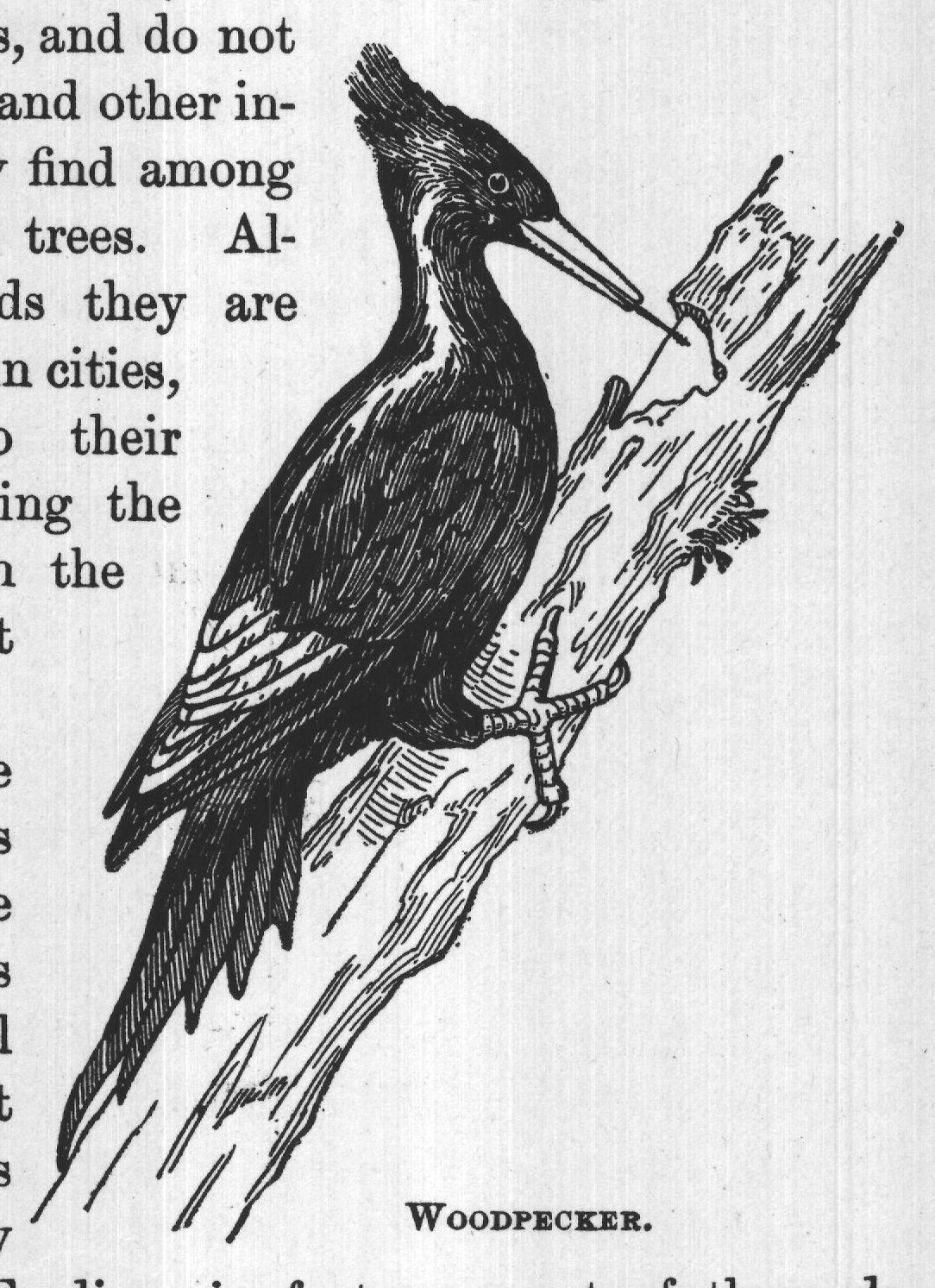
WOODPECKER.
Taking the Woodpeckers as a family, there are few persons but who will readily admit that these birds comprise a very useful group. Feeding, in fact, as most of them do, upon the larvæ of wood-boring insects, they can readily do much greater good for the actual number of insects destroyed than if they destroyed only those that feed upon the foliage of trees. Not unfrequently will a single borer kill an entire tree if left to itself, while hundreds of foliage-feeding caterpillars of the same size have but little effect upon the appearance, to say nothing of the health, of the same tree.
Mr. M. L. Beal, assistant in the Division of Ornithology and Mammalogy of the United States Department of Agriculture, in summing up the results obtained from the examination of six hundred and seventy-nine stomachs of these birds, writes as follows: "In reviewing the results of these investigations and comparing one species with another, without losing sight of the fact that comparative good is not necessarily positive good, it appears that of seven species considered the Downy Woodpecker is the most beneficial." He then goes on to give the food habits based on contents of the stomachs of our most common species. "Judged by the stomach examinations of the Downy and Hairy Woodpecker and Flicker it would be hard to find three other species of our common birds with fewer harmful qualities."
The Flicker is one of our most common woodpeckers in Nebraska and does much towards keeping down a number of different kinds of insects. It is very fond of ants as a diet, in fact is partial to them, and this element forms almost half of its entire food-supply during the year. It also occasionally feeds upon the chinchbug, as can be attested by the fact that the stomach of a specimen killed near Lincoln contained in the vicinity of one thousand of these bugs. It is also a fruit-eater to the extent of about one-quarter of its entire bill of fare, but nature, not man, furnishes the supply. It takes the wild kinds in preference to those that are cultivated.
The Whippoorwill, Night Hawk, and Swifts feed entirely on insects, and must consequently be classed among the beneficial birds. They all capture their prey while upon the wing, and naturally destroy large numbers of troublesome kinds.
The various species of Flycatchers, as the name imples, destroy insects which they capture for the most part while on the wing. Flies and allied insects are quite prominent on their bill of fare; but these by no means are the only kinds of insects destroyed by them. Many a luckless locust, butterfly, moth or even beetle is snapped up and devoured by the different species of the family. The Bee-bird, or Kingbird as it is more frequently called, sometimes even catches bees. These latter, however, consist largely of drones, hence comparatively little harm is done. One should be unprejudiced in order to write a fair biography of even a bird, or group of birds. To say that I am without such prejudice with reference to some of the members of the family of birds now to be considered, would be a falsehood. Still, I shall endeavor to give as unbiased testimony as possible with reference to their food-habits at least, and let the reader judge for himself as to what would be the proper treatment for these birds. Taking the family as a whole that which is made up of birds like the Crows, Ravens, Magpies, Jays, Nut-crackers, "Camp-robbers," etc., though some of them have unenviable names and reputations at least, are not at all as bad as we are sometimes requested to believe them to be. The Crows, Ravens, Magpies, and immediate relatives are what might be termed "omnivorous" in foodhabits, eating everything that comes their way. Crows, however, have been shown to feed largely on insects, which in great measure at least, offsets the harm done in other directions. They also feed on various substances, the removal of which is for the general good. The Raven is too rare a bird in this state to be taken into consideration in respect to food-habits, and the Magpie certainly can be put out of the question of doing any possible harm for the same reason. This leaves then to be considered, the Jays, of which we seem to have six or seven distinct kinds; but only two of these are at all common. The Blue Jay is found over the entire state, and is familiar to everybody. The second species is found only in the western and north-western portions among the pine forests, and is known as the Pinon Jay or "Camp-robber" - the latter name not very flattering to the bird I must confess. The Blue Jay does much of the mischief that is laid at the door of the Robin, orioles, thrushes, and other birds, and then sneaks away unobserved. He also destroys large numbers of insects and robs the nest of some small birds.