Home › What Worms Do › What Worms Do
What Worms Do
(FROM THE FORMATION OF VEGETABLE MOULD.) BY CHARLES DARWIN.
W E now come to treat of a curious and important subject, - namely, the amount of earth which is brought up by worms from beneath the surface, and is afterwards spread out more or less completely by the rain and wind. The amount can be judged of by two methods, - by the rate at which objects left on the surface are buried, and more accurately by weighing the quantity brought up within a given time. We will begin with the first method, as it was first followed.

Near Maer Hall in Staffordshire, quick-lime had been spread, about the year 1827, thickly over a field of good pasture-land, which had not since been ploughed.
Some square holes were dug in this field in the beginning of October, 1837, and the sections showed a layer of turf, formed by the matted roots of the grasses, ½ inch in thickness, beneath which, at a depth of 2 inches (or 3 inches from the surface), a layer of the lime in powder or in small lumps could be distinctly seen running all round the vertical sides of the holes. The soil beneath the layer of lime was either gravelly or of a coarse sandy nature, and differed considerably in appearance from the overlying dark-coloured fine mould. Coal-cinders had been spread over a part of this same field either in the year 1833 or 1834; and when the above holes were dug, that is, after an interval of 3 or 4 years, the cinders formed a line of black spots round the holes, at a depth of 1 inch beneath the surface, parallel to and above the white layer of lime. Over another part of this field cinders had been strewed, only about half a year before, and these either still lay on the surface or were entangled among the roots of the grasses; and I here saw the commencement of the burying process, for worm-castings had been heaped on several of the smaller fragments. After an interval of 4 years this field was re-examined, and now the two layers of lime and cinders were found almost everywhere at a greater depth than before by nearly 1 inch, we will say by of an inch. Therefore, mould to an average thickness of .22 of an inch had been annually brought up by the worms, and had been spread over the surface of this field.
Coal-cinders had been strewed over another field, at a date which could not be positively ascertained, so thickly that they formed (October, 1837) a layer, 1 inch in thickness at a depth of about 3 inches from the surface. The layer was so continuous that the overlying dark vegetable mould was connected with the sub-soil of red clay only by the roots of the grasses; and when these were broken, the mould and the red clay fell apart. In a third field, on which coal-cinders and burnt marl had been strewed several times at unknown dates, holes were dug in 1842; and a layer of cinders could be traced at a depth of 3½ inches, beneath which at a depth of 9½ inches from the surface there was a line of cinders together with burnt marl. On the sides of one hole there were two layers of cinders, at 2 and 3½ inches beneath the surface; and below them at a depth in parts of 94, and in other parts of 10½ inches there were fragments of burnt marl. In a fourth field two layers of lime, one above the other could be distinctly traced, and beneath them a layer of cinders and burnt marl at a depth of from 10 to 12 inches below the surface.
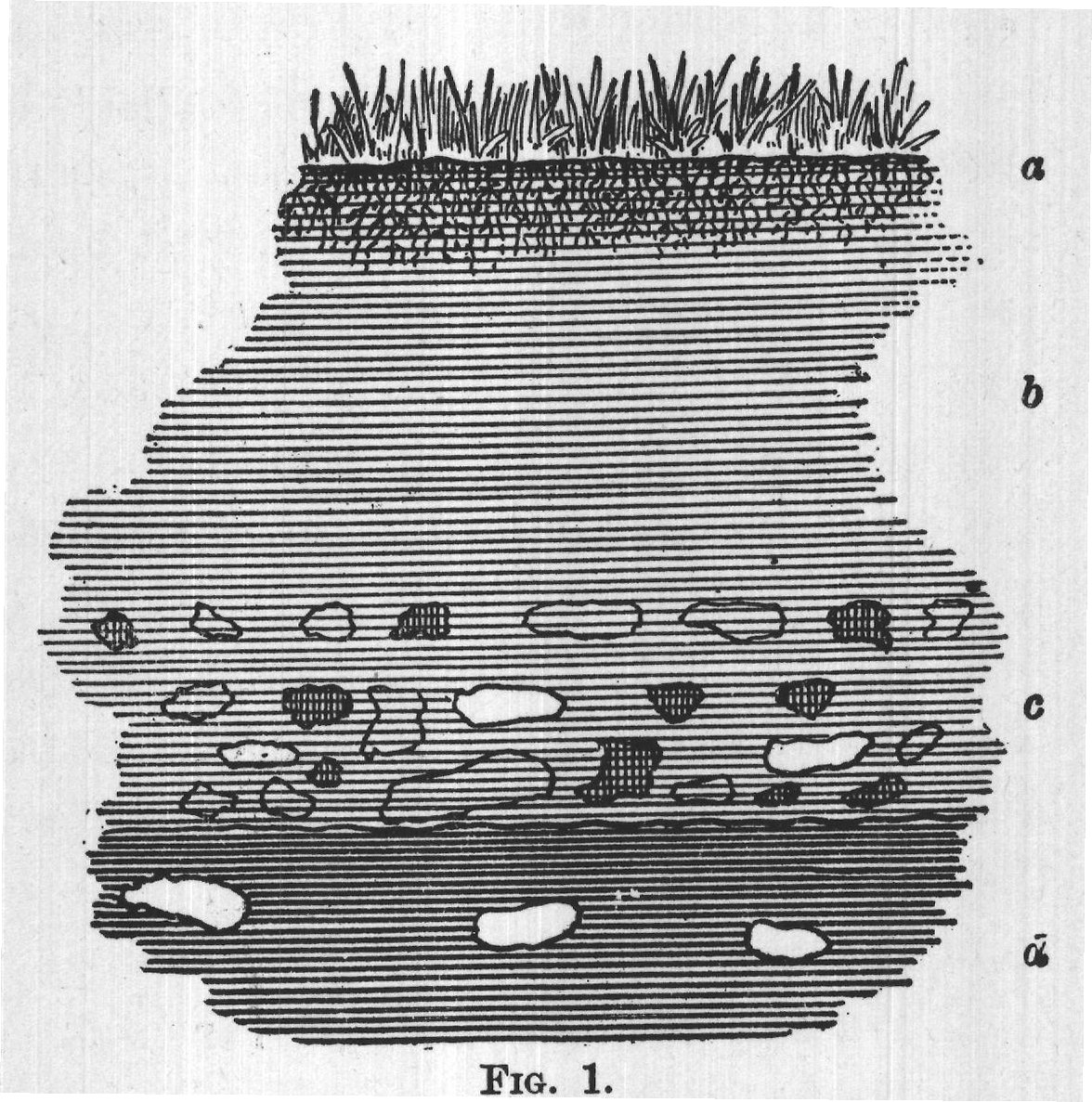
A piece of waste land was enclosed, drained, ploughed, harrowed, and thickly covered in the year 1822 with burnt márl and cinders. It was sowed with grass seeds, and now supports a tolerably good but coarse pasture. Holes were dug in this field in 1837, or 15 years after its reclamation, and we see in the accompanying diagram (Fig. 1) reduced to half of the natural scale, that the turf was½ inch thick, beneath which there was a layer of vegetable mould 2½ inches thick. This layer did not contain fragments of any kind; but beneath it there was a layer of mould, 1½ inch in thickness, full of fragments of burnt marl, conspicuous from their red color, one of which near the bottom was an inch in length; and other fragments of coal-cinders together with a few white quartz pebbles. Beneath this layer and at a depth of 4½ inches from the surface, the original black, peaty, sandy soil with a few quartz pebbles was encountered. Here, therefore, the fragments of burnt marl and cinders had been covered in the course of 15 years by a layer of fine vegetable mould, only 21 inches in thickness, excluding the turf. Six half and a years subsea b C FIG. 1. field was requently this Section of the vegetable mould in a field, drained and reclaimed fifteen years previously; a, turf; b, vegetable mould without any stones; c, mould with fragments of burnt marl, coal cinders, and pebbles; d, sub-soil of black, peaty sand with quartz pebbles. examined, and the fragments were now found at from 4 to 5 inches beneath the surface. So that in this interval of 64 years, about 1½ inch of mould had been added to the superficial layer. I am surprised that a greater quantity had not been brought up during the whole 21+ years, for in the closely underlying black, peaty soil there were many worms. It is, however, probable that formerly, whilst the land remained poor, worms were scanty; and the mould would then have accumulated slowly. The average annual increase of thickness for the whole period is .19 of an inch.
Two other cases are worth recording. In the spring of 1835 a field, which had long existed as poor pasture, and was so swampy that it trembled slightly when stamped on, was thickly covered with red sand so that the whole surface appeared at first bright red. When holes were dug in this field after an interval of about 24 years, the sand formed a layer at a depth of inch beneath the surface. In 1842 (i.e., seven years after the sand had been laid on) fresh holes were dug, and now the red sand formed a distinct layer, 2 inches beneath the surface, or 1½ inch beneath the turf; so that on an average .21 inches of mould had been annually brought to the surface. Immediately beneath the layer of red sand the original sub-stratum of black, sandy peat extended.
A grass field, likewise not far from Maer Hall, had formerly been thickly covered with marl, and was then left for several years as pasture; it was afterwards ploughed. A friend had three trenches dug in this field 28 years after the application of the marl, and a layer of the marl fragments could be traced at a depth, carefuly measured, of 12 inches in some parts, and of 14 inches in other parts. This difference in depth depended on the layer being horizontal, whilst the surface consisted of ridges and furrows from the field having been ploughed. The tenant assured me that it had never been turned up to a greater depth than from 6 to 8 inches; and as the fragments formed an unbroken horizontal layer from 12 to 14 inches beneath the surface, these must have been buried by the worms whilst the land was in pasture before it was ploughed, for otherwise they would have been indis criminately scattered by the plough throughout the whole thickness of the soil. Four and a half years afterwards I had three holes dug in this field, in which potatoes had been lately planted, and the layer of marl fragments was now found 13 inches beneath the bottoms of the furrows, and therefore probably 15 inches beneath the general level of the field. It should, however, be observed that the thickness of the blackish, sandy soil, which had been thrown up by the worms above the marl fragments in the course of 32+ years, would have measured less than 15 inches, if the field had always remained as pasture, for the soil would in this case have been much more compact. The fragments of marl almost rested on an undisturbed substratum of white sand with quartz pebbles; and as this would be little attractive to worms, the mould would hereafter be very slowly increased by their action.
We will now give some cases of the action of worms, on land differing widely from the dry, sandy, or the swampy pasture just described. The chalk formation extends all round my house in Kent; and its surface, from having been exposed during an immense period to the dissolving action of rain-water, is extremely | irregular, being abruptly festooned and penetrated by many deep, well-like cavities. During the dissolution of the chalk the insoluble matter, including a vast number of unrolled flints of all sizes, has been left on the surface and forms a bed of stiff red clay, full of flints. and generally from 6 to 14 feet in thickness. Over the red clay, wherever the land has long remained as pasture, there is a layer a few inches in thickness of darkcoloured vegetable mould. A quantity of broken chalk was spread, on December 20, 1842, over a part of a field near my house, which had existed as pasture certainly for 30, probably for twice or thrice as many, years. The chalk was laid on the land for the sake of observing at some future period to what depth it would become buried. At the end of November, 1871, that is, after an interval of twentynine years, a trench was dug across this part of the field; and a line of white nodules could be traced on both sides of the trench, at a depth of 7 inches from the surface. The mould, therefore (excluding the turf), had here been thrown up at an average rate of .22 inches per year. Beneath the line of chalk nodules there was in parts hardly any fine earth free of flints, while in other parts there was a layer 24 inches in thickness. In this latter case the mould was altogether 94 inches thick; and in one such spot a nodule of chalk and a smooth flint pebble, both of which must have been left at some former time on the surface, were found at this depth. At from 11 to 12 inches beneath the surface, the undisturbed reddish clay, full of flints, extended. The appearance of the above nodules of chalk surprised me much at first, as they closely resembled water-worn pebbles, whereas the freshly-broken fragments had been angular. But on examining the nodules with a lens, they no longer appeared waterworn, for their surfaces were pitted through unequal corrosion, and minute, sharp points, formed of broken fossil shells, projected from them. It was evident that the corners of the original fragments of chalk had been wholly dissolved, from presenting a large surface to the carbonic acid dissolved in the rain-water and to that generated in soil containing vegetable matter, as well as the humus-acids. The projecting corners would also, relatively to the other parts, have been embraced by a larger number of living rootlets; and these have the power of even attacking marble, as Sachs has shown.
Thus, in the course of twenty-nine years, buried angular fragments of chalk had been converted into wellrounded nodules. Another part of this same field was mossy, and as it was thought that sifted coal-cinders would improve the pasture, a thick layer was spread over this part either in 1842 or 1843, and another layer some years afterwards. In 1871 a trench was here dug, and many cinders lay in a line at a depth of 7 inches beneath the surface, with another line at a depth of 5½ inches parallel to the one beneath. In another part of this field, which had formerly existed as a separate one, and which it was believed had been pasture-land for more than a century, trenches were dug to see how thick the vegetable mould was. By chance the first trench was made at a spot where at some former period, certainly more than forty years before, a large hole had been filled up with coarse, red clay, flints, fragments of chalk, and gravel; and here the fine vegetable mould was only from 41 to 40 inches in thickness. In another and undisturbed place, the mould varied much in thickness, namely, from 6 to 8½ inches; beneath which a few small fragments of brick were found in one place. From these several cases, it would appear that during the last 29 years mould has been heaped on the surface at an average annual rate of from 2 to .22 of an inch. But in this district when a ploughed field is first laid down in grass, the mould accumulates at a much slower rate. The rate, also, must become very much slower after a bed of mould, several inches in thickness, has been formed; for the worms then live chiefly near the surface, and burrow down to a greater depth so as to bring up fresh earth from below, only during the winter, when the weather is very cold (at which time worms were found in this field at a depth of 26 inches), and during summer, when the weather is very dry.
A field which adjoins the one just described, slopes in one part rather steeply (viz., at from 10° to 15°); this part was last ploughed in 1841, was then harrowed and left to become pasture-land. For several years it was clothed with an extremely scant vegetation, and was so thickly covered with small and large flints (some of them half as large as a child's head) that the field was always called by my sons "the stony field." When they ran down the slope the stones clattered together. I remember doubting whether I should live to see these larger flints covered with vegetable mould and turf. But the smaller stones disappeared before many years had elapsed, as did every one of the larger ones after a time; so that after thirty years (1871) a horse could gallop over the compact turf from one end of the field to the other, and not strike a single stone with his shoes. To anyone who remembered the appearance of the field in 1842, the transformation was wonderful. This was certainly the work of the worms, for though castings were not frequent for several years, yet some were thrown up month after month, and these gradually increased in numbers as the pasture improved. In the year 1871 a trench was dug on the above slope, and the blades of grass were cut off close to the roots, so that the thickness of the turf and of the vegetable mould could be measured accurately. The turf was rather less than half an inch, and the mould, which did not contain any stones, 2½ inches in thickness. Beneath this lay coarse, clayey earth full of flints, like that in any of the neighboring ploughed fields. This coarse earth easily fell apart from the overlying mould when a split was lifted up. The average rate of accumulation of the mould during the whole thirty years was only .083 inch per year (i.e., nearly one inch in twelve years); but the rate must have been much slower at first, and afterwards considerably quicker.