Home › The Color of Animals › The Color of Animals
The Color of Animals
(FROM CHAPTERS IN POPULAR NATURAL HISTORY.) BY SIR JOHN LUBBOCK, BART., M.P., F.R.S., ETC.
HE color of animals is by no means a matter of chance; it depends on many considerations, but in the majority of cases tends to protect the animal from danger by rendering it less conspicuous.
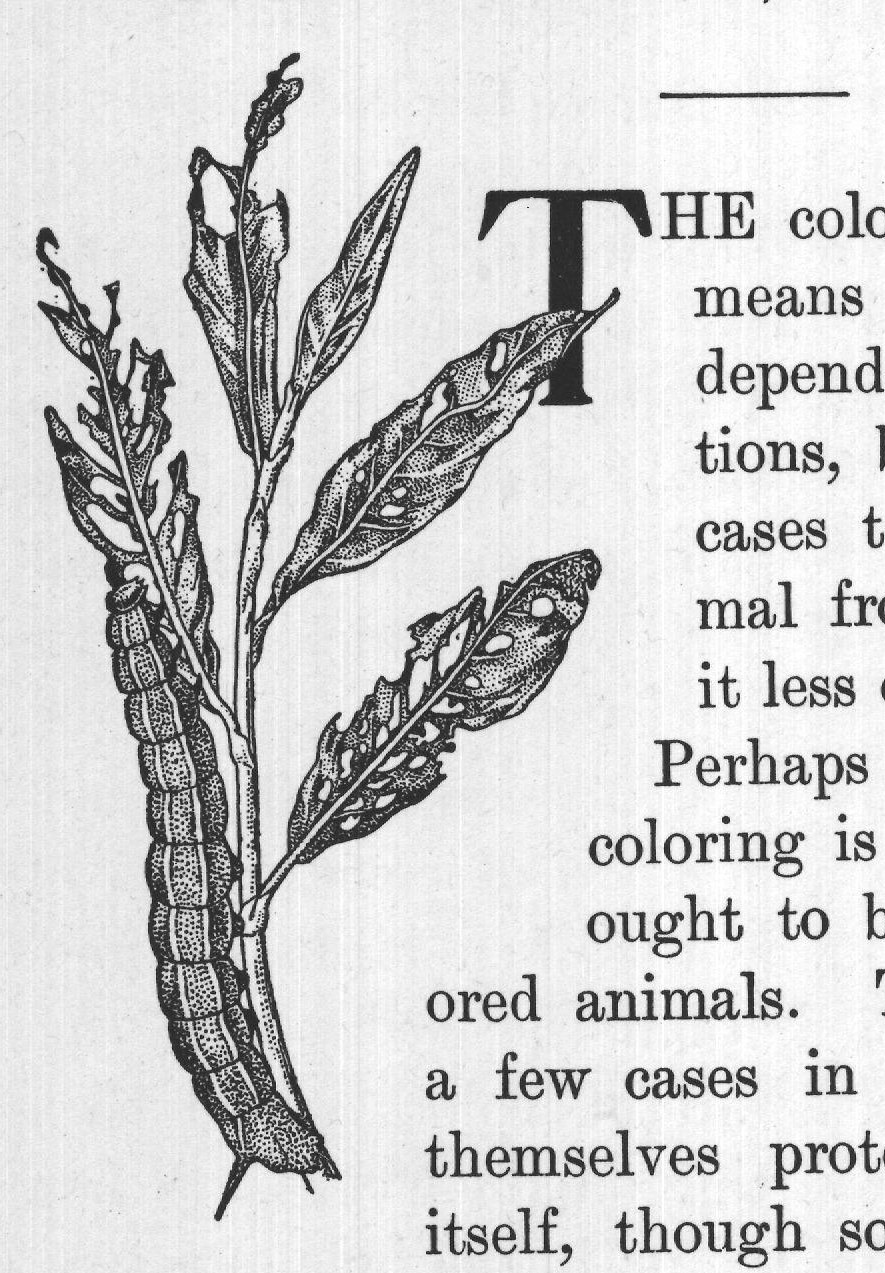
Perhaps it may be said that if coloring is mainly protective, there ought to be but few brightly colored animals. There are, however, not a few cases in which vivid colors are themselves protective. The kingfisher itself, though so brightly colored, is by no means easy to see. The blue harmonizes with the water, and the bird as it darts along the stream looks almost like a flash of sunlight; besides which, protection is not the only consideration. Let us now consider the prevalent colors of animals and see how far they support the rule.
Desert animals are generally the color of the desert. Thus, for instance, the lion, the antelope, and the wild ass are all sand-colored. ass are all sand-colored. "Indeed," says Canon Tristram, "in the desert, where neither trees, brushwood, nor even undulation of the surface afford the slightest protection to its foes, a modification of color which shall be assimilated to that of the surrounding country is absolutely necessary. Hence, without exception, the upper plumage of every bird, whether lark, chat, sylvain, or sand grouse, and also the fur of all the smaller mammals and the skin of all the snakes and lizards, is of one uniform sand color."
It is interesting to note that, while the lion is sandcolored like the desert, the long, upright, yellow stripes of the tiger make it very difficult to see the animal among the long dry grasses of the Indian jungles in which it lives. The leopard, again, and other tree cats are generally marked with spots which resemble gleams of light glancing through the leaves.
The colors of birds are in many cases perhaps connected with the position and mode of construction of their nests. Thus, we know that hen birds are generally less brightly colored than the cocks, and this is partly, perhaps, because bright colors would be a danger to the hens while sitting on their eggs. When the nest is placed underground or in the hole of a tree, etc., we find it no longer to be such an invariable rule that the hen bird is dull-colored; but, on the contrary, she is then often as gaily colored as the male. Such, for instance, is the case with the hen kingfisher, which is one of the brightest of British birds and one of the very few which make their nests underground; the hen woodpecker, which is also gaily colored and builds in hollow trees, forms a second instance.
In the few cases where the hens are as conspicuously colored as the cocks, and yet the nest is open to view, we generally find that the hens are strong, pugnacious birds, and well able to defend themselves. There are even instances, though these are comparatively rare, in which the hens are more brilliantly colored than the cocks; and it is an interesting fact that it is then the cocks, and not the hens, which hatch the eggs.
It therefore seems to be a rule, with very few exceptions, that when both the cocks and hens are of strikingly gay or conspicuous colors, the nest is such as to conceal the sitting bird; while, whenever there is a striking contrast of colors, the nest is open and the sitting bird exposed to view.
Again, most fishes are dark above and pale below.
This points to the same fact, for when one looks down into the dark water, the dark color of their backs renders them the less easy to distinguish; while, to an enemy looking up from below, the pale belly would be less conspicuous against the light of the sky. Those fishes which live deep down in the depths of the ocean present no such contrast between the upper and under surface. Many of the smaller animals which live in the sea are as transparent as glass, and are consequently very difficult to distinguish.
It is sometimes said that if animals were really colored with reference to concealment, sheep would be green, like grass. This, however, is quite a mistake. If they were green they would really be more easy to see. In the gray of the morning and the evening twilight, just the time when wild animals generally feed, gray and stone colors are most difficult to distinguish. Sheep were originally mountain animals, and every one who has ever been on a mountain-side knows how difficult it is to distinguish a sheep, at some distance, from a mass of stone or rock.
It is, again, a great advantage to the rabbit and hare to be colored like earth; black or white rabbits are more easy to see, and consequently more likely to be killed. This, however, does not apply to those which are kept in captivity, and we know that tame rabbits are often black and white. Again, in the far north, where for months together the ground is covered with snow, the white color, which would be a danger here, becomes an advantage; and many Arctic animals, like the polar bear and polar hare, are white, while others, such as the mountain hare and ptarmigan, change their color, being brown in summer and white in winter.
So are the Arctic fox and the ermine, to whom it is then an advantage to be white, not to avoid danger, but in order that they may be the more easily able to steal unperceived upon their prey.
Many of the cases in which certain insects escape danger by their similarity to plants are well known; the leaf insect and the walking-stick insect are familiar and most remarkable cases. The larvæ of insects afford, also, many interesting examples, and in other respects teach us, indeed, many instructive lessons. It would be a great mistake to regard them as merely preparatory stages in the development of the perfect insect. They are much more than this, for external circumstances act on the larvæ, as well as on the perfect insect: both, therefore, are liable to adaptation. In fact, the modifications which insect larvæ undergo may be divided into two kinds - developmental, or those which tend to approximation to the mature form; and adaptational or adaptive, those which tend to suit them to their own mode of life.
It is a remarkable fact, that the forms of larvæ do not depend on those of the mature insect. In many cases, for instance, very similar larvæ produce extremely dissimilar insects. In other cases, similar, or comparatively similar, perfect insects have very dissimilar larvæ. Indeed, a classification of insects founded on larvæ would be quite different from that founded on the perfect insects. The group to which the bees, wasps, and ants belong, for instance, and which, so far as the perfect insects are concerned, form a very natural division, would be divided into two; or rather one portion of them - namely, the saw-flies - would be united to the butterflies and moths.. Now, why do the larvæ of sawflies differ from those of their allies, and resemble those of butterflies and moths? It is because their habits differ from those of ants and bees, and they feed on leaves like ordinary caterpillars.