Home › The Color of Animals › The Color of Animals: Sitaris
The Color of Animals: Sitaris
M. Fabre was in despair. The first ray of light came to him from our countryman Newport, who ascertained that a small parasite found on one of the wild bees was, in fact, the larva of the oil-beetle. The larvæ of Sitaris much resembled this larva. Acting on this hint, M. Fabre examined many specimens of the bee, and found on them at last the larvæ of his Sitaris. The males of the bee emerge from the pupe sooner than the females, and M. Fabre ascertained that, as they come out of their galleries, the little Sitaris larvæ fasten upon them. Not, however, for long: instinct teaches them that they are not yet in the straight path of development; and, watching their opportunity, they pass from the male to the female bee. Guided by these indications, M. Fabre examined several cells of the bee; in some, the egg of the bee floated by itself on the surface of the honey; in others, on the egg, as on a raft, sat the still more minute larva of the Sitaris. The mystery was solved. At the moment when the egg is laid, the Sitaris larva springs upon it. Even while the poor mother is carefully fastening up her cell, her mortal enemy is beginning to devour her offspring; for the egg of the bee serves not only as a raft, but as a repast. The honey, which is enough for either, would be too little for both; and the Sitaris, therefore, at its first meal, relieves itself from its only rival. After eight days the egg is consumed, and on the empty shell the Sitaris undergoes its first transformation, and makes its appearance in a very different form. - The honey, which was fatal before, is now necessary the activity, which before was necessary, is now useless; consequently, with the change of skin, the active, slim larva changes into a white fleshy grub, so organized as to float on the surface of the honey, with the mouth beneath and the breathingholes above the surface; for insects breathe, not as we do through the mouth, but through a row of holes arranged along the side. In this state it remains until the honey is consumed; then the animal contracts, and detaches itself from its skin, within which the further transformations take place. In the next stage the larva has a solid corneous envelope and an oval shape, and, in its color, consistency, and immobility, resembles the chrysalis of a fly. The time passed in this condition varies much. When it has elapsed, the animal moults again, again changes its form; after this, it becomes a pupa, without any re markable peculiarities. Finally, after these wonderful changes and adventures, in the month of August the perfect beetle makes its appearance.
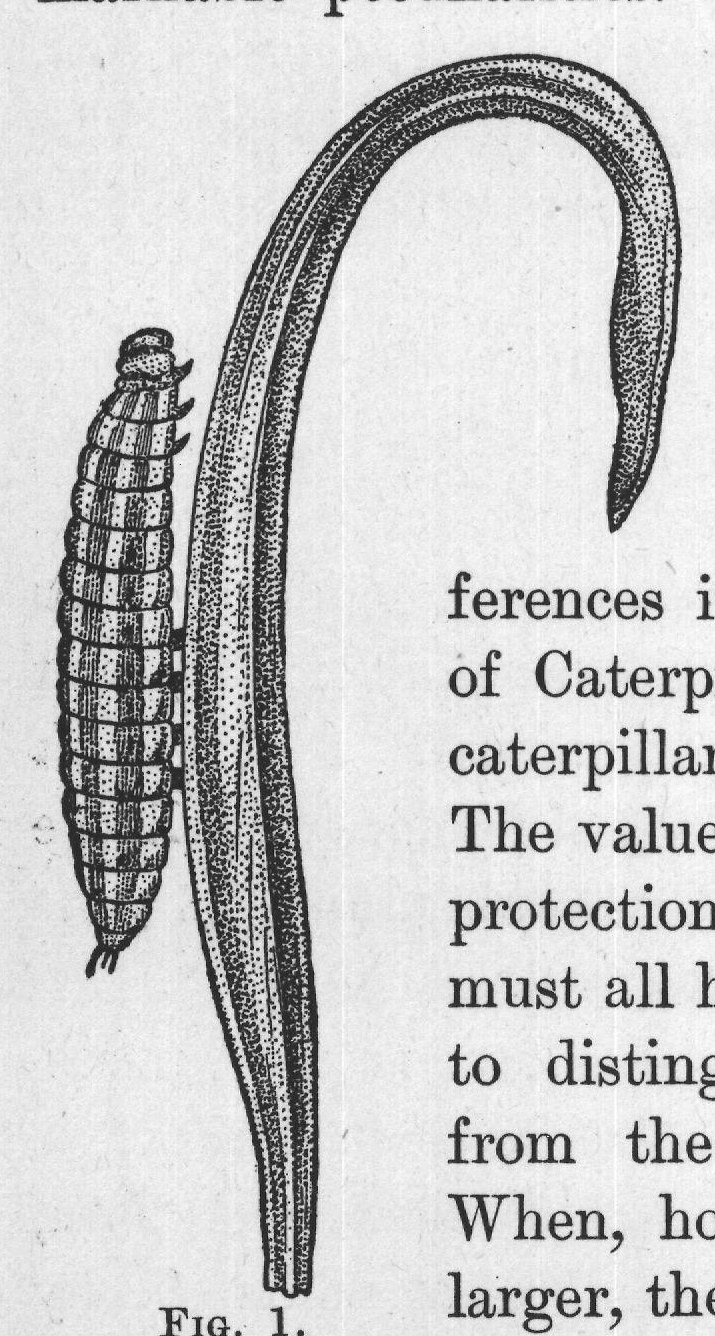
FIG. 1.
In fact, whenever in any group we find differences in form or color, we shall always find them associated with differences in habit. Let us take the case of Caterpillars. The prevailing color of caterpillars is green, like that of leaves.
The value of this to the young insect, the protection it affords, are obvious. We must all have observed how difficult it is to distinguish small green caterpillars from the leaves on which they feed.
When, however, they become somewhat larger, their form betrays them, and it is THE CATERPILLAR important that there should be certain OF THE MAR- marks to divert the eye from the outlines BLED WHITE BUTTERFLY of the body. This is effected, and much (Arge galathea). protection is given, by longitudinal lines (Fig. 1), which accordingly are found on a great many caterpillars. These lines, both in color and thickness, much resemble some of the lines on leaves (those, for instance, of grasses), and also the streaks of shadow which occur among foliage. If this be the explanation of them, then they ought to be wanting, as a general rule, in very small caterpillars, and should prevail most among those which feed on or among grasses.
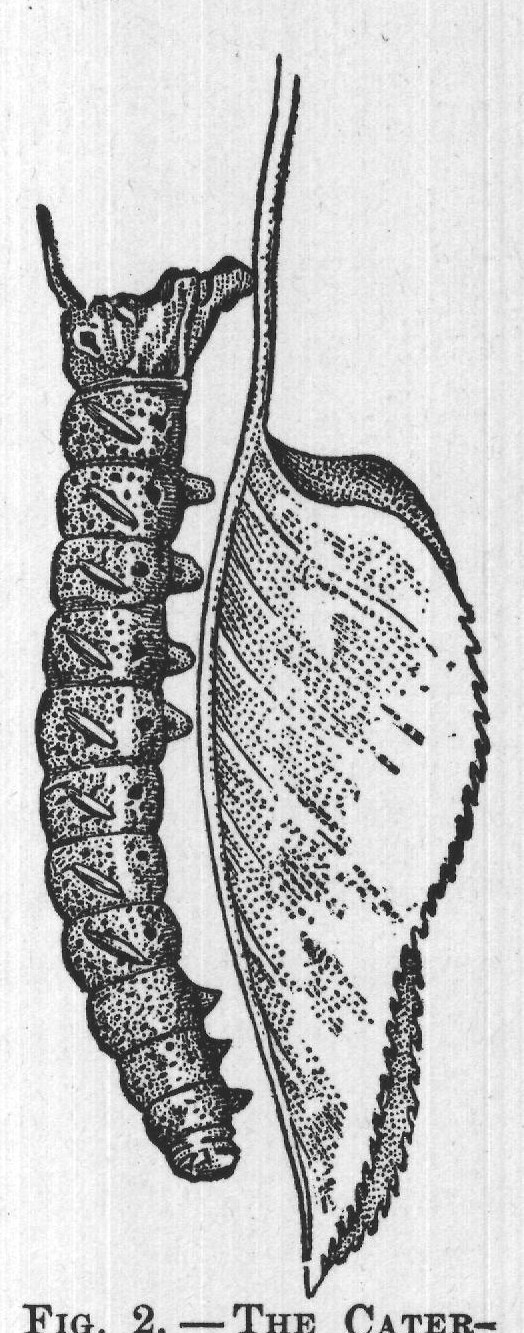
- Now, similar lines occur on a great number of caterpillars belonging to most different groups of butterflies and moths, as you may see by turning over the illustrations of any monograph of the group. They exist among the Hawk-moths - as, for instance, in the Humming-bird Hawk-moth; they occur in many butterflies, especially in those which feed on grass; and in many moths. But you will find that the smallest caterpillars rarely possess these white streaks. As regards the second point, also, the streaks are generally wanting in caterpillars which feed on large-leaved plants. The Satyridæ, on the contrary, all possess them, and all live on grass. In fact we may say, as a general rule, that these longitudinal streaks only occur on caterpillars which live on or among narrow-leaved plants. As the insect grows, these lines often disappear on certain segments, and are replaced by diagonal lines. These diagonal lines (Fig. 2) occur in a great many caterpillars, belonging to the most distinct families of butterflies and moths.
They come off just at the same angle as the ribs of leaves, and resemble them very much in general effect. They occur also especially on species which feed on large-leaved plants; and I believe I may say that though a great many species of caterpillars present these lines, they rarely, if ever, occur in species which live on grass; while, on PILLAR OF THE EYED HAWK-MOTH (Smerinthus ocellatus). the contrary, they are very frequent in those species which live on large-leaved plants.
It might at first be objected to this view that there are many cases, as in the Elephant-Hawk-moth, in which caterpillars have both. A little consideration, however, will explain this. In small caterpillars these oblique lines would be useless, because they must have some relation, not only in color, but in their distance apart, to the ribs of the leaves. Hence, while there are a great many species which have longitudinal lines when young, and diagonal ones when they are older and larger, there is not, I believe, a single one which begins with diagonal lines, and then replaces them with longitudinal ones. with longitudinal ones. The disappearance of the longitudinal lines on those segments which have diagonal ones, is striking, where the lines are marked. It is an advantage, because white lines crossing one another at such an angle have no relation to anything which occurs in plants, and would make the creature more conspicuous. When, therefore, the diagonal lines are developed, the longitudinal ones often disappear. There is one other point in connection with these diagonal lines to which I must call your attention.
In many species they are white, but in some cases - as, for instance, in the beautiful green caterpillar of the Privet-Hawk-moth - the white streak is accompanied by a colored one, in that case lilac. At first we might think that this would be a disadvantage, as tending to make the caterpillar more conspicuous; and in fact, if we put one in full view - for instance, out on a table- and focus the eye on it, the colored lines are very striking. But we must remember that the habit of the insect is to sit on the lower side of the leaf, generally near the middle rib, and in the subdued light of such a situation, especially if the eye be not looking exactly at them, the colored lines beautifully simulate a line of soft shadow, such as must always accompany a strong rib; and I need not tell any artist that the shadows of yellowish-green must be purplish. Moreover, any one who has ever found one of these large caterpillars will, I am sure, agree with me that it is surprising, when we consider their size and conspicuous coloring, how difficult it is to see them. But though the prevailing color of caterpillars is green, there are numerous exceptions. In one great family of moths the prevailing color is brown. These caterpillars, however, escape observation by their great similarity to brown twigs - a resemblance which is heightened by their peculiar attitudes, and in many cases by the existence of warts or protuberances, which look like buds. Some, however, even of these caterpillars, when very young, are green. Again, some caterpillars are white. These feed on and burrow in wood. The Ringlet Butterfly also has whitish caterpillars, and this may at first sight appear to contradict the rule, since it feeds on grass. Its habit is, however, to keep at the roots by day, and feed only at night.
In various genera we find Black caterpillars, which are of course very conspicuous, and, so far as I know, not distasteful to birds. In such cases, however, it will be found that they are covered with hairs or spines, which protect them from most birds. In these species the bold dark color may be an advantage, by rendering the hair more conspicuous. Many caterpillars are black and hairy, but I do not know any large caterpillar which is black and smooth. Brown caterpillars, also, are frequently protected by hairs or spines in the same way; but, unlike black ones, they are frequently naked. These fall into two principal categories: firstly, those which, like the Geometridæ, put themselves into peculiar and stiff attitudes, so that in form, color, and position they closely resemble bits of dry stick; and, secondly, those which feed on low plants, concealing themselves on the ground by day, and only coming out in the dark.
Yellow and yellowish-green caterpillars are abundant, and their color is a protection. Red and blue, on the contrary, are much less common colors, and are generally present as spots.
Moreover, caterpillars with red lines or spots are generally hairy, and this for the reason given above. Such species, therefore, would be avoided by birds.
There are, no doubt, some apparent exceptions. The Swallow-tail Butterfly, for instance, has red spots and still is smooth; but as it emits a strongly-scented liquid when alarmed, it is probably distasteful to birds. I cannot recall any other case of a British caterpillar which has conspicuous red spots or lines, and yet is smooth.