Home › The Dartmoor Ponies › The Dartmoor Ponies: Utah
The Dartmoor Ponies: Utah
Come back with me to a time so remote that we cannot measure it even by hundred of thousands of years, and let us visit the territories of Utah and Wyoming. Those highlands were very different then from what they are now. Just risen out of the seas of the Cretaceous Period, they were then clothed with dense forests of palms, tree-ferns, and screw-pines, magnolias and laurels, interspersed with wide-spreading lakes, on the margins of which strange and curious animals fed and flourished. There were large beasts with teeth like the tapir and the bear, and feet like the elephant; and others far more dangerous, half bear, half hyæna, prowling around to attack the clumsy paleotherium or the anoplotherium, something between a rhinoceros and a horse, which grazed by the waterside, while graceful antelopes fed on the rich grass. And among these were some little animals no bigger than foxes, with four toes and a splint for the fifth, on their front feet, and three toes on the hind ones.
These clumsy little animals, whose bones have been found in the rocks of Utah and Wyoming, have been called Eohippus, or horses of the dawn, by naturalists. They were animals with real toes, yet their bones and teeth show that they belonged to the horse tribe, and already the fifth toe common to most other toed animals was beginning to disappear. This was in the Eocene Period, and before it passed away with its screw-pines and tree-ferns, another rather larger animal, called the Orohippus, had taken the place of the small one, and he had only four toes on his front feet. The splint had disappeared, and as time went on still other animals followed, always with fewer toes, while they gained slender fleet legs, together with an increase in size and in gracefulness. First one as large as a sheep (Mesohippus) had only three toes and a splint. Then the splint again disappeared, and one large and two dwindling toes only remained, till finally these two became mere splints, leaving one large toe or hoof with almost imperceptible splints, which may be seen on the fetlock of a horse's skeleton.
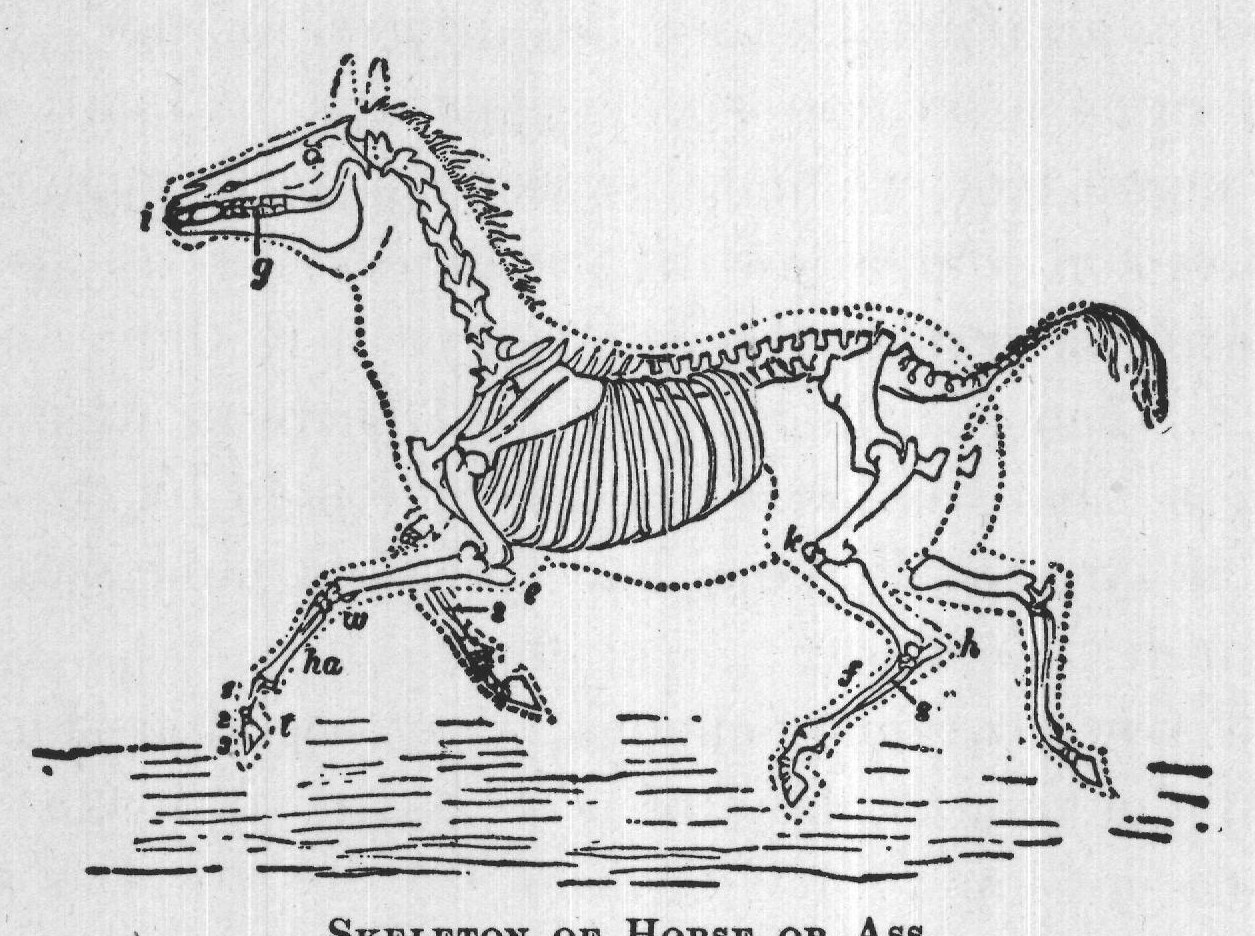
You must notice that a horse's foot really begins at the point which we call his knee in the front legs, and at his hock in his hind legs. His true knee and elbow are close up to the body. What we call his foot or hoof is really the end of the strong, broad, middle toe ha 9 s SKELETON OF HORSE OR ASS. i, Incisor teeth. g, Grinding teeth, with the gap between the two as in all grass-feeders. k, Knee. h, Hock or heel. f, Foot. s, Splints or remains of the two lost toes. e, Elbow. w, Wrist. h, Hand-bone. t, Middle toe of three joints, 1, 2, 3 forming the hoof. covered with a hoof, and farther up his foot we can feel two small splints, which are remains of two other toes.
Meanwhile during these long succeeding ages while the foot was lengthening out into a slender limb the animals became larger, more powerful, and more swift, the neck and head became longer and more graceful, the brain-case larger in front and the teeth decreased in number, so that there is now a large gap between the biting teeth and the grinding teeth of a horse. Their slender limbs too became more flexible and fit for running and galloping, till we find the whole skeleton the same in shape, though not in size, as in our own horses and asses now.