Home › Volumes › Butterflies › Milkweed Butterflies
Queen
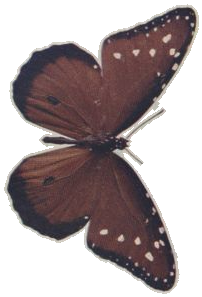
This butterfly is smaller than the Monarch, and the ground-color of the wings is a livid brown. The markings are some what similar to those in A. plexippus, but the black borders of the hind wings are relatively wider, and the light spots on the apex of the fore wings are whiter and differently located, as may be learned from the figures given in Plate VII.
There is a variety of this species, which has been called Anosia strigosa by H. W. Bates (Plate VII, Fig. 3, male), which differs only in that on the upper surface of the hind wings the veins as far as the black outer margin are narrowly edged with grayish-white, giving them a streaked appearance. This insect is found in Texas, Arizona, and southern New Mexico.
All of the Euploeinae are "protected" insects, being by nature provided with secretions which are distasteful to birds and predaceous insects. These acrid secretions are probably due to the character of the plants upon which the caterpillars feed, for many of them eat plants which are more or less rank, and some of them even poisonous to the higher orders of animals. Enjoying on this account immunity from attack, they have all, in the process of time, been mimicked by species in other genera which have not the same immunity. from attack, they have all, in the process of time, been mimicked by species in other genera which have not the same immunity. This protective resemblance is well illustrated in Plate VII. The three upper figures in the plate represent, as we have seen species of the genus Anosia; the two lower figures represent two species of the genus Basilarchia. Fig. 4 is the male of B. disippus, a very common species in the northern United States, which mimicks the Monarch. Fig. 5 represents the same sex of B. bulstii, a species which is found in Arizona, and there flies in company with the Queen, and its variety, A strigosa, which latter it more nearly resembles.