Home › Volumes › Butterflies › Milkweed Butterflies
Monarch
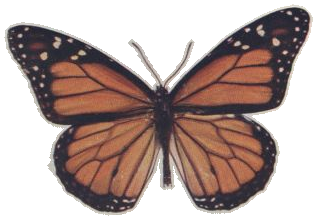
Butterfly.--The upper surface of the wings of this butterfly is bright reddish, with the borders and veins broadly black, with two rows of white spots on the outer borders and two rows of pale spots of moderately large size across the apex of the fore wings. The males have the wings less broadly bordered with black than the females, and on the first median nervule of the hind wings there is a black scent-pouch.
Egg.--The egg is ovate conical, and is well represented in Fig. 4 in the introductory chapter of this book.
Caterpillar.--The caterpillar is bright yellow or greenish-yellow, banded with shining black, and furnished with black fleshy thread-like appendages before and behind. It likewise is well delineated in Fig. 16, as well as in Plate III, Fig. 5.
Chrysalis.--The chrysalis is about an inch in length, pale green, spotted with gold.
The butterfly is believed to be polygoneutic, that is to say, many broods are produced annually; and it is believed by writers that with the advent of cold weather these butterflies migrate to the South, the chrysalids and caterpillars which may be undeveloped at the time of the frosts are destroyed, and that when these insects reappear, as they do every summer, they represent a wave of migration coming northward from the warmer regions of the Gulf States. It is not believed that any of them hibernate in any stage of their existence. This insect sometimes appears in great swarms on the eastern and southern coasts of New Jersey in late autumn. The swarms pressing southward are arrested by the ocean. The writer has seen stunted trees on the New Jersey coast in the middle of October, when the foliage has already fallen, so completely covered with clinging masses of these butterflies as to present the appearance of trees in full leaf (Fig. 79).
This butterfly is a great migrant, and within quite recent years, with Yankee instinct, has crossed the Pacific, probably on merchant vessels, the chrysalids being possibly concealed in bales of hay, and has found lodgment in Australia, where it has greatly multiplied in the warmer parts of the Island Continent, and has thence spread northward and westward, until in its migrations it has reached Java and Sumatra, and long ago took possession of the Philippines. Moving eastward on the lines of travel, it has established a more or less precarious foothold for itself in southern England, as many as two or three dozen of these butterflies having been taken in a single year in the United Kingdom. It is well established at the Cape Verde Islands, and in a short time we may expect to hear of it as having taken possession of the continent of Africa, in which the family of plants upon which the caterpillars feed is well represented.