Home › Volumes › Butterflies › Long-wings
Californian Long-wing
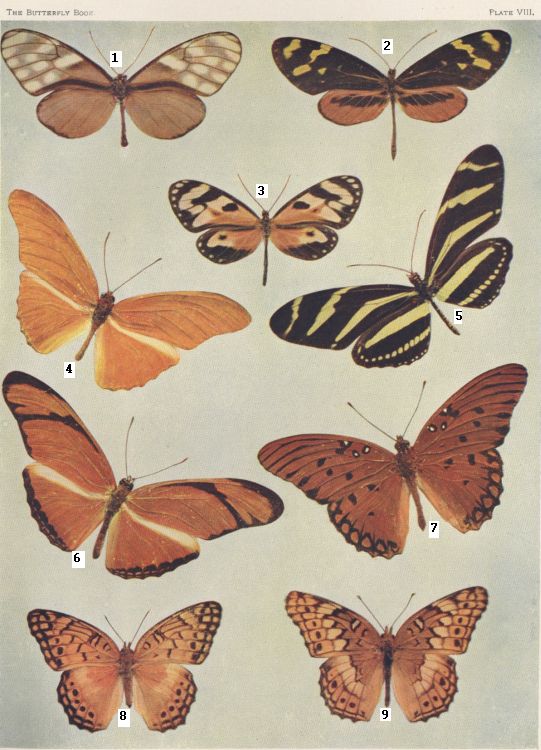
The original description given by Reakirt in the "Proceedings of the Entomological Society of Philadelphia, " vol. v,p. 223, is as follows:
"Expanse,2.45-2.56 inches. Fore wing above, brownish-black; a basal streak over the median nervure, and two rounded spots near the inner angle, orange-tawny; of these the outer is the largest, sometimes the inner is yellow, and sometimes both are nearly obsolete; a spot across the cell near its termination, much narrower than in M. isthmia, and in one example reduced to a mere dot on the median nervure; a more or less interrupted belt across the wing from the costa to near the middle of the outer margin, and an oblong subapical spot, yellow; in the specimen just mentioned there is an additional yellow spot below the medio-central veinlet.
"Beneath the same, suffused with orange-tawny at the base and the inner angle, with a row of eight or nine submarginal white spots along the outer margin.
"Hind wing above, orange-tawny, with a broad mesial band, entire, and a narrow outer border, from the middle of the costa to the anal angle, brownish-black.
"Beneath the same, a yellow spot on the root of the wing; a band runs along the subcostal nervure from the base to the margin, where it is somewhat dilated; immediately below its termination, a mark in the form of an irregular figure 2, usually with the upper part inordinately enlarged; between this and the base, on the central line of the band above, three small subtriangular spots; all these marking blackish-brown; a submarginal row of seven white spots on the outer margin.
"Body brownish; wing-lappets and thorax spotted with tawny-orange; antennae yellowish, with the base dusky.
"Hab.--Los Angeles, California."
The species is probably only a local race of the insect known to naturalists as M. polymnia, Linnaeus, as Reakirt himself admits. The figure in the plate is from one of Reakirt's paratypes.