Home › The Nymphs › The Gray Emperor (Chlorippe celtis Chlo-rip'pe)
The Gray Emperor (Chlorippe celtis Chlo-rip'pe)
Chlorippe celtis (Chlo-rip'pe cel'tis) PLATE XXIX, FIG. 1, 3 In this and the following species the apex of the front wings and the anal angle of the hind wings are considerably produced in the males, but more rounded in the females. The club of the antennæ is quite broad and distinct. In this species the wings are russety brown marked with blackish brown. There is a submarginal row of six eyelike spots on the hind wings and one in cell Cu, of the fore wings. In the fore wings there are also two brown spots and a bar in cell R + M. The front wings are also crossed by two irregular rows of white spots. Expanse of wings about two inches. CATERPILLAR.-Length one and one-fourth inches. The green face has four paler green stripes on it; there are spines at the side and two long forked tubercles on the top of the head. The body is naked, yellowish green above and bluish green at the sides.
Food-plant. Hackberry.
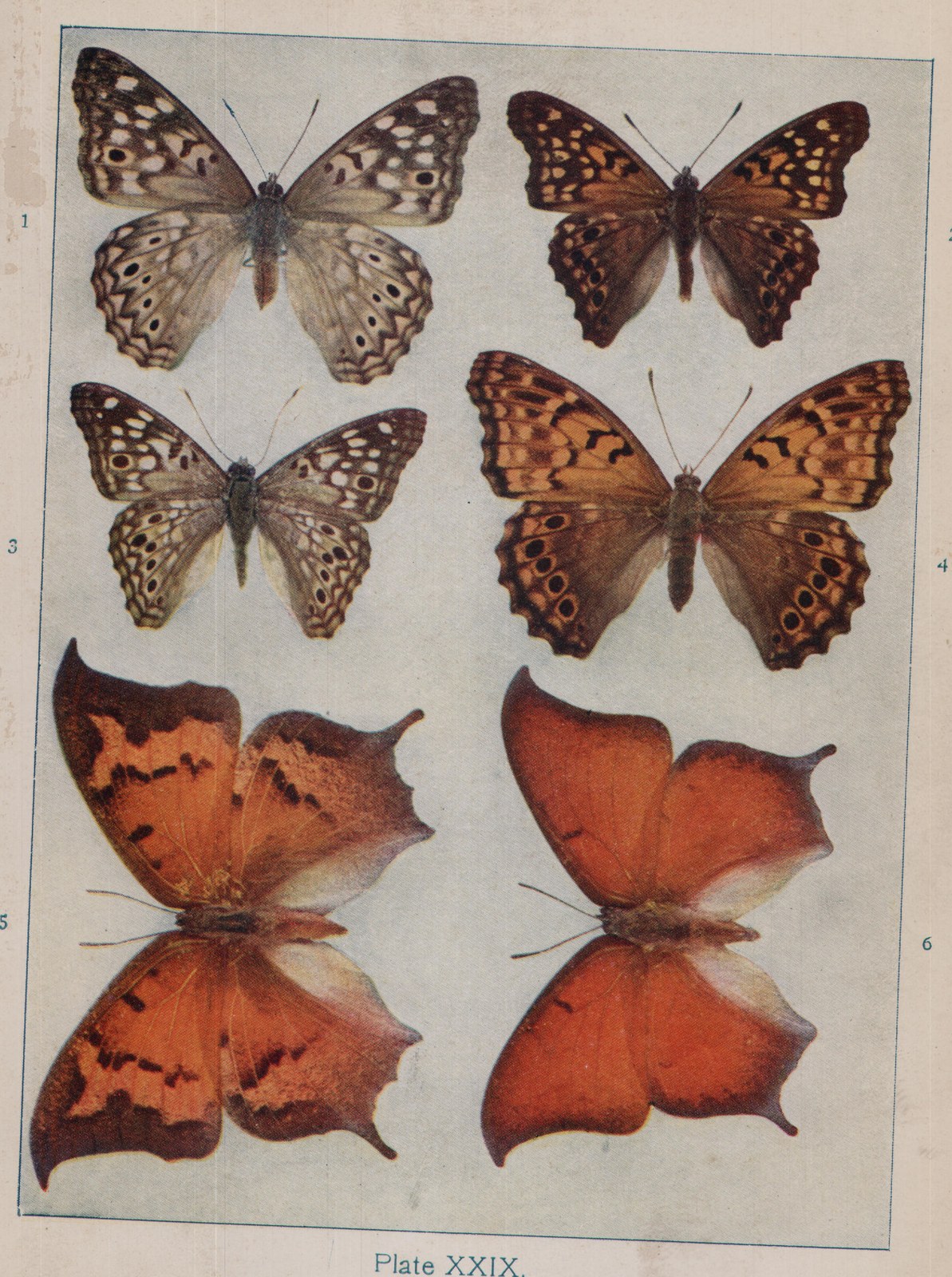
The gray emperor resembles the tawny emperor quite closely, except that it is smaller and 5 3 Plate XXIX. 0000 6 4 duller in color and more slender and graceful in shape. It is a long-lived butterfly and may be found during the entire season. The caterpillar is similar in habit to that of the goatweed emperor. It lines the upper surface of the leaf with silk, causing it to roll up, making a more or less secure nest.
The gray emperor is partially double-brooded.
Some of the caterpillars of the first brood finish their growth in a great hurry and change to adults, while others of the same brood dawdle along and hibernate. The species extends from southern Pennsylvania, Ohio, and Illinois southward. Lastly his shinie wings as silver bright, Painted with thousand colors passing farre All painters' skill, he did about him dight:
Not halfe so manie sundrie colours arre In iris bowe; ne heaven doth shine so bright, Distinguished with manie a twinckling starre ; Nor Junoes bird, in her ey-spotted traine, So many goodly colours doth containe.
SPENSER.