Home › The Nymphs › The Violet-Tip (Polygonia interrogationis)
The Violet-Tip (Polygonia interrogationis)
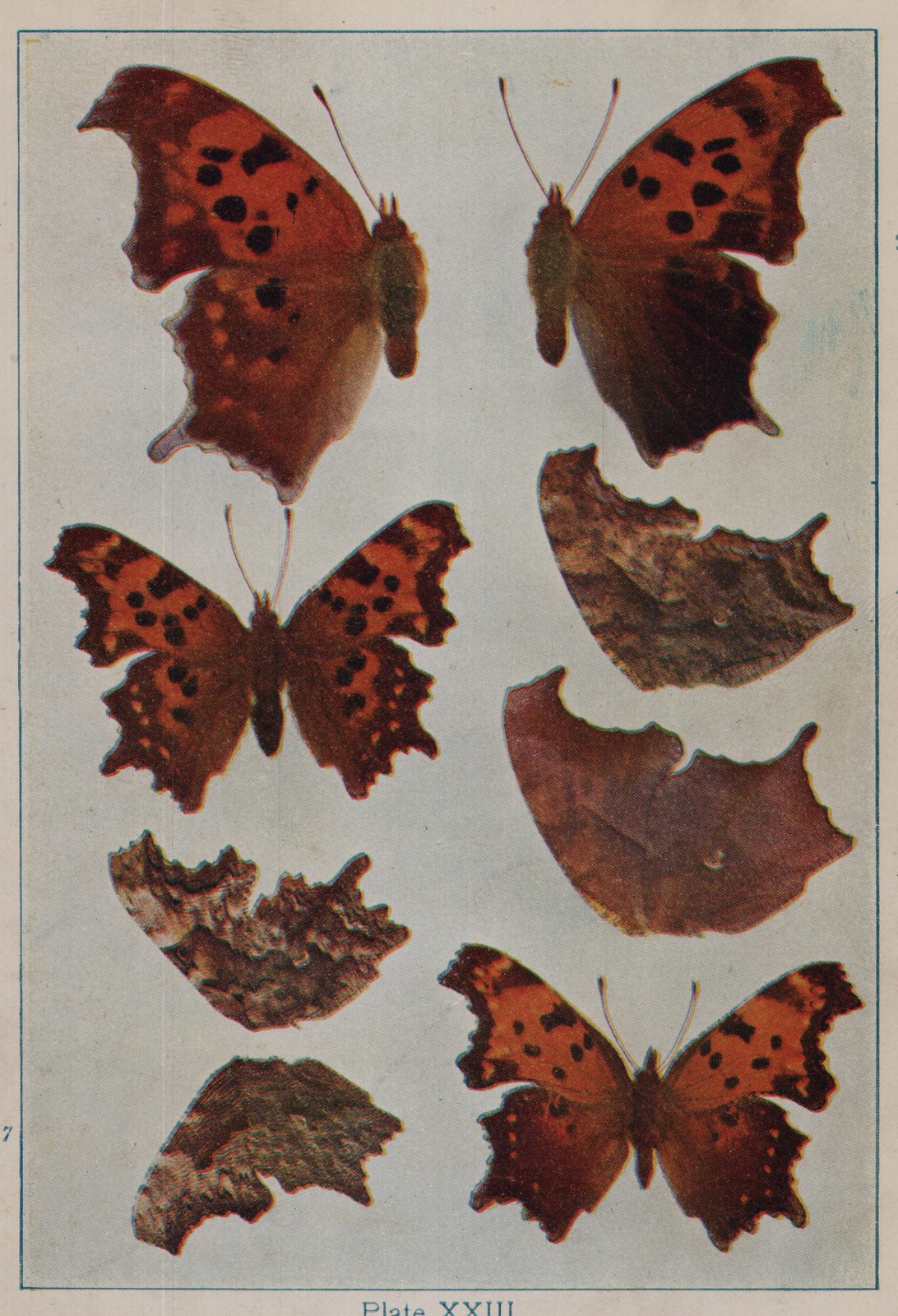
Polygonia interrogationis (Pol-y-go'ni-a in-ter-ro-ga-ti-o'nis) PLATE XXIII, FIG. 1, 2, 4, 6 2 This species differs from its allies found in the East by the presence of a black spot on the upper surface near the base of cell M, of the front wings, a short distance from the black bar on the discal vein, and opposite the spot in cell M.; and in the form of the silvery mark on the lower surface of the hind wings, which consists of a dot and crescent, resembling 3 3 5 7 Plate XXIII. 4 6 8 somewhat an interrogation-mark, but more nearly a semicolon. On the upper side the outer margins of the wings and the tails of the hind wings are tinged with violet. Expanse two and one-half to three inches.
This species is dimorphic; and the two forms differ so constantly and in such a marked manner that they were described as distinct species. In P. interrogationis interrogationis the upper surface of the hind wings is not much darker than that of the fore wings, and there is a submarginal row of fulvous spots in the broad ferruginous brown border; this variety is commonly known as fabricii. In P. interrogationis umbrosa (P. i. um-bro'sa) the outer two-thirds of the upper surface of the hind wings is blackish, and the submarginal fulvous spots are obliterated, except sometimes faint traces near the costal margin. Many other differences are pointed out by Scudder. The relation of these two forms to each other was thoroughly investigated by Edwards. The dimorphism is seasonal, but not strictly so. All of the wintering butterflies are fabricii; and from their eggs are produced chiefly umbrosa; but fabricii occurs in the summer broods. CATERPILLAR. -About one and one-half inches long. Reddish-brown in color with lighter markings of irregular dots and patches. It has many branching spines, a pair of them being on the top of the head.
Food-plants. Elm, hop, hackberry, nettle, false nettle, and linden.
It would seem at first glance that certain butterflies come to us labeled with a recognition mark on the hind wings, so that we shall have no trouble about identifying the species. The violettip thus wears a semicolon, wrought in silver and very striking. But Fabricius evidently never stopped to "count two" when he saw this, as he should have done had he been versed in the proper way of regarding pauses, but at once named the species interrogationis, to the utter confusion of beginners in butterfly study, who try in vain to make an interrogation-mark out of this very plain semicolon. The popular name of this butterfly is much more apropos, for it is not only violet-tipped but violet-edged. The border on its wings of rich velvety maroon shading off at the edge into lavender fills the lover of color with a sense of luxurious content. The exquisite shadings of brown on the under side of the wings have a purplish tint that is almost an iridescence.
The violet-tip is the largest of the polygon butterflies and is the most graceful in shape of all the butterfly family. As it passes the winter in the winged stage it finds its first food in spring in the sap of trees, and it undoubtedly rejoices in the industry of sugar-making, which induces man to kindly tap trees for its especial benefit. It frequents open places within or near woodlands. In the fall it is more neighborly, and may often be found about our orchards taking its share of the ripe fruit.
The caterpillar is well disposed toward its fellows, though not gregarious; if you find one feeding on a leaf you are likely to find others in the neighborhood. It has a comical way of resting after eating its fill; it lifts its head and disdainfully turns it away, as if to say, "Please excuse me from any more of that." The chrysalis is suspended near the feeding-place and looks like a bit of dried and broken leaf. It is said that Fabricius thought this chrysalis looked like an interrogation-mark and so gave the name; this seems rather far-fetched considering the punctuation plainly to be seen on the wings. The butterfly is interesting in that it has two forms, a summer form which has the upper sides of the hind wings nearly black except at base, and the markings almost obscured thereby. This form is called umbrosa. The winter form is called fabricii. They were regarded as two distinct species until they were bred. This species is found in Canada and throughout the United States east of the Rocky Mountains.
There are two broods in the North and three or four in the South. The butterflies hibernate.
Zigzag butterflies many a pair Doubled and danced in sunny air.