Home › The Nymphs › The Hop-Merchant (Polygonia comma Pol-y-go'ni-a)
The Hop-Merchant (Polygonia comma Pol-y-go'ni-a)
Polygonia comma (Pol-y-go'ni-a com'ma) PLATE XXIV, FIG. I, 2, 4, 6 As in the preceding species, the silvery mark of the hind wings is in the form of a Cora G; but the general color of the lower surface of the hind wings is very different, being marbled with light and dark brown; and the green spots so characteristic of faunus are represented here by a few liliaceous scales on a submarginal row of black spots. Expanse two inches or more.
Two forms of this species occur. In one, P. comma dryas, the hind wings above are suffused with black on the outer half, so that the submarginal row of fulvous spots is obscured, and on the lower side the wings are more yellowish than in the other form. The latter is the typical form, P. comma comma. This form has been known under the name harrisii. This species resembles the violet-tip in appearance and in its dimorphism; but it is a smaller butterfly, and it lacks the spot in cell M, of the fore wings. It also differs in the form of the silver mark on the lower side of the hind wings. CATERPILLAR.-Length one inch; color varying from dark brown to greenish or nearly white; it is marked with blotches and transverse lines and is most variable as to color and markmeans so easily observed when the butterfly is flitting about in the open. In western New York, on a hill from whose crest a glimpse of Canada is possible on a clear day, we once saw a comma darting about a mass of ferns at the side of a road threading a dense beech woods. We were very sure that we detected on this butterfly the olivegreen color of the green comma. Breathlessly we waited for the nervous creature to alight, which it did on some not very attractive refuse in the road. Yes, it was surely green! A professorial hat was brought into use as an instrument for capture. Stealthily the approach was made, but at the last moment the butterfly, eluding the headgear, made a wild flight far above the professorial head and we saw it no more. There is something strange about the madness which possesses one hunting for species. What difference did it make to us what that butterfly was or was not? None at all! And yet the butterfly hunter will understand that ever afterward when we passed that spot we always grew pensive and murmured, "Was it really a green comma?"
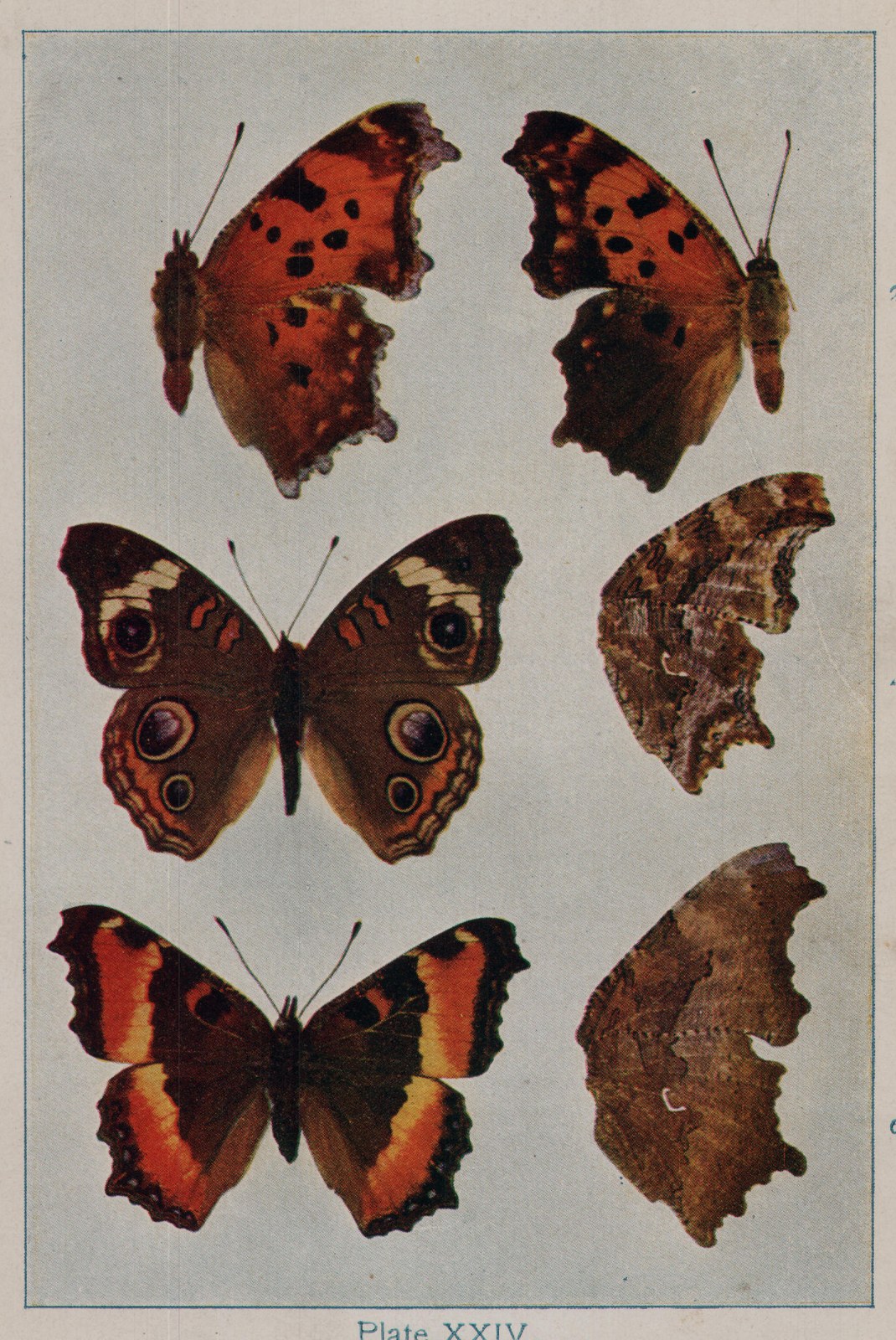
The caterpillar of this species is caparisoned in a white saddle-cloth and looks quite different from other caterpillars of the genus. The green comma is a Northern species, not occurring south 3 5 Plate XXIV. 4 4 6 ings. It is armed with thorny spines, and has one pair on its head.
Food-plants. Nettle, hop, elm, etc.
At first glance we might take this butterfly to be a dwarf violet-tip. The shape of the wings is similar to that of the violet-tip, and with sufficient imagination one can see the violet margins on them. But the punctuation on the under side of the hind wing is quite different. In this species it is not an inverted semicolon, but looks more like an erratic G, the lower portion of it wandering off at an angle. If we hold the butterfly head toward us we can perhaps make of this mark a more or less distorted comma.
The hop-merchant hibernates as a butterfly, and is one of those which we find dashing about the woods during the first warm days in March.
Its flight is a miracle of erratic swiftness. It has much curiosity and a disposition to meddle, evincing the same by dashing at anything it happens to see moving; and it is always more than willing to join in any fray. It starts up like magic from the path in front of us, the gleam of its red wings making it seem like a bit of chain-lightning as it zigzags upward over our heads, when we lose sight of it altogether; but after we pass, if we take note, we will see that it has alighted again on the selfsame spot where we first found it.
It is not visible unless its wings are open. The mottled browns on the under side of the wings and their angular outline afford one of the prettiest studies in protective coloring which we know. The hop-merchant likes paths through the woods and damp places.
A pretty superstition about the chrysalis gives the species its common name. Along the back of the angular chrysalid are rows of tubercles with bases which shine like metal. If they shine golden then the price of hops will be high; but if they shine like silver then the price will be low.
The caterpillar sometimes harvests the hops for the farmer; but usually it does not occur in sufficient numbers to do damage. For the way the eggs are laid in columns and the action of the young caterpillar when descending, see Mr. Scudder's account in that most delightful of books, Everyday Butterflies. The caterpillar about the time of its third molt cuts the central veins of the leaf near the midrib most cunningly, and thus is able to draw the edges of the leaf together, making for itself a safe house for protection while eating. The chrysalis is like a bit of dead and broken scrolled leaf, and is as perfectly protected by shape and color as is the butterfly. The species is double-brooded in the North, and at least three-brooded in the South. It is a Northeastern species, extending south to North Carolina and Tennessee. Fluttering like some vain painted butterfly From glade to glade along the forest path.
ARNOLD.