Home › General Account of Butterflies › IV. the Metamorphoses of Butterflies
IV. the Metamorphoses of Butterflies
A butterfly in the course of its existence appears under four distinct forms; these are the egg, the larva or caterpillar, the pupa or chrysalis, and the adult.
The eggs are small, and consequently are rarely seen except by those who observe very closely. They are attached by the parent butterfly to the particular kind of plant upon which the larva feeds.
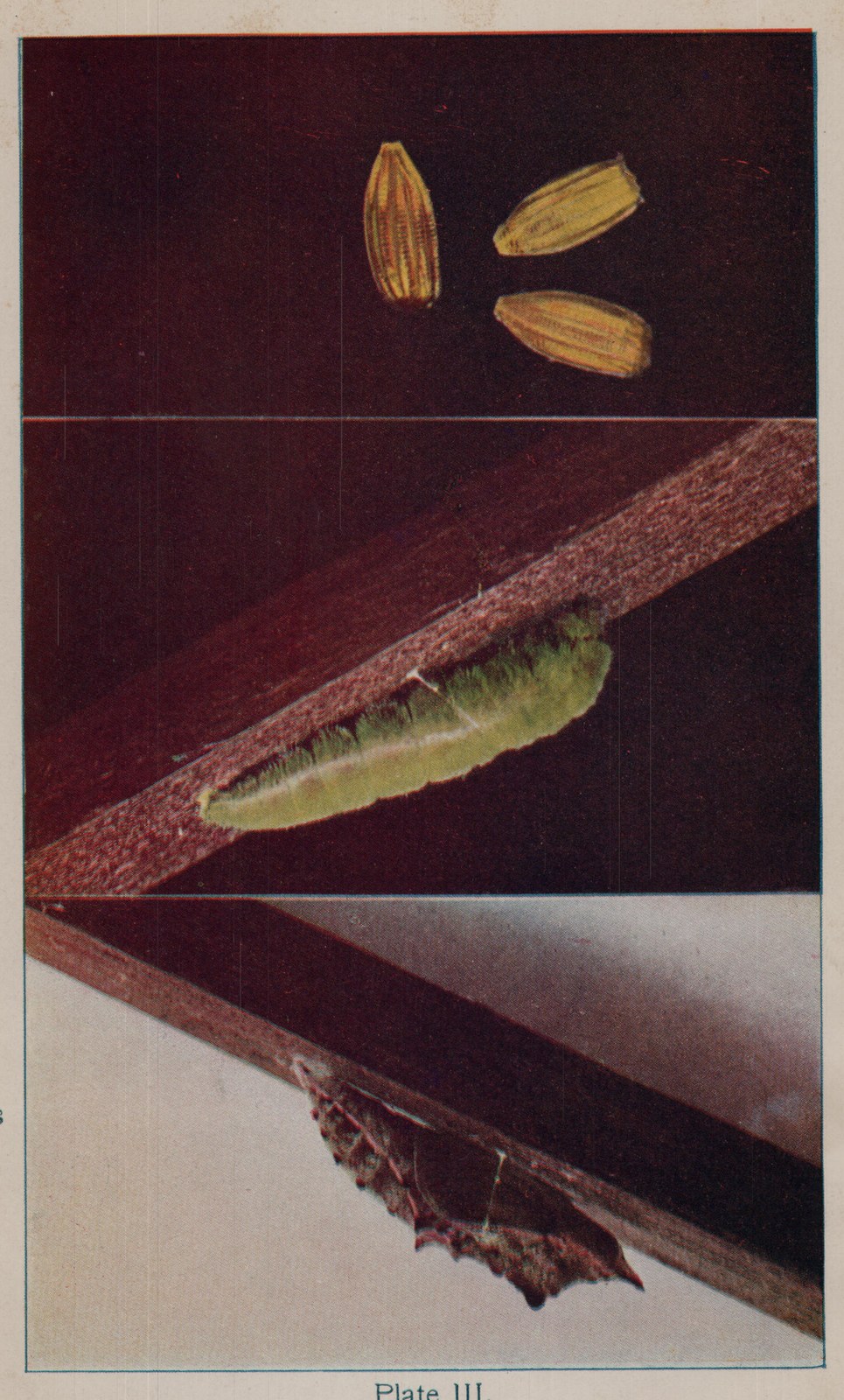
The eggs may have smooth oval shells; but often the shells are beautifully ribbed and pitted (Plate III, Fig. 1; Plate XXV, Fig. 1); sometimes they are ornamented with spines, and frequently they are exquisitely colored. When the young butterfly emerges from the egg it is what is known as a larva. This is a general term applied to the corresponding stage of all insects that appear under four distinct forms in the course of their development. Usually the larvæ of butterflies and moths are called caterpillars; both terms are used in the following pages.
Caterpillars vary greatly in appearance; but they are long, more or less wormlike in form.
This fact has suggested the common names of many species; thus the cabbage-worm and the tomato-worm are caterpillars; the former is the larva of a butterfly, the latter develops into a moth.
There is no characteristic by which we can distinguish the larvæ of butterflies from those of moths; but with a little experience the student can learn to recognize the larvæ of our larger and more common butterflies.
In the caterpillar state the division of the body into three regions is not so well marked as it is with the adult butterfly. The head is always distinct; following the head there are thirteen comparatively similar segments, which constitute the thorax and the abdomen. The first three segments following the head form the thorax of the adult insect; each of these segments bears a pair of legs, which develop into the legs of the adult.
The remaining ten segments constitute the abdomen. On the lower side of the abdomen there are five pairs of fleshy appendages, which are known as the prolegs; these are borne by the third to the sixth and the last abdominal segments. Each proleg is armed at the tip with a series of hooks by which it clings to the object upon which the caterpillar is walking, When a caterpillar changes to a chrysalis the prolegs are lost, being shed with the last larval skin.
The larvæ of butterflies differ greatly in respect to the clothing of the body; some are apparently naked, the few hairs with which the body is clothed being inconspicuous (see Plate XI, Fig. 2); with others the hairs are more numerous and larger (Plate IV, Fig. 1); and still others are clothed with large spines (Plate XXV, Fig. 2).
All insects in the course of their development shed their skin at regular intervals. This process is termed molting, and the cast skin is referred to as the exuvia (ex-u'vi-æ).
Before an insect molts a new skin is formed beneath the old one; then the old skin bursts open, and the insect crawls forth, clothed in a soft skin, which stretches, if necessary, to accommodate the increased size of the insect. Very soon, however, this new skin becomes hard. Caterpillars molt four or five times during their larval life; some other insects molt many more times.
When a caterpillar is full-grown it makes preparation for the quiet period that is to follow.
The larvæ of some moths go into the ground and form a cell within which the pupa state is passed; the larvæ of others spin a dense silken case about the body which is known as the cocoon; some of these cocoons are familiar objects. The larvæ of skippers, which are commonly classed with butterflies (see Part III), spin a cocoon; but almost no true butterflies do so.
A few butterflies undergo their transformations in a crevice or cell upon or in the ground; but nearly all species fasten themselves to some object and hang suspended during the pupa stage.
There are two distinct methods of suspension; in one, the chrysalis hangs suspended by the tail alone (Plate I, Fig. 3), in the other, the tail is fastened in a similar manner, but there is also a girth about the middle of the body (Plate III, Fig. 3).
When a caterpillar is full-grown it stops eating and seeks a convenient place in which to transform. It then spins, upon the object to which it is to fasten itself, a button of silk, into which it fastens the prolegs at the hind end of the body. Plate II, Figure 1, represents a caterpillar which has done this and is ready to transform; and Plate III, Figure 2, represents another caterpillar which has suspended itself by a button at the tail and a girth about the middle of the body.
After suspending itself, the caterpillar rests for a time; then its skin splits open in the middle of the back, and the head end of the body is worked out through this opening. Plate II, Figure 2, represents one which was photographed just as it reached this stage in the transformation. As the shed skin dries it shrinks back toward the tail, where it is attached to the button of silk. Before the body is entirely freed from the skin, the tail of the chrysalis, which is armed with hooks, is withdrawn from it and firmly fastened to the button of silk. 2 3 Plate III.
L The duration of the chrysalis state varies greatly; in the summer time in many cases it is only a few days; on the other hand, it may be several months, as is the case with those that pass the winter in this state.
When the butterfly emerges from the chrysalis skin, the wings are at first small and limp. The butterfly hangs for a time by the legs; the wings expand rapidly, and soon become stiff and fitted for flight. On Plate I, Figure 4, and Plate XXV, Figure 3, are represented recently emerged butterflies which were waiting for their wings to dry.
V. THE STUDY OF THE LIFE OF BUTTERFLIES If one would know the butterflies he must study their lives, and their relations to each other. We do not feel that we are acquainted with a man when we merely know his name; and our acquaintance with a butterfly is only begun when we have determined its species. The learning of the names of species should be regarded as merely a means, not the end of our studies. It is neces sary to learn by what name an insect is known in order to find out what has been published regarding it; but having learned the name we should not stop there. The name is merely the kev that will let us into the storehouses of knowledge accumulated by our predecessors. The determining of the name of a butterfly may teach us much about the insect if it be done in the better way; for there are two ways in which the names of the species described here can be determined. The student may learn the name by comparing a specimen with the pictures.
This is probably the way in which many who use the book will begin; and some will not be able to devote the time to this subject necessary to study it in a more serious manner.
But there is another way of classifying our specimens, one by means of which we may learn something of the relation of the various kinds to each other, and of their distinguishing characteristics, that is, by the use of the analytical tables, which are given throughout the book. The student is advised, even when he knows the name of a species, to make use of the tables for the sake of learning the distinctive characteristics pointed out in them.
After a species has been properly classified, we are ready to begin the study of its life. This will be found to be the most fascinating part of the study; for it includes the watching of the ways of the butterflies in the field, the observing of their transformations, and, often, the working out of the relations between the different forms of the same species.
In studying the transformation sone may begin either with larvæ or with eggs; the latter way is the more desirable, but more difficult.
By careful watching, one can often see a butterfly laying its eggs upon the food plant of its larva, and in this way obtain them; but if one fails to find the eggs, it is easy to find the larvæ later.
In many cases the eggs can be readily obtained by caging a living female butterfly with the proper food plant.
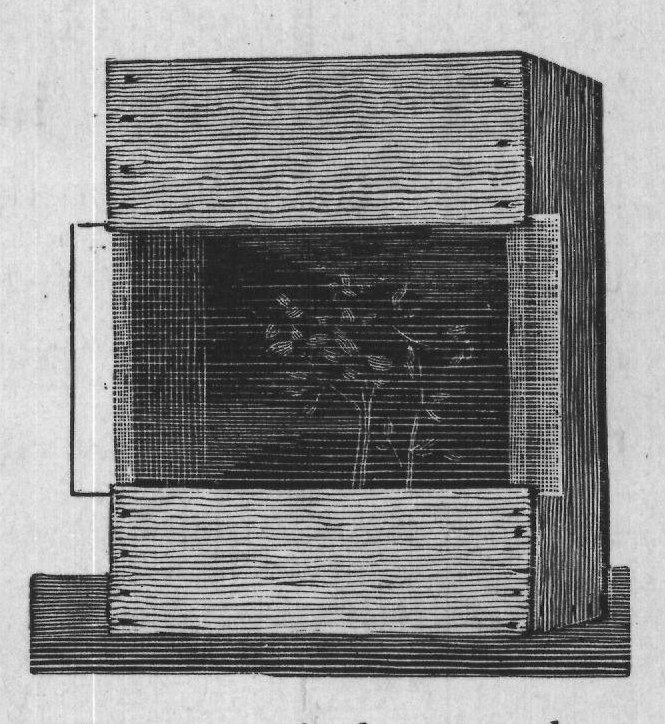
Breeding-cages are necessary for rearing caterpillars. A good homemade cage can be built by fitting a pane of glass into one side of an empty soapbox. A board, three or four inches wide, should FIG. 13. A home-made breeding-cage. be fastened below the glass so as to admit of a layer of soil being placed in the lower part of the cage, and the glass can be made to slide, so as to serve as a door (Fig. 13). The glass should fit closely when shut, to prevent the escape of insects. The soil is put into the box so that if larvæ of moths are reared they may have a chance to go into the ground to transform.¹ Branches of the proper food plant should be stuck into bottles or cans which are filled with sand saturated with water. By keeping the sand wet the plants can be kept fresh longer than in water alone, and the danger of the larvæ being drowned is avoided by the use of sand.
Hibernating chrysalids may be left in the breeding-cages or removed and packed in moss in small boxes. Great care should be taken to keep moist the soil in the breeding-cages, or the moss if that be used. The cages or boxes containing the pupæ should be stored in a cool cellar, or in an unheated room, or in a box placed out of doors where the sun can not strike it. Low temperature is not so much to be feared as great and frequent changes of temperature.
An excellent breeding-cage can be made by combining a flower-pot and a lantern-globe or a large lamp-chimney; the top of the lantern-globe is covered with Swiss muslin.
The student of butterflies needs a collect- 1 The following suggestions for breeding insects and the care of specimens are taken, in large part, from the work by the senior author, Insect Life, published by D. Appleton and Company, New York. ing outfit, consisting of a net, a killing-bottle, a few vials or pill-boxes for bringing home living larvæ, a cork-lined collecting box, and a vial of chloroform with a small brush fitted in the cork.