Home › General Account of Butterflies › III. the Clothing of Butterflies
III. the Clothing of Butterflies
Every country lad knows that if a butterfly be handled there comes off from it upon the fingers a dustlike substance; this is the clothing of the butterfly. If this dust is examined with a microscope each particle is seen to be of regular form, although a wide range of forms may be obtained from a single butterfly. The form that is most abundant on the wings is a flattened scale, beautifully ribbed, with a series of projecting teeth at one end, and a single pedicel at the other (Fig. 10).
If a piece of a wing of a butterfly be examined with a microscope, it will be seen that these scales are arranged in regular, overlapping rows; the arrangement being as regular as that of the scales on a fish or of the shingles on a FIG. 10. A series of scales taken from the body and wings of a single moth. (From Kellogg.) roof (Fig. 11). In the upper part of the figure the membrane of the wing is represented with the scales removed.
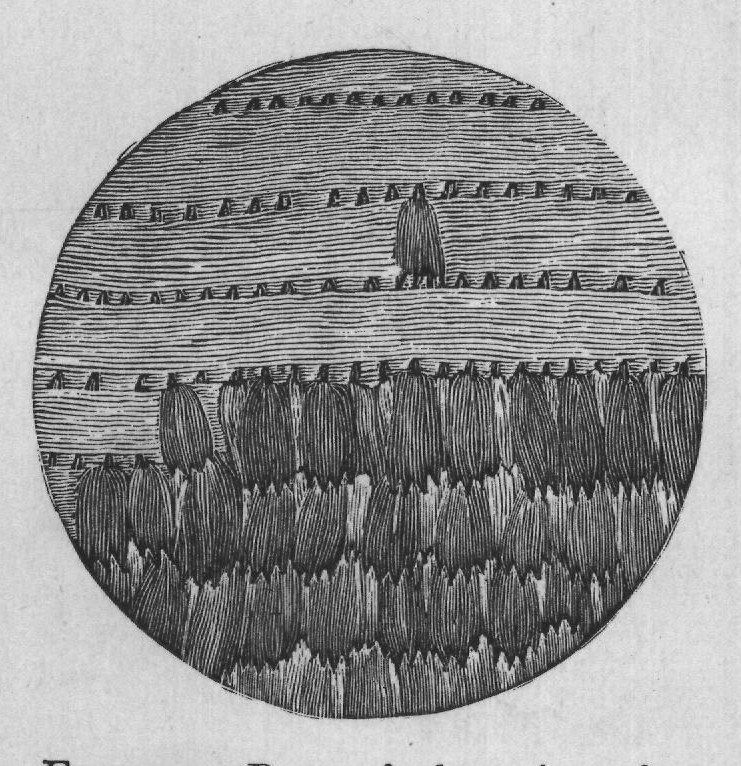
The scales of butterflies are modified hairs.
That is, they are hairs which, instead of growing long and slender as hairs usually do, remain short, but grow very wide as compared with their length. Every gradation in form can be found from the ordinary hairlike form, which occurs most abundantly upon the body, to the short and broad scale, which is best seen upon the wings (Fig. 10).
The use of the scales on the wings is to strengthen them.
We thus see that the wings of these insects are furnished with much fewer cross-veins than are the wings of similar size in other orders. A secondary use of these scales is that of ornamentation; for the beautiful colors and markings of these insects are due entirely to FIG. 11. Part of the wing of a butterfly, greatly magnified. the scales, and are destroyed when the scales are removed. Upon the body, legs, and other appendages, the scales and hairs doubtless serve to protect the insect, being a sort of armor.
In the wings of males of many butterflies there are scent glands that open through scales.
It should be stated in this connection that scales, like other hairs of insects, are hollow and well fitted to be the outlets of glands. The odor emitted by these scent-glands is supposed to attract the females; as do the bright plumage and the songs of male birds.
To these scales, characteristic of the males, has been applied the name androconia (an-droco'ni-a), a word signifying male dust. a C b Androconia are of remarkable and various forms. "Among the Nymphalidæ the androconia are usually long, slender, and feathered at the tip (Fig. 12, a); in the Pieridæ they are usually fringed at the apex and heart-shaped at the base, the pedicel being peculiarly developed into a slender stem with a ball at its tip (Fig. 12, 6); in the Lycænidæ a battledore shape is presented, the scale usually being quite small (Fig. 12, c). The androconia are found almost without exception on the upper side of the wings, and are more commonly met with on the fore wings than on the hind wings. They are often FIG. 12.-Androconia from the wings of male butterflies. found in certain limited spots or in folds of the wings." (Kellogg.) The most familiar illustrations of the grouping of the androconia in distinct patches are in the "brands" of the males of certain skippers, and in the discal patch of the fore wings of hairstreaks. It is among the skippers also that we find the most striking examples of folds formed for containing androconia, i. e., in the skippers with a costal fold. In the milkweed butterflies the androconia are in a little pocket close to vein Cu, of the hind wings (see Plate xxxii.) In caterpillars the fine hairs scattered over the surface of the body are sense-organs and are probably tactile; and it is believed that the organs of taste and of smell of insects are modified hairs.
We thus see that the clothing of these insects serves many and widely different uses.