Important: Safety Warning
This page contains a formula or preparation using substances now known to be dangerously toxic, such as arsenic, mercury, lead, or cyanide compounds. Exposure to these substances can cause severe poisoning, permanent injury, or death.
In addition, this page directs the use of hazardous substances — such as benzine, gasoline, lye, or strong acids — for household tasks. These materials are highly flammable, corrosive, or poisonous, and the practices described have caused fires, burns, and poisonings.
This information has been left in for historical purposes but should not be acted upon.
Home › General Account of Butterflies › IV. the Metamorphoses of Butterflies: Poison
IV. the Metamorphoses of Butterflies: Poison
The usual form of an insect-net is shown in Figure 14, and the killingbottle in Figure 15. The bottle is prepared in the following manner : Take a wide-mouth bottle holding four or six ounces. Put in this a piece of cyanide of potassium, about three- FIG. 14.-An fourths of an inch square, and water enough to cover the cyanide; and then immedi- Poison FIG. 15.-A killing-bottle. insect-net. ately, before there is time for the cyanide to dissolve, put enough plaster of Paris in the bottle to entirely soak up the water. In this way the cyanide will be firmly cemented in place in the bottom of the bottle.
The bottle should then be left open in a shady place for an hour to dry, and then securely corked with a long cork and labeled Poison, after which it is ready for use.
In using a cyanide bottle care should be taken not to leave it open unnecessarily, lest it lose its strength. With proper care a bottle will retain its strength for several months.
Specimens placed in the bottle to be killed should be left there for at least a half hour. They may be left in the bottle several hours, even overnight, without injury. Collectors of butterflies usually have a shallow tin box, lined with pith or cork, into which specimens can be pinned, and fitted with a strap by means of which it can be slung over the shoulder FIG. 16. A collecting-box. (Fig. 16). A cheap substitute for such a box can be made by using a shallow cigar-box, lined with cork and fitted with a strong cord.
There is another method of caring temporarily for specimens of butterflies, which is used when it is not convenient to pin them. The specimen is killed while it is yet in the net with chloroform or by pinching the thorax, care being taken that the wings are folded together above the back, so that they shall not be rubbed. Then the specimen is dropped into a triangular envelope made by folding a piece of paper, as shown in Figure 17, and a memorandum of the locality and date of capture is written on the envelope. When it is desired to pin and spread specimens that have been stored in this way, they are relaxed by put- FIG. 17.-Folded papers for butterflies. ting them on damp sand in a tightly closed vessel and leaving them there two or three days.
For pinning insects a special kind of pin is ordinarily used-one made of slender wire-so that the specimens are mutilated as little as possible (Fig. 18). These can be procured of any dealer in entomological supplies. The pin is pushed through the middle of the thorax, and about one-fourth of its length is left projecting above the specimen.
It is necessary that specimens of butterflies be "spread" before they are 1 3 5 FIG. 18.- Insect-pins. placed in a cabinet.
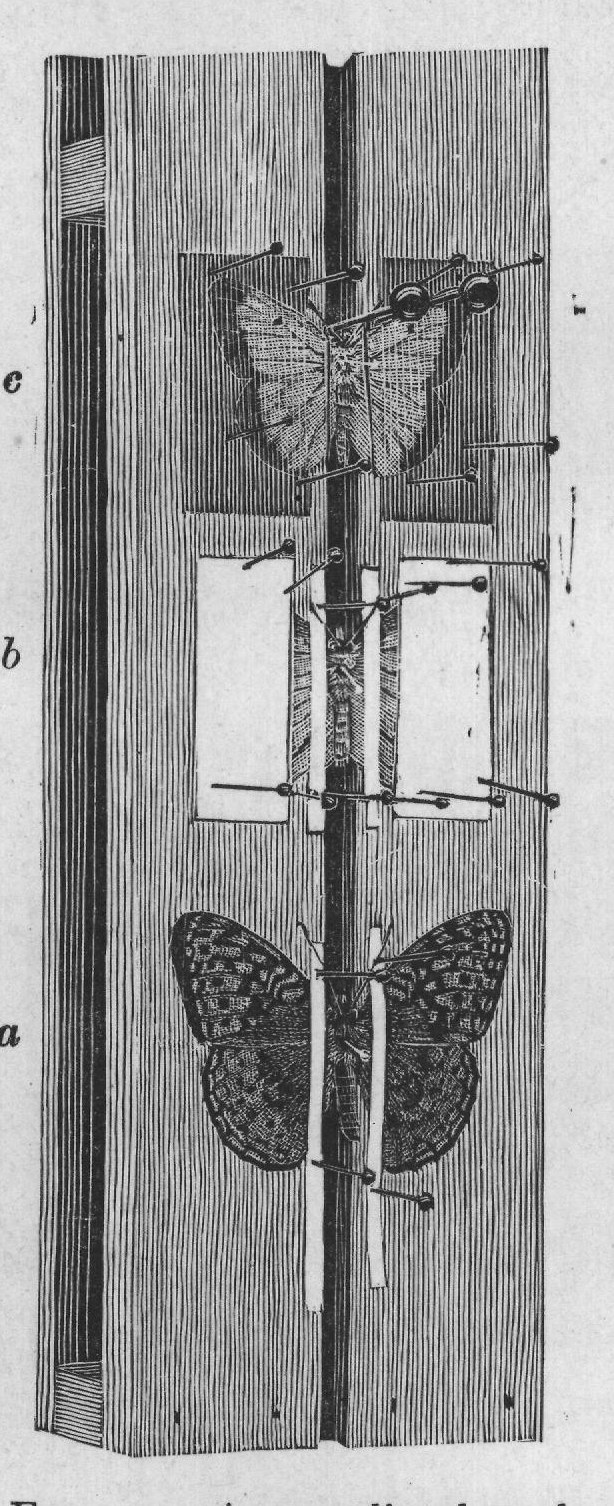
For doing this a device known as a spreading-board is used. This consists of two strips of wood fastened a short dis- C tance apart, so as to leave a groove for the body of the insect, upon which the wings are fastened in position and left until the insect is dry (Fig. 19). A narrow strip of cork is tacked to the lower side of the two strips of wood; this closes the groove below, and serves as a support for the pin upon which the insect is pinned.
Another strip of wood is fastened to the lower side of the cleats to which the two strips are nailed. This serves as a bottom, and protects the points of the pins which project through the piece of cork. b a FIG. 19. A spreading-board.
In spreading a specimen a narrow piece of paper is used on each side to hold the wings in place till they are properly arranged (Fig. 19, a). The wings are moved into position by slipping them forward or backward under the slips of paper, using for this purpose a fine pin, which is inserted near a strong vein of the wing.
When the wings are properly arranged their entire surface is covered with wider strips of paper (Fig. 19, 6). The specimens are left on the boards till they are dry; this usually requires two or three days.
For pinning the sheets of paper over the wings the sharp-pointed "mourning-pins" are much better than ordinary brass pins; and thin sheets of mica are often used instead of sheets of paper (Fig. 19, c). f If one wishes to keep a collection of butterflies, it is essential that they be stored in tightly covered boxes, for there is a small beetle-the museum pestwhich is sure to destroy the specimens if it can reach them. Various styles of in- FIG. 20. A cabinet. sect cases are sold by dealers; we prefer those that have a glass top, and which may be stored as drawers in a cabinet (Fig. 20). By using this kind, the specimens can be seen without opening the case.
The value of a collection of butterflies will be greatly enhanced if specimens of the eggs, larvæ, and chrysalids be preserved with the adults. The chrysalids should be killed in a cyanide bottle; they can then be pinned and preserved dry. It is more difficult to preserve caterpillars, on account of the soft nature of the body. They can be preserved in vials of alcohol; this is the simplest way. But the fact that the appearance of many larvæ is greatly altered by preserving them in alcohol leads many entomologists to remove the viscera from such larvæ and inflate and dry the skins. The process is somewhat difficult and dis- FIG. 21. A blown larva. larvæ much better than those prepared in any other way (Fig. 21).¹ agreeable to perform, but if it is well done very beautiful specimens are obtained, which preserve the form and color of the In collecting butterflies each specimen should be carefully labeled with the name of the locality in which it was taken and the date of capture.
While this is important for all specimens, it is especially so in the study of those species that occur under different forms in different sections of the country, and those in which the successive generations of a year present a different appearance. 1 Directions for inflating larvæ are given in Insect Life, pp. 301-303.