Home › Skin Cells › Skin Cells
Skin Cells
SKIN covers over and protects what is underneath. It is thin compared with what it covers, but it is important, as we discover when we lose a piece of our own skin. A fluid substance or even blood oozes out, and the spot where the skin is off is very painful.
Plants have a skin too, and it does for them what our skin does for us. It is tough and protects the soft inner parts and keeps the sap from oozing out.
Skin, of course, is built up of cells. These cells generally lie close together, touching each other, except at certain spots, where there is an opening.
Skin cells are usually long and wide, and their outer walls, as you would expect, are thicker than the inside walls. The protoplasm builds up hard material on the outside to protect the rest of the leaf or stem. Leaves and young stems and roots and flower parts all have skin.
The skin is alike in all in a general way, just as all houses are alike in a general way. They all have a roof, walls, partitions, doors, and windows, though these are of different sizes and arranged differently in different houses to suit the needs of the people who live in them. So with plants. The skin cells are different in size and shape and thickness in different plants to suit the needs of the plants, though in all there is a general resemblance. a b. b Here is a row of skin cells (a) with other cells (b) back of them. See how thick the skin cells are on the outside (c). They are very tough there too. d is an opening between two cells, and all is magnified several hundred times. a Sometimes there are several layers of skin cells where the plant needs a particularly thick skin; a in the illustration is an example of such a skin.
But it would not do to have an air-tight skin, even for a plant.
Our own skins are full of holes, or pores, as you know, to let out the extra water and other waste materials in what we call perspiration. The plants need such an arrangement as much as we do. So in their skin we find pores. You see the plant needs a great deal of water. The water is used in making the substance of the plant. It is also used in the sap to carry food about from place to place. Sap contains a great deal of water in order that it may flow easily. This water cannot all be used by the plant, and when it comes up from the roots in the sap a large part of it has to be got rid of by the leaves. If the skin were solid, the water could not escape.
But you know what protoplasm can do.
If the skin needs pores, it will make them. And this is how it does it.
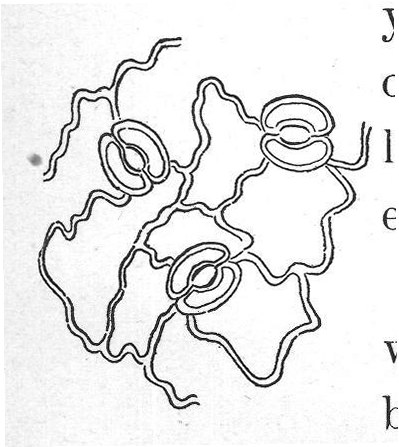
If you peel off a bit of skin from the under side of a leaf and put it under the microscope, you will see something like this.
The round forms are the pores. The crooked lines between are the edges of the cell walls, and you are looking at them right through the outer wall of the skin, which is transparent like glass, otherwise you could not see the edges of the partitions.
Let us look at these pores, or stomata as we must call them, if we want to talk like botanists.
One of the stomata is called a "stoma"; stoma comes from the Greek and means a "mouth," or "opening." These little mouths, or stomata, are made of two cells lying close together. These cells reach through the skin into an open space back of it. There are open spaces between many of the inner plant cells, and there is always one behind a stoma. There are very few spaces between skin cells, excepting, of course, the openings between the two cells of a stoma. The two cells which make a stoma are called "guard cells," because they guard the opening into the plant.
They are shaped, you see, something like half- When the plant is full of water these halfmoons. moons swell apart-so. -X up and their edges are drawn This, you see, makes an opening (x) into the plant.
This little mouth through the skin opens into the space back of the skin, and this space connects with other spaces all through the plant. Through these stomata all parts of the plant can communicate with the outer air. The extra water and other waste materials pass out through the open stomata and air and other gases pass in and out.
Now, if the air outside is very dry and the earth is dry so that the roots are not able to send up much water, these wise little guard cells do not swell up and separate.
They are too good gatekeepers for that. They straighten out, their edges meet and the opening is closed.
SO Now the water cannot so readily escape and the plant will not wither so soon. In dry climates the stomata are often surrounded by hairs which prevent too rapid evaporation; these hairs are often thick enough to make the plant look woolly. In fact, many plants have hairs upon those parts of the leaves where the stomata are found; they not only prevent too rapid evaporation, but also keep the rain or dew from getting into the stomata and closing them up. They hold off the water so that it cannot wet that part of the leaf.
There are a great many stomata on one leaf, on some kinds as many as thousands to a square inch.
Usually, among land plants, there are more on the under side of the leaf, and in very dry places all are on the under side. The sun shining on the upper side would often cause too great evaporation, so the stomata are found underneath. In very hot, dry air there will be a little evaporation, even when the stomata are closed.
But when we come to look at leaves that lie on the surface of the water, like water-lily leaves, of course the stomata are all on top, as that is the only part of the leaf the air can reach.
Many water plants have their stomata above, for you see there is no danger of their water supply running short.
It is very important for a plant to keep its pores open and it is quite ingenious in contriving ways to do this . Perhaps hairs are most frequently used.
They often cover the under side of the leaf where the stomata are thickest, or are found in lines along the leaf, when the stomata are distributed in this way.
But, you say, rain cannot get to the under side of the leaf. No, but dew can. Dew wets the under leaf.
No, but dew can. Dew wets the under side of the leaf quite as much as the upper side, for dew does not fall, as some people think, but is deposited all over the surface of a cool object like a leaf, for dew is nothing but the vapor in the air which is deposited in the form 20000 of water at night.
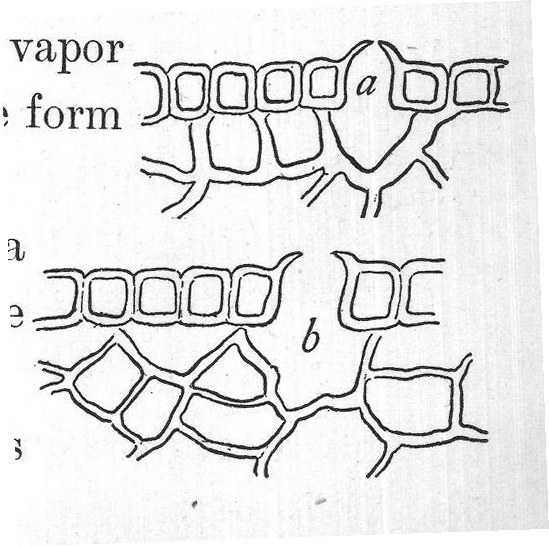
To see better how the stomata work, here is a side view of one 20 closed (a) and one open (b).
Stomata, you see, are the doors a to the plant through which things pass in and out.
Not only water goes out through them, but also other waste substances, such as oxygen and carbon dioxide.
You must not suppose because so many things go out at the doors that nothing goes in; for air passes in and also carbon dioxide.
Carbon dioxide passes out from the plant and in from the air! That seems curious, but you must remember the plant has to use its stomata for both lungs and mouths, -lungs to breathe out impure air, which contains carbon dioxide, and mouths to take in carbon dioxide, which is one of its principal foods. Besides stomata, plant skin has other kinds of special cells. These other cells form hairs or prickles or scales or glands. The hairs, prickles, and scales form on the outside of the skin, as you can see by the illustration.