Home › Skin Cells › Skin Cells: Bayberry
Skin Cells: Bayberry
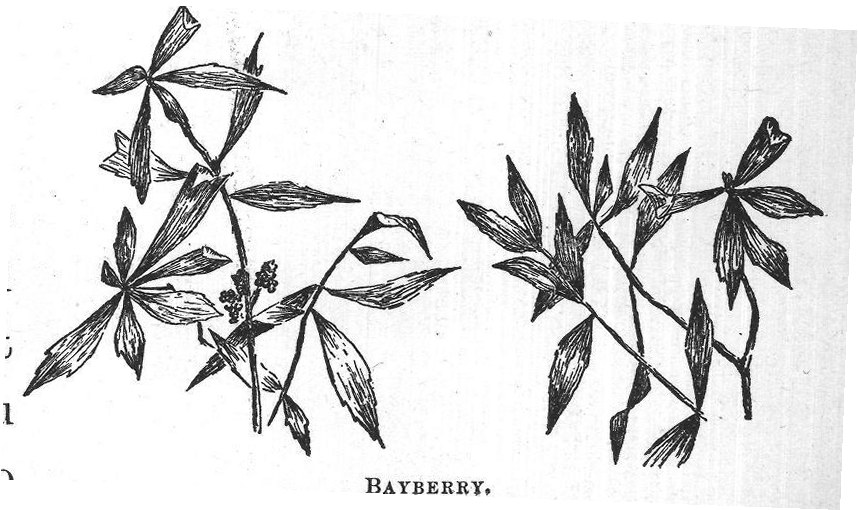
Some plants secrete wax which covers leaves or stems or fruits. Bayberry berries are covered with white wax, of which fragrant candles can be made.
Bayberry grows abundantly all along the New the New England coast, and friends of Thoreau used to make these fragrant candles as Christmas presents.
Whenever Thoreau went to visit them, he insisted upon having a bayberry candle to go to bed by.
The bloom on cabbage leaves and on plums and plums and other fruits is made of tiny scales of wax.
Wax is a very good substance to keep the plant dry.
You may be sure the plant knows this and often uses it about the stomata.
You see, the object is to BAYBERRY, allow water to pass freely out of the stomata by evaporation, but not, as a rule, to pass into them.
So the clever plants often have wax instead of hairs as a protection to the stomata. It would not do at all to let the stomata get closed up, so they are always protected in some way. Sometimes little projections grow out of the skin, close to the stomata. The raindrops fall upon these little knobs and stay there, instead of settling down into the stomata. You see, the pegs are very small, and when the rain falls on them there is a layer of air below them which the water cannot displace, and which prevents it from going any farther.
If you want to know just where the stomata are situated in a leaf, plunge it in water, then shake the drops off and notice what part of the leaf has not been wet. Wherever the leaf is dry, there are the stomata. In many plants, as, for instance, the jewelweed, it is quite impossible to wet the leaf.
Soak it in water for an hour, and when you take it out it is dry! The parts that cannot be wet usually have a silvery, glistening appearance. Put the leaf in water and notice where it glistens; there are the stomata, - sometimes all over the under side of the leaf, sometimes in lines or patches, sometimes on both sides of the leaf. Wax, gum, and resin are not the only things plant glands secrete. There are the glands in the flower cups that secrete nectar. In some plants this breaks through the delicate plant skin and runs into and fills up the little hollows or horns we call nectaries. In others the nectar is provided with stomata by means of which it can escape from the interior of the plant.
You may be surprised to learn that the flower is not the only part of the plant that can secrete nectar!
In some plants the stipules do it, and in some even the stems.
This is not to call visitors to the flowers, but perhaps to keep them away. Where ants trouble the flowers, certain kinds have invented this very clever way of stopping the unwelcome visitors. They do not want the ants to take the honey from the flowers, so they secrete honey on the leaves or stems, and the ants take that instead of traveling on to the flowers.
Of course each living skin cell contains protoplasm. The protoplasm lies in a thin layer against the walls and builds, builds, builds, until the skin is thick enough.
When a good thick wall has been built, the protoplasm passes out through tiny openings in the inner When a good thick wall has been built, the protowall into the inside cells, where it goes to work doing something else. The skin cells are then empty of protoplasm; they are only filled with air, and we say they are dead cells. Their hard walls are a good protection to the plant. In stems there is often a layer of thick cells behind the skin cells which also protects. These are called cork cells. All very young plants have their stems covered with living skin.
Older plants, particularly woody ones, have their stems covered with the tough, dead skin. And trees have finally a thick layer of dead cork cells. In tree trunks the skin cells have disappeared entirely. The skin protected the young shoot; then its empty cells finally peeled off, as the cork cells formed underneath and made a thick bark. The bark then does the work of the skin. It protects the stem.
It becomes very thick sometimes, as layers are constantly added beneath. The outside of the bark keeps peeling and scaling off.
Of course there are no stomata in bark. We find them only in the living skin. Bark does not need stomata, as it does not regulate the water supply.
The young green parts of the plant do that by stomata, as it does not regulate the water supply. means of their covering of living skin. Living skin is usually transparent like glass.
It is tough and yet transparent. You see, the light must get through it to the cells which lie behind it.
There is usually no green color in skin. Sometimes there are other coloring materials, though not as a rule.
The living skin covers the leaf or stem or other part of the plant like a window of tough glass.
Even where the skin is several cells thick, the light can pass through, just as it can through thick glass.