Home › Rings in Ecclesiastical Usages › Rings in Ecclesiastical Usages: Aves
Rings in Ecclesiastical Usages: Aves
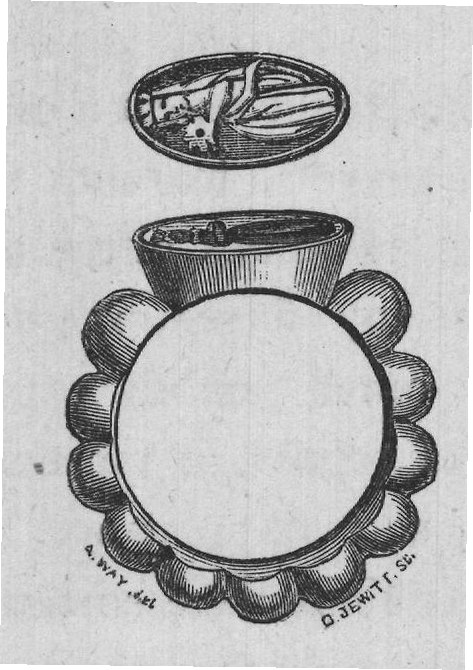
What are termed DECADE-rings, having ten projections at intervals all round the hoop, were common in former times, and were used as beads for repeating Aves. In the Braybrooke Collection a ring is mentioned with eleven knobs, the last being larger than the others, indicating ten Aves and one Paternoster. Each of the knobs is separated by three small beaded dots across the hoop from its neighbour, probably symbolic of the Trinity. At a meeting of the Archæological Institute at Norwich, in 1847, a curious ring was exhibited dating from the reign of Henry VI., found at St. Faith's, near Norwich. It is engrailed, presenting ten cusps, and may be placed in the class of decaderings. On the facet is engraved the figure of St. Mary Magdalen (or St. Barbara?), and on the outer circle 'de bon cver' ('de bon cœur').
Another ring of the same date is of a more delicate workmanship, and bears on the facet, St. Christopher, the hoop engrailed like the last, and has the legend 'en. bo. n. ane' ('en bon an ').
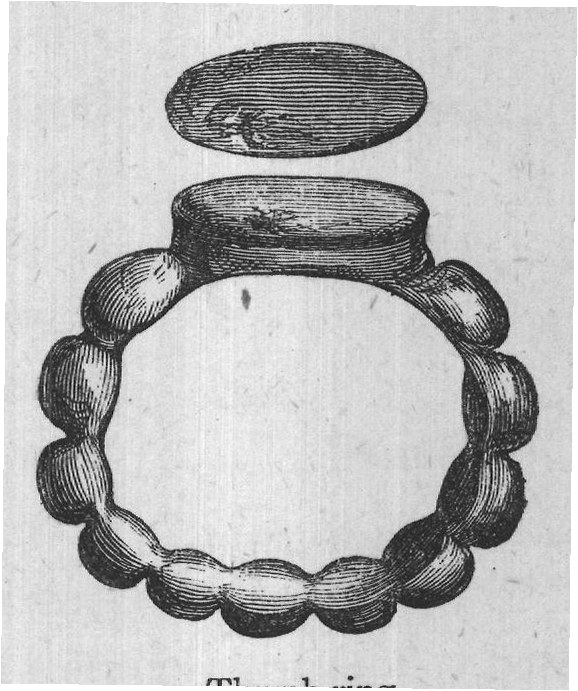
At the same exhibition of antiquities among the rings of latten or base-metal was shown one engraved with the figure of a female saint, probably St. Catherine; the hoop formed with eleven bosses, date about 1450. A similar brass ring bearing the same figure, found near British and 4.WAY d OJET Г. St.
Latten ring, with figure of St. Catherine (?).
Thumb-ring.
Roman weapons in the bed of the Thames, at Kingston, engraved in Jesse's 'Gleanings in Natural History,' is here represented. This ring has eleven bosses, and, although found in the immediate vicinity of vestiges of an earlier date, may be regarded as of mediæval date, having been accidentally thrown together in the alluvial deposit. Two decade-rings of the fifteenth century were also exhibited at the Norwich meeting, bearing the monogram I.H.S. one found in Norwich Castle, and the other at Heigham.
A gold ring with ten knobs, was found in 1846, at Denbigh, in pulling down an old house. Its weight is a quarter of an ounce. A similar ring of base metal, discovered in a tomb in York Minster, is preserved in the treasury of that church; and another example, in silver, of precisely similar form, was found in Whitby Abbey, Yorkshire.