Home › Rings in Ecclesiastical Usages › Rings in Ecclesiastical Usages: Cornwall
Rings in Ecclesiastical Usages: Cornwall
In the 'Journal of the Royal Institution of Cornwall' (Sept. 1875) is a note on an ancient signet-ring found at Penryn by Mr. W. H. Tregelles: 'This ring was found a few years since in a field near Budock church, by a watchmaker of the neighbourhood, of whom I bought it for Mr. Octavius Morgan, F.S.A., late M.P. for Monmouthshire. It has been the subject of much interesting discussion, the result of which, with a description of the ring, and three impressions in hard wax, I have deposited in the Museum of the Royal Institution of Cornwall, at Truro. 'It is an oriental ring of silver, set with an oblong sard, engraved; it appears at one time to have been gilt, and the loop and back of the bezel were ornamented with a small pattern in niello, now almost obliterated by long wear. 'In the middle of the device is a cartouche, or escutcheon, terminating at the top in a Greek cross potent. In the lower part of the escutcheon is engraved a paschal lamb, and in the upper part are some oriental characters, which have not been deciphered with certainty. On either side of the escutcheon is some ornamental scroll-work, having in the middle the Jerusalem cross potent. 'It was submitted to Mr. Albert Way and Mr. C. W.
King; and the latter gentleman, who took much pains to make out the inscription, considered that the characters were Servian, and that they represent the name of some ecclesiastic of the Greek Church to whom it once belonged. 'It was evidently an ecclesiastical ring, and M. Castellane stated that he has seen several Armenian priests at Rome wearing similar rings. It may, perhaps, date from the early part of the last century. 'The most probable conjecture as to the reason of such an object being found in Cornwall is that it may have been brought over by some traveller, and, having been lost by him or the person to whom he gave it, was mislaid among rubbish, and carted out with manure.' In the first chapter of this work I have alluded to rings of the early Christians, a subject of great interest, to which I again refer in these notices of 'religious' rings, with additional illustrations from the 'Archæological Journal.' The following cut represents a portion of a ring of darkgreen jasper, from Rome, dating, probably, from the second or third century. On the oval bezel a symbol is engraved in intaglio, viz. a boat, on which is a cock, carrying a branch of palm.
A bronze ring, probably Christian, of the third or fourth century, of an oval octagonal form, set with red jasper, engraved in intaglio with the subject of a shepherd. From Rome.
The ring here represented is of bronze, engraved with a ship, the emblem of the Church, between the letters chi and rho. This ring was obtained at Rome.
The accompanying illustrations are of small gold rings, in workmanship and form dating from the third or fourth century.
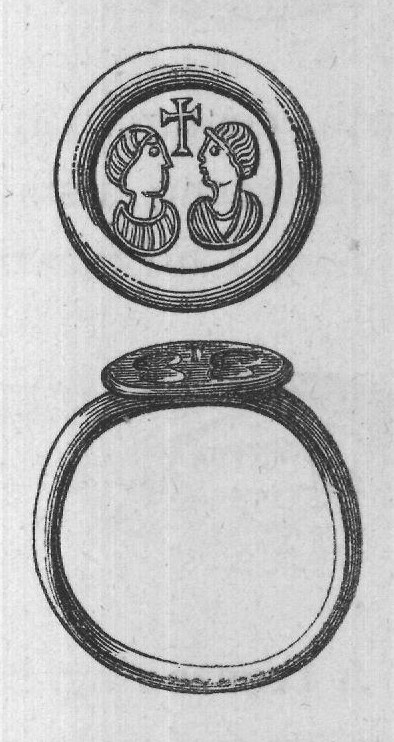
Annexed (probable date about 440) is a signet-ring, the subject incised upon the gold apparently a matrimonial or love-ring.
To the same period may be ascribed a bronze ring, of coarse workmanship, taken from the Roman catacombs. A circular hoop is surmounted by a flat circular bezel, on which is engraved an ear of corn between two fishes, emblem of the bread of life, and those who live in faith of it. 1 Another bronze ring is engraved with the sacred symbol, the united chi and rho between the alpha and omega above, and two sheep below. Probable date, the middle of the fourth century. Found at Rome.
To the same class of rings belongs the last of the above engravings. It is of bronze, having a simple convex hoop; the device, a draped male figure with nimbus, and standing before a cross appearing to spring from a bunch of grapes. It was brought from Athens, and is probably Byzantine, of the sixth or seventh century.
The following engraving represents a ring of duplex form, FILINAN VIVAS INDEO of solid gold, weighing 5½ dwts. It has engraved FILINAN A and in Vivas Deo D A Vivas in *.
The ring probably dates from the latter part of the third, or beginning of the fourth, century. It was discovered in the neighbourhood of Masignano, a small township of Fermo.