Home › Rings in Ecclesiastical Usages › Rings in Ecclesiastical Usages: Bronze
Rings in Ecclesiastical Usages: Bronze
Bronze ring, formed as a circle of half-round metal, engraved with a double-fluked anchor, crossed by one of a single fluke, and surrounded by a pearl border. From the catacombs at Rome.
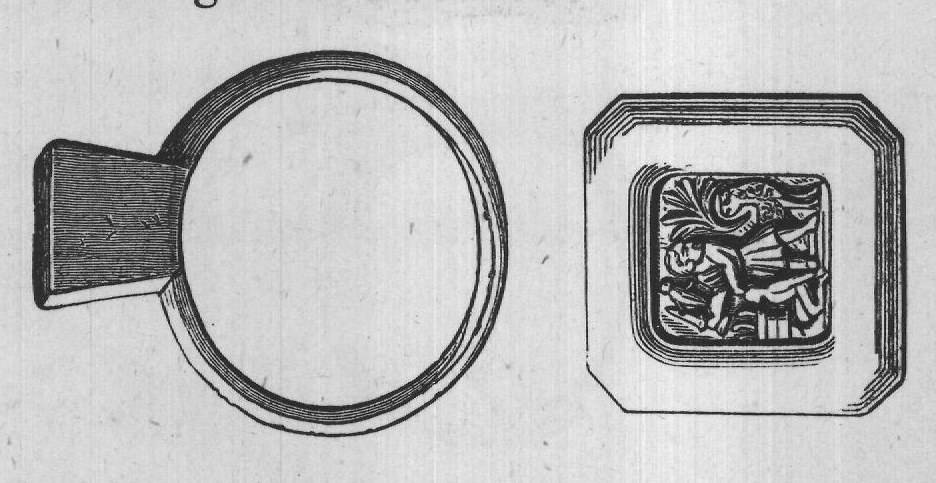
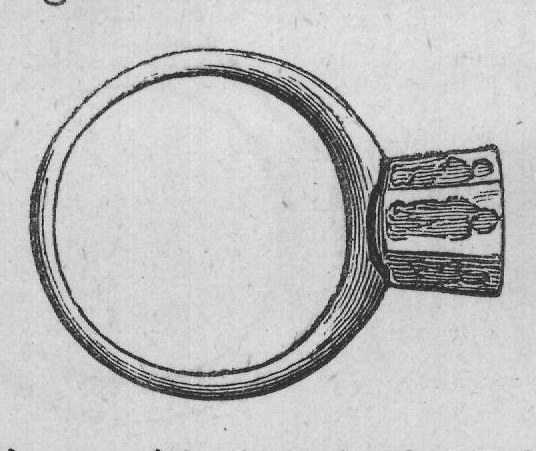
D 8 Bronze ring, with plain rounded hoop. Device, a draped female standing between two birds. On either side is the Christian monogram. Found, it is believed, in the catacombs of St. Calixtus; date, fourth century of our era. An iron ring of octagonal form, the bezel engraved with two human figures and the sacred monogram. A human figure is represented on each face of the octagon. This is a remarkable ring of its class. * Bronze ring, with bezel shaped as the sole of a shoe, and incised with the legend IN DEO, in the collection of C. D. E. Fortnum, Esq., F.S.A. :
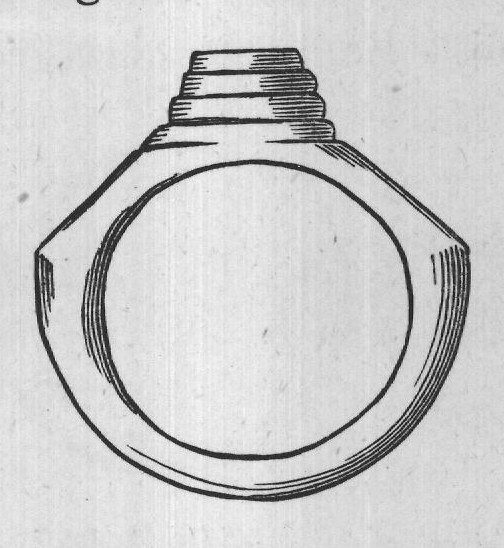
IVIDED In Montfaucon's 'L'Antiquité Expliquée' are several illustrations of Roman rings with the bezels representing a human foot. One seems to have been a Christian seal, the inscription on which, DEDONAO, is there, perhaps, put for DEI DONA. Montfaucon mentions one in his own cabinet, inscribed, between two crosses, DEI DONA.
A bronze stamp, formed as the sole of a shoe, is preserved in the Christian Museum of the Vatican. Inscription reversed, SPES IN DEO.
A child's ring of gold. A simple hoop, flattened out on the bezel, which is engraved with the palm-branch. This ring was found in a child's tomb in the neighbourhood of Rome.
Bronze ring, the bezel engraved with the sacred monogram, round which is placed the inscription, COSME VIVAS. This was discovered in one of the catacombs on the Via Appia. 105 EЯM ZAVI A small iron ring, on which is engraved the lion of St. Mark, dating, probably, from the sixth century. Found in a Coptic grave near the temple of 'Medinet Aboo,' at Thebes. T Mr. Hodder M. Westropp, in his 'Handbook of Archæology,' remarks that Christian inscriptions are all funeral, and are, for the most part, found in the Catacombs, or subterranean cemeteries of the early Christians in Rome. They are characterised by symbols and formulæ, peculiar to the Christian creed; the idea of another life-a life beyond the grave-usually prevails in them. The symbols found in connection with the funeral inscriptions are of three kinds; the larger proportion of these refer to the profession of Christianity, its doctrines and its graces. A second class, of a partly secular description, only indicate the trades of the deceased, and the remainder represent proper names; thus a lion must be named as a proper name, Leo; Onager, an ass; a dragon, Dracontius. Of the first kind the most usually met with is the monogram of Christ. The other symbols generally in use are the ship, the emblem of the church; the fish, the emblem of Christ; the palm, the symbol of martyrdom; the anchor, representing hope in immortality; the dove, peace; the stag, reminding the faithful of the pious aspiration of the Psalmist; the horse was the emblem of strength in the faith; the hunted hare, of persecution; the peacock and the phenix stood for signs of the resurrection ; Christ, as the good pastor, and the A-Ω of the Apocalypse, was also introduced in the epitaphs. Even personages of the pagan mythology were introduced, which the Christians employed in a concealed sense, as Orpheus, enchanting the wild beasts with the music of his lyre was the secret symbol of Christ, as the civilizer of men, leading all nations to the faith. Ulysses, fastened to the mast of his ship, was supposed to present some faint resemblance to the Crucifixion.'