Home › Rings from the Earliest Period › Rings from the Earliest Period: Henry
Rings from the Earliest Period: Henry
A similar story is recorded of Henry the Fourth of France and the Duke of Montpensier. The latter had written with his diamond ring on a pane of glass the following, in allusion to his love for the aunt of the King :- Nul bonheur me contente, Absent de ma Divinité.
Henry, in the same manner, wrote under it :- . N'appellez pas ainsi ma tante, Elle aime trop l'Humanité.
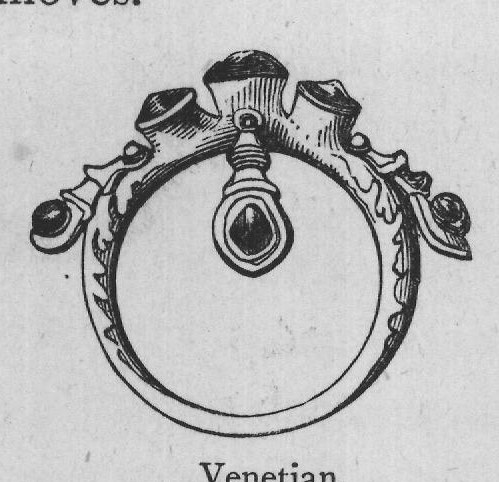
It was on the pane of a window in Hampton Court Palace that, during one of the festivals given there by Henry the Eighth, the ill-fated Earl of Surrey wrote with his diamond ring the name of fair Geraldine, and in quaint verse commemorated her beauty. discovered in the ruins of one of the most ancient temples : to its centre are affixed bunches of pear-shaped, hollow drops of silver, which jingle with a soft, low note as the hand moves.1 Venetian.
East Indian.
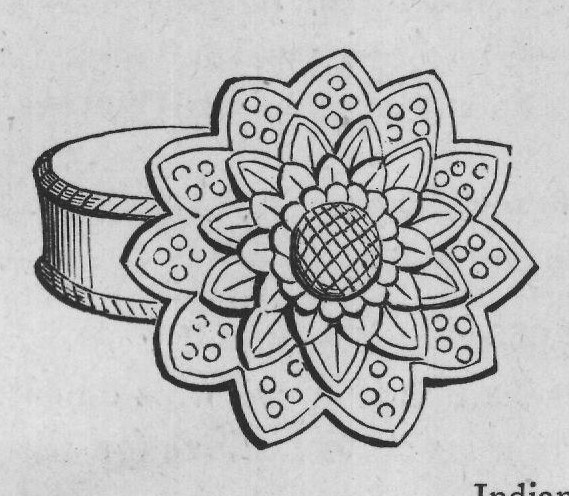
The Indians prefer rings with large floriated faces spreading over three fingers like a shield. When made for the wealthy, in massive gold, the flower leaves are of cut jewels, but the humbler classes are content with them in cast silver. Representations are here given of these rings. ১০ 00 00 Indian.
In Southern Europe, where jewellery is deemed almost an essential of life and the poorest will wear it in profusion, though only made of copper, the rings are curious 1 Calmet, in his 'Dictionary,' states that the Arabian princesses wore golden rings on their fingers, to which little bells were suspended, as well as in the flowing tresses of their hair, that their superior rank might be known, and that they might receive in passing the homage due to them. and elaborate. A Spanish ring, of the early part of the last century, has a heart, winged and crowned, in its centre : the heart is transfixed by an arrow, but surrounded by It may possibly be a religious emblem. Another. flowers.
Spanish.
Spanish ring, of more modern manufacture, has a very light and elegant design. The flowers are formed of rubies and diamonds, and the effect is extremely pleasing. Such work may have originated the 'giardinetti' rings, specimens of 'Giardinetti' rings. which are seen in the South Kensington Museum. Two are there described as English work of the seventeenth and eighteenth centuries. They appear to have been used as 'guards,' or 'keepers,' to the wedding-ring, and are of pleasing floriated design, and of very delicate execution.