Home › Posy, Inscription, and Motto Rings › Posy, Inscription, and Motto Rings: Henry
Posy, Inscription, and Motto Rings: Henry
You dear! (The meaning is thus conjectured of, possibly, a rebus, or canting device, on a silver signet-ring, found in the bed of the river Nene, at Wisbeach St. Peter's; the letter U and a deer trippant implying, perhaps, the writer's tender regard towards his correspondent. Date about the time of Henry V. or Henry VI.) The annexed engraving (from the 'Archæological Journal,' March, 1848) represents a curious ring, the property of Mr. Fitch, and belonging to his interesting cabinet of Norfolk antiquities. It is a plain hoop of silver, of the size here seen, and bears the inscription 'ETHRALDRIC ON LYND.' Its ND ETH A.w.
Φ ETHRALDRICOULUND Inscription ring. date has been assigned to as early a period as Saxon times, but we are inclined to attribute it to a subsequent age, the twelfth, or, perhaps, so late a date even as the thirteenth century. It may deserve notice that the mintage of London, of coins of Canute, Harold, Edward the Confessor, the Conqueror, and subsequent kings, is designated by the legend 'ON LYNDE.' This ring was found during the construction of the railway at Attleborough, in Norfolk.
True-love knots were common formerly. In the inventory of the effects of Henry Howard, K.G., Earl of Northampton, 1614, is mentioned ' a golde ringe sett with fifteene diamondes in a true lover's knotte, with the wordes nec astu, nec ense.' In the Waterton Collection in the South Kensington Museum are some interesting specimens of this peculiar kind of ring of English and Italian workmanship.
At the commencement of the present century 'Harlequin' rings were fashionable in England. They were so called because they were set round with variously-coloured stones, in some way resembling the motley costume of the hero of pantomime. 'Regard rings,' of French origin, were common even to a late period, and were thus named from the initials with which they were set forming the acrostic of these words : 1 1 This play upon words has been applied in a political sense. 'So,' as the late Mr. Crofton Croker observed, 'when the Repeal question was agitated in Ireland, rings and brooches, set in precious stones, made to represent the word "Repeal" were popular R uby E merald Pearl E merald A methyst L apis lazuli. :- One of these was given to a gentleman as a relic of this memorable agitation, but the bit of lapis lazuli had dropped out, and he took it to a working jeweller in Cork to have the defect supplied. When it was returned, he found that a topaz had been substituted for the missing bit of lapis lazuli. "How is this?" he inquired, "you have made a mistake." "No mistake, sir," said the witty workman, whom he after- R uby E merald Garnet A methyst R uby Diamond Lapis lazuli O pal V erd antique E merald.
The French have precious stones for all the alphabet, excepting f, k, q, y, and z, and they obtain the words souvenir and amitié thus :
S aphir or sardoine O nyx or opale U raine V ermeille E meraude N atralithe I ris Rubis, or rose diamant.
A méthiste, or aigue-marine Malachite I ris Turquoise or topaze I ris E meraude.
Thus lapis lazuli, opal, verd antique, emerald represented love, and for me malachite and emerald. wards discovered to be an ardent Repealer, "It is all right: it was repeal, but let us repeat that we may have it yet."" Names are represented on rings by the same means.
The Prince of Wales, on his marriage to the Princess Alexandra, gave her as a keeper one with the stones set with his familiar name, Bertie-beryl, emerald, ruby, turquoise, jacinth, emerald.
These name-rings are common in France; thus, Adèle is spelt with an amethyst, a diamond, an emerald, a lapis lazuli, and another emerald.
Among the motto or 'reason' rings, as they were termed, is an example, described in the 'Archæologia' (vol. xxxi), a weighty ring of fine gold, found in 1823 at Thetford, in Suffolk. The device which appears upon this ring is an eagle displayed; on the inner side is engraved a bird, with the wings closed, apparently a falcon, with a crown upon its head.
The following posy or motto, commencing on the outer side, is continued on the interior of the ring: 'Deus me ouroye de vous seuir a gree-com moun couer desire' (God work for me to make suit acceptably to you, as my heart desires). The devices appear to be heraldic, and the motto that of a lover, or a suitor to one in power. The eagle is the bearing of several ancient Suffolk families ; it was also a badge of the House of Lancaster, and Thetford was one portion of the Duchy of Lancaster.
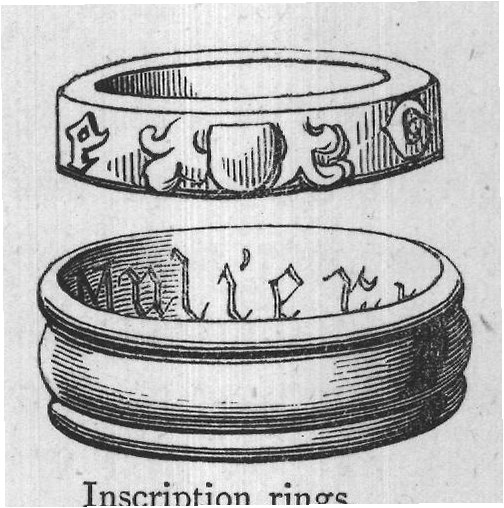
These mottos were occasionally engraved in relief. In the Londesborough Collection is one of gold, found in the Thames. The inscription upon it is 'Sans vilinie' (without baseness). 'A very early ring,' remarks Mr. Fairholt, with an unusually pretty posy, is in the collection of J. Evans, Esq., F.S.A. It is gold, set with a small sapphire, and is inscribed "IE, SVI, ICI, EN LI'V D'AMI" (I am here in place of a friend). It was probably made at the beginning of the fourteenth century. Beside it is placed two other specimens of inscribed rings. The first is chased with the Nortons' motto, 'God us ayde; the second is inscribed withinside with the sentence, 'Mulier, viro subjecta esto.' Both are works of the fifteenth century.
Juliev Posy ring.
Inscription rings.
Mr. Fairholt describes two gold wedding-rings of the sixteenth century, which were then generally inscribed with a posy of one or two lines of rhyme. One is formed like a badge of the Order of the Garter, with the buckle in front and the motto of the Order outside the hoop; withinside are the words, 'I'll win and wear you.' The other is the ordinary form of wedding-ring, inscribed, 'Let likinge laste.' They were generally inscribed withinside the hoop. win & wear you HONI Posy rings.
KINGELASTI Thus Lyly, in his 'Euphues' (1597), addressing the ladies, hopes they will favour his work' writing their judgments as you do the posies in your rings, which are always next to the finger, not to be seen of him that holdeth you by the hand, and yet known by you that wear them on your hands.' The Rev. C. W. King remarks that 'antique intagli set EE in mediæval seals have, in general, a Latin motto added around the setting. For this the Lombard letter is almost invariably employed, seldom the black letter, whence it may be inferred, which, indeed, was likely on other grounds, that such seals, for the most part, came from Italy, where the Lombard alphabet was the sole one in use until superseded by the revived Roman capitals about the year 1450. Of such mottos a few examples will serve to give an idea, premising that the stock was not very extensive, judging from the frequent repetitions of the same legends, on seals of widely different devices. Thus a very spirited intaglio of a lion passant, found in Kent, proclaims-“ SUM LEO QUOVIS EO NON NISI VERA VEHO;" another gives the admonition to secresy-" TECTA LEGE, LECTA TEGE; " a third in the same strain-" CLAUSA SECRETA TEGO ; " another lion warns us with "IRA REGIA," the wrath of a king is as the roaring of a lion-an apt device for a courtier. Less frequently seen are legends in old French, and these are more quaint in their style; for instance, around a female bust- "PRIVÉ SUY E PEU CONNU :" whilst a gryllus of a head, covered with a fantastic helmet made up of masks, gives the advice, in allusion to the enigmatical type-“CREEZ CE KE VUUS LIRREZ," for "Croyez ce que vous lirez."'