Home › Rings from the Earliest Period › Rings from the Earliest Period: Anglo-Saxon
Rings from the Earliest Period: Anglo-Saxon
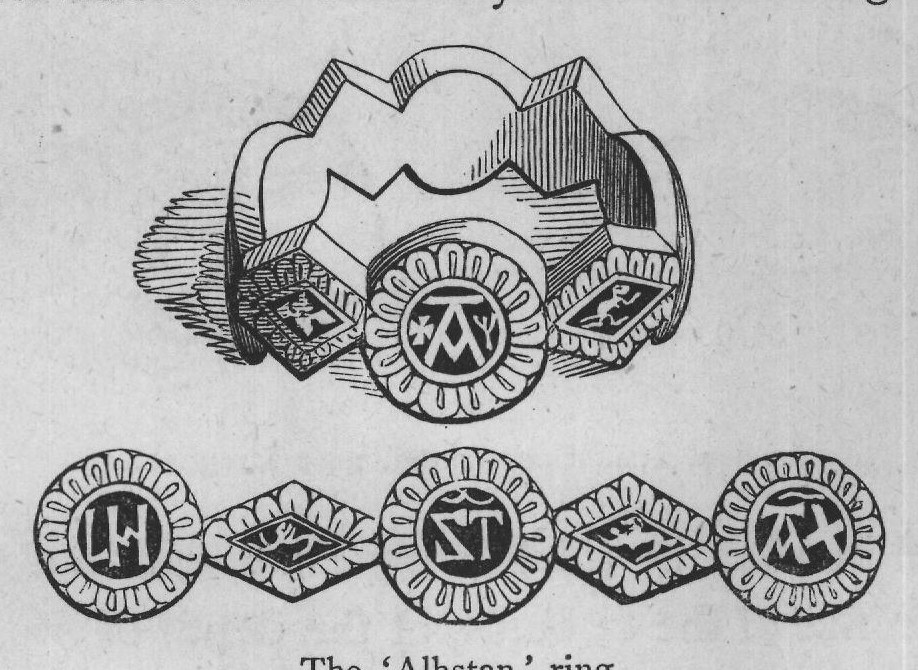
Rings were given in Anglo-Saxon times to propitiate royal favours. Thus, towards the end of the tenth century, Beorhtric, a wealthy noble in Kent, left in his will a ring worth thirty mancuses of gold that the queen might be his advocate that the will should stand. In the Braybrooke Collection is a plain silver ring, inscribed on the top of the exterior of the hoop, with the Anglo-Saxon word 'Dolzbot,' the meaning of which is, compensation made for giving a man a wound, either by a stab or blow. This ring is ornamented by a simple wavy line, and dots, as if to represent a branch, and was found in Essex. From its size, probably a woman's ring-perhaps for injury, or the death of her husband. There are various nielloed rings of the Saxon period; notably a gold ring with an inscription, and partly in runes, meaning 'Alhreds owns me, Eanred engraved (or wrought) me,' now in the British Museum, which also has a gold ring with two facets, found in the river Nene, near Peterborough, engraved in the Archæological Institute Proceedings for 1856. Anglo-Saxon.
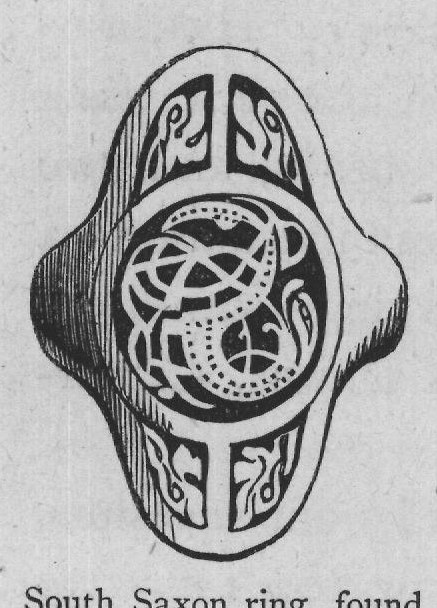
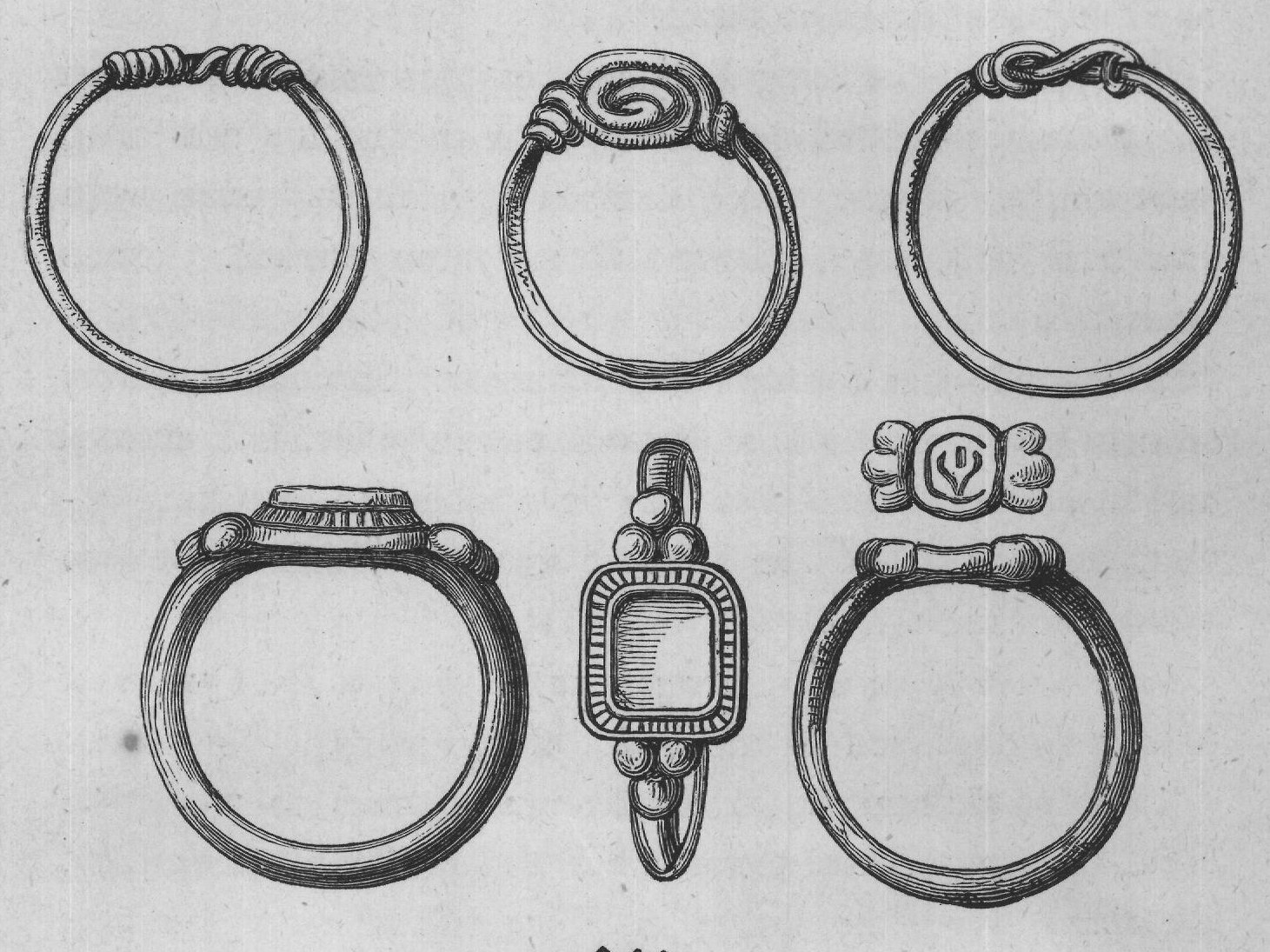
Plain wire rings were used by the South Saxons; specimens have been obtained in Anglo-Saxon grave-mounds in England, and others, identical in form, in the old Saxon cemeteries in Germany. Mr. Fairholt says: 'In the museum at Augsburg are several, which were found in cutting for the railway near that city. One of the plain wire rings' (the first of our illustrations) 'was exhumed from a tumulus on Chartham Downs, a few miles from Canterbury, in 1773, by the Rev. Bryan Faussett, who says: "The bones were those of a very young person. Upon the neck was a cross of silver, a few coloured earthen beads, and two silver rings with sliding knots." The second illustration-a wire ring, twisted so as to resemble a seal ring-was discovered in a Saxon cemetery on Kingston Downs, Canterbury.' The simplest form of finger-ring worn by our ancestors, consisted of a band of metal, merely twisted round to Early Saxon rings, found near Salisbury. embrace the finger, and open at either end. One of these rings found upon the finger-bone of an early Saxon, in excavating at Harnham Hill, near Salisbury, was found on the middle finger of the right hand of a person of advanced age. Sometimes several rings were found on one hand. Among the bones of the fingers of the left hand of an adult skeleton was found a silver ring of solid form, another of spiral form, and a plain gold ring. Mr. Akerman, who superintended these researches, says: 'Similar rings have been found at Little Wilbraham, at Linton Heath, at Fairford, and other 人 localities. They are, for the most part, of a uniform construction, being so contrived that they could be expanded or contracted, and adapted to the size of the finger of the wearer.' In the Waterton Collection is a very curious South Saxon ring, described as 'an elongated oval with a circular centre; within the circle is the conventional figure of a dragon, surrounded by four convoluted ornaments, reminding one of the prevailing enrichments so lavishly bestowed on old Runic ornaments, at home and abroad. Four quaintly-formed heads of dragons occupy the triangular spaces above and below this centre.
South Saxon ring, found in the Thames.
The ground between the ornaments has been cut down, probably for the insertion of niello or enamel colour.' It was found in the Thames at Chelsea in 1856.
At a meeting of the Royal Archæological Institute in June 1873 Mr. J. J. Rogers exhibited some Anglo-Saxon bronze rings which were found in a cave, in the parish of St. Keverne, Cornwall.
The Duke of Northumberland possesses a beautiful ring of pale-coloured gold (weight 157 grains), set with a rubycoloured gem, surrounded with filagree work, the hoop beaded with small circles, punched, as on work of the Saxon age. It was discovered, about 1812, by a boy who was ploughing, near Watershaugh, Northumberland, and found the ring fixed on the point of his ploughshare. In the collection of R. H. Soden Smith, Esq., F.S.A., is a curious Anglo-Saxon ring, found about ten feet below the surface of the ground, in making Garrick Street, Covent Garden. It is of gold, the hoop nearly half an inch wide, with a broad oval bezel, expanding to 11 inches; the gold pale, alloyed with silver. The whole is overlaid with funiform wire ornaments and granulated work; on the bezel are four curves of beaded filagree radiating from the centre ornament, and having smaller bosses of similar work between.1 Spiral elastic band rings of Anglo-Saxon work have been found in considerable numbers in excavations. Douglas, in his 'Nenia Britannica,' describes many specimens under this term, found by him in the graves of Anglo-Saxon tribes. In the earlier history of Ireland we find instances of a wonderful development of artistic skill in goldsmith work. The Royal Irish Academy possesses some beautiful specimens of rings. The Londesborough Collection includes two remarkable rings which were found with other gold ornaments near the remarkable tumulus, known as 'New Grange,' a few miles from Drogheda. They were accidentally Ancient Irish rings, found near Drogheda. discovered in 1842 by a labouring man, within a few yards to the entrance of the tumulus, at the depth of two feet from the surface of the ground, and without any covering or protection from the earth about them. Another labouring 1 I am much indebted to Mr. R. H. Soden Smith, F. S. A. -a gentleman so distinguished in art circles, and the possessor of a remarkably fine and rare collection of rings -for information on some points connected with this work. man, hearing of this discovery, carefully searched the spot whence they were taken, and found a denarius of Geta. The stone set in both rings is a cut agate.
Aildergoidhe, son of Muinheamhoin, monarch of Ireland, who reigned 3070 A.M., is traditionally said to have been the first prince who introduced the wearing of gold rings into Ireland, which he bestowed on persons of merit who excelled in knowledge of the arts and sciences.
OJENITI・ Early Irish gold ring.
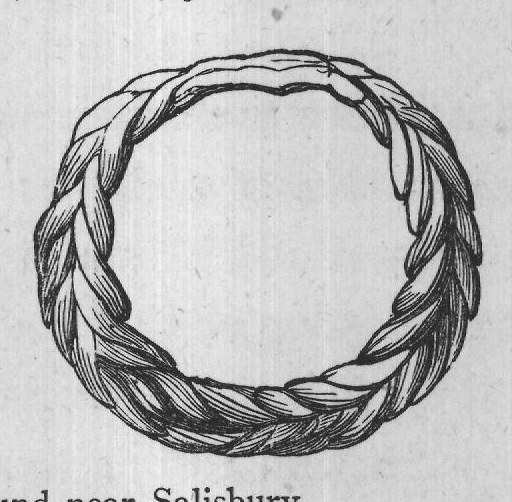
The engraving (from the 'Archæological Journal,' June 1848), represents a gold ring twisted, or plaited, of early Irish work, in the fine collection of antiquities of Edwin Hoare, Esq., of Cork.