Home › Rings from the Earliest Period › Rings from the Earliest Period: Ishtar
Rings from the Earliest Period: Ishtar
At a meeting of the Society of Biblical Archæology, in June 1873, Dr. H. F. Talbot, F.R.S., read an interesting paper on the legend of 'Ishtar descending to Hades,' in which he translated from the tablets the goddess's voluntary descent into the Assyrian Inferno. In the cuneiform it is called 'the land of no return.' Ishtar passes successively through the seven gates, compelled to surrender her jewels, viz. her crown, ear-rings, head-jewels, frontlets, girdle, finger- and toe-rings, and necklace. A cup full of the Waters of Life is given to her, whereby she returns to the upper world, receiving at each gate of Hades the jewels she had been deprived of in her descent.
Mr. Greene, F.S.A., has an Egyptian gold ring, formerly in the possession of the late Mr. Salt, belonging to the nineteenth dynasty, probably from the Lower Country, below Memphis. It is engraved with a representation of the goddess Nephthis, or Neith. Another gold ring of a later period, from the Upper Country, dates, probably, from the time of Psammitichus, B.C. 671 to 617.
In the collection of Egyptian antiquities formed by the late R. Hay, Esq., of Limplum, N.B., were two Græco- Egyptian gold rings, found, it is conjectured, in the Aasaseef, near Thebes. One of these is of the usual signet form, but without an inscription; the other is of an Etruscan pattern, and is composed of a spiral wire, whose extremities end in a twisted loop, with knob-like intersections. Both these objects are of fine workmanship, and are wrought in very pure gold. Sir J. G. Wilkinson, in 'Manners and Customs of the Ancient Egyptians,' remarks: 'The rings were mostly of gold, and this metal seems always to have been preferred to silver for rings and other articles of jewellery. Silver rings are, however, occasionally to be met with, and two in my possession, which were accidentally found in a temple at Thebes, are engraved with hieroglyphics, containing the name of the royal city. Bronze was seldom used for rings; some have been discovered of brass and iron (of a Roman time), but ivory and blue porcelain were the materials of which those worn by the lower classes were usually made.' The Rev. C. W. King observes: 'I have seen fingerrings of ivory of the Egyptian period, their heads engraved with sphinxes and figures of eyes cut in low relief as camei, and originally coloured.' The porcelain finger-rings of ancient Egypt are extremely beautiful, the band of the ring being seldom above one-eighth of an inch in thickness. Some have a plate in which in bas-relief is the god Baal, full-faced, playing on the tambourine, as the inventor of music; others have their plates in the shape of the right symbolical eye, the emblem of the sun, of a fish of the perch species, or of a scarabæus. Some few represent flowers. Those which have elliptical plates with hieroglyphical inscriptions bear the names of Amen-Ra, and of other gods and monarchs, as Amenophis III., Amenophis IV., and Amenmest of the eighteenth and nineteenth dynasties. One of these rings has a little bugle on each side, as if it had been strung on the beaded work of a mummy, instead of being placed on the finger. Blue is the prevalent colour, but a few white and yellow rings, and some even ornamented with red and purple colours, have been discovered. It is scarcely credible that these rings, of a substance finer and more fragile than glass, were worn during life, and it seems hardly likely that they were worn by the poorer classes, for the use of the king's name on sepulchral objects seems to have been restricted to functionaries of state. Some larger rings of porcelain of about an inch in diameter, seven-eighths of an inch broad, and one-sixteenth of an inch thick, made in open work, represents the constantly-repeated lotus-flowers, and the god Ra, or the sun, seated and floating through the heavens in his boat.
At the Winchester meeting of the Archæological Institute in 1845 a curious swivel-ring of blue porcelain was exhibited, found at Abydus in Upper Egypt; setting modern. It has a double impression: on the one side is the king making an offering to the gods, with the emblems of life and purity; on the other side the name of the monarch in the usual 'cartouche,' one that is well known, being that of Thothmes III., whom Wilkinson supposes to have been the Pharaoh of Exodus. It is worthy of remark that this cartouche is 'supported' by asps, which are usually considered to be the attributes of royalty.
The annexed engraving represents an Egyptian ring, en pâte céramique, from M. Dieulafait's 'Diamants et Pierres Précieuses.' Egyptian Porcelain Ring.
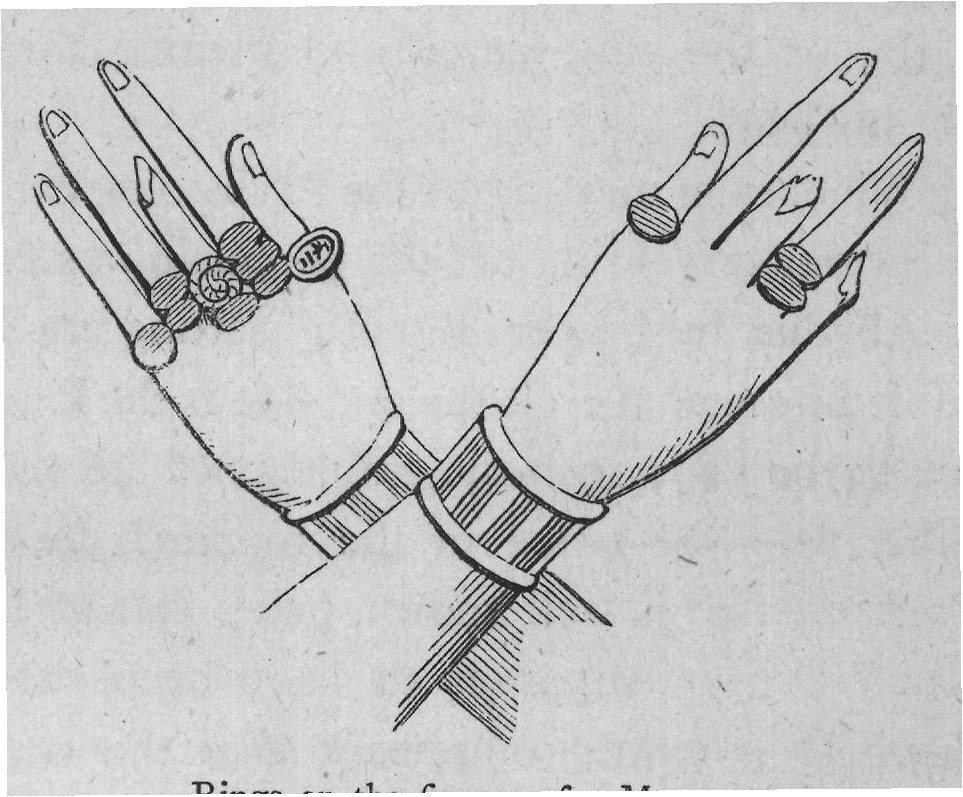
The signet of Sennacherib in the British Museum is made of Amazon stone, one of the hardest stones known to the lapidary, and bears an intaglio 'which,' observes the IO Rev. C. W. King, 'by its extreme minuteness, and the precision of the drawing, displays the excellence to which the art had already attained.' On a mummy-case in the British Museum is a representation of a woman with crossed hands, covered with rings; the left hand is most loaded. Upon the thumb is a signet with hieroglyphics on the surface, three rings on the forefinger, two on the second, one formed like a snail shell, the same number on the next, and one on the little finger. The right hand carries only a thumb ring, and two upon the third finger.
Rings on the fingers of a Mummy.
Sir J. G. Wilkinson observes: 'The left was considered the hand peculiarly privileged to bear these ornaments; and it is remarkable that its third finger was decorated with a greater number than any other, and was considered by them, as by us, par excellence, the ring-finger, though there is no evidence of its having been so honoured at the marriage ceremony.' The same author mentions that rings were a favourite decoration among the Egyptians; women wore sometimes two or three on the same finger. They were frequently worn on the thumb. Some were simple, others had an engraved stone, and frequently bore the name of the owner; others the monarch in whose time he lived, and they were occasionally in the form of a snail, a knot, a snake, or some fancy device. A cat-emblem of the goddess Bast, or Pasht, the Egyptian Diana- was a favourite subject for ladies' rings.
One of the oldest, if not the most ancient ring known, is supposed to be that in the collection of Dr. Abbot, of Cairo, now preserved with his other Egyptian antiquities at New York. It is thus described by him :- This remarkable piece of antiquity is in the highest state of preservation, 6 Egyptian Gold Ring, from Ghizeh. and was found at Ghizeh, in a tomb near the excavation of Colonel Vyse, called Campbell's tomb. It is of fine gold, and weighs nearly three sovereigns. The style of the hieroglyphics within the oval make the name of that Pharaoh (Cheops, Shofo) of whom the pyramid was the tomb. The details are minutely accurate and beautifully executed. The heaven is engraved with stars; the fox or jackal has significant lines within its contour; the hatchets have their handles bound with thongs, as is usual in the sculptures; the volumes have the strings which bind them hanging below the roll-differing in this respect from any I2 example in sculptured or painted hieroglyphics. The determinative for country is studded with dots, representing the land of the mountains at the margin of the valley of Egypt. The instrument, as in the larger hieroglyphics, has the tongue and serni-lunar mark of the sculptured examples; as is the case also with the heart-shaped vase. The name is surmounted with the globe and feathers, decorated in the usual manner; and the ring of the cartouche is engraved with marks representing a rope, never seen in the sculptures; and the only instance of a royal name similarly encircled is a porcelain example in this collection, inclosing the name of the father of Sesostris. The O in the name is placed as in the examples sculptured in the tombs, not in the axis of the cartouche; the chickens have their unfledged wings; the cerastes its horns, now only to be seen with a magnifying glass.' In a lecture to the deaf and dumb in St. Saviour's Hall, Oxford Street, London (October 1875), on 'Eastern Manners and Customs,' amongst various relics exhibited was the hand of a female mummy, on one finger of which was a gold ring, with the signet of one of the Pharaohs. A gold ring exhibited at the exhibition of antiquities at the Ironmongers' Hall, in 1861, had hieroglyphics meaning 'protected by the living goddess Mu.' Among some interesting specimens of Egyptian rings exhibited at the South Kensington Loan Exhibition of 1872 I may mention an antique ring of pale gold, with a long oval bezel chased in intaglio, with representation of a sistrum (timbrel, used by the Egyptians in their religious ceremonies), the property of Viscount Hawarden; an antique ring of pale gold (belonging to Lady Ashburton), formed of a slender wire, the ends twisted round the shoulders, upon which is strung a signet, in form of a cat, made of greenish-blue glazed earthenware.
From the collection of R. H. Soden Smith, Esq. F.S.A., an ancient pale gold ring, with revolving cylinders of lapislazuli, engraved with hieroglyphics; the shoulders of the hoop wrapped round with wire ornament.
The Waterton Collection contains Egyptian rings of various descriptions: one of silver, with revolving bezel of cornelian representing the symbolical right eye. Several rings of glazed earthenware; one of gold, very massive, with revolving scarab of glazed earthenware, partially encased in gold. A gold ring, the hoop of close-corded work, revolving bezel with blood-stone scarab, engraved with Hathor and child. The same engraving is on a gold signet-ring, with vesica-shaped bezel, and upon a white-metal ring, where the figures are surrounded by lotus-flowers. Another gold signet-ring is engraved with the figure of Amen-ra; a probably Egyptian white-metal ring, with narrow oblong bezel, engraved with a frieze of figures, and winged Genii, divided by candelabra.
Several of the Egyptian rings in the Museum of the Louvre at Paris date from the reign of King Meris. One of the oldest rings extant is that of Cheops, the founder of the Great Pyramid, which was found in a tomb there. It is of gold, with hieroglyphics.
The Egyptian glass-workers produced small mosaics of the most minute and delicate finish, and sufficiently small to be worn on rings.
Dr. Birch, in a very interesting paper communicated to the Society of Antiquaries, at the meeting of November 17, 1870, observes, with regard to the scarabæi and signet-rings of the ancient Egyptians, that the use of these curious objects (the exhibition comprising upwards of five hundred scarabs from the collection of Egyptian antiquities formed by the late R. Hay, Esq., of Sinplum, N.B., to which I have alluded) dates back from a remote period of Egyptian history. As it is well known, they were not merely made in porcelain, but also in steatite, or stea-schist, and the various semi-precious stones suitable for engraving, such as cornelian, sard, and such-like.' In the time of the twelfth dynasty the cylindrical ring, also found in use among the Assyrians and Babylonians, came into vogue. The hard stones and gems were of later introduction, probably under the influence of Greek art, for the ancient Egyptians themselves do not appear to have possessed the method of cutting such hard substances. A few, however, exist, which are clearly of great antiquity-as, for example, a specimen in yellow jasper now in the British Museum.
The principal purpose to which these scarabs were applied was to form the revolving bezel of a signet-ring, the substance in which the impression was taken being a soft clay, with which a letter was sealed.
It is singular that some of these objects have been found in rings fixed with the plane engraved side inwards, rendering them unfit for the purposes of sealing. It is well known that the use of these scarabs was so extensive as to have prevailed beyond Egypt, being adopted by the Phoenicians and the Etruscans.