Home › Rings from the Earliest Period › Rings from the Earliest Period: Fairholt
Rings from the Earliest Period: Fairholt
Fairholt, in Rambles of an Archæologist,' describes an ancient Etruscan ring in the British Museum, with chimeræ on it opposing each other. The style and treatment partake largely of ancient Eastern art. There is also in the Etruscan, with Chimeræ.
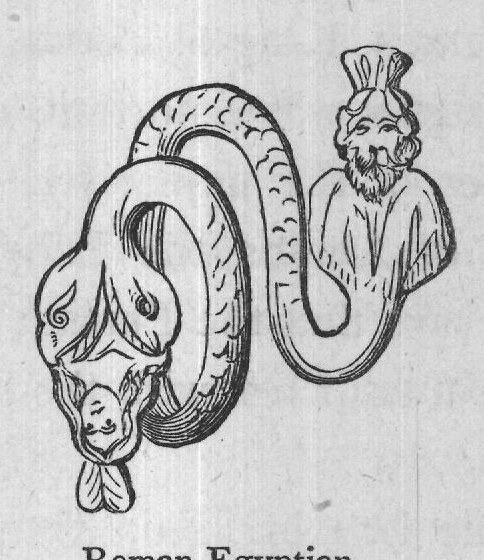
Roman-Egyptian. same collection a remarkable ring having the convolutions of a serpent, the head of Serapis at one extremity and of Isis at the other; by this arrangement one or other of them would always be correctly posited; it has, also, the further advantage of being flexible, owing to the great sweep of its curve.
Silver rings are rarer than those of gold in the tombs of Etruria, and iron and bronze examples are gilt.
All the Hindoo Mogul divinities of antiquity had rings; the statues of the gods at Elephanta, supposed to be of the highest antiquity, had finger-rings.
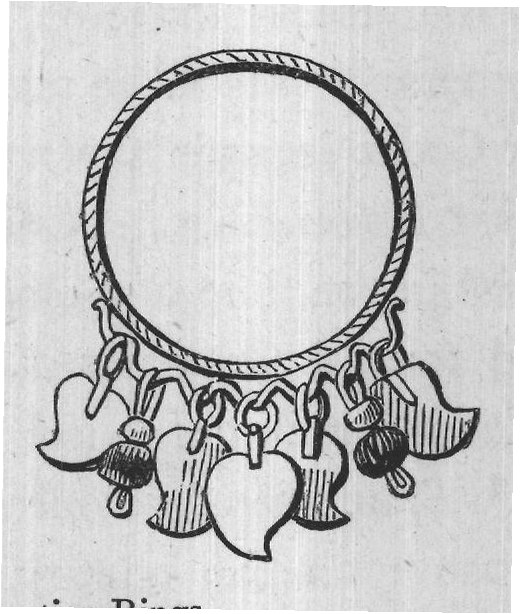
The Rev. C. W. King describes a ring in the Waterton collection, of remarkable interest-apparently dating from the Lower Empire, for the head is much thrown up, and has the sides pierced into a pattern, the 'interrasile opus, so much in fashion during those times. It is set with two diamonds of (probably) a carat each: one a perfect octahedron of considerable lustre, the other duller and irregularly crystallised. Another such example might be sought for in vain throughout the largest cabinets of Europe.' After the conquest of Asia Alexander the Great used the signet-ring of Darius to seal his edicts to the Persians; his own signet he used for those addressed to the Greeks. Xerxes, King of Persia, was a great gem-fancier, but his chief signet was a portrait, either of himself, or of Cyrus, the founder of the inonarchy. He also wore a ring with the figure of Anaitis, the Babylonian Venus, upon it. Thucydides says that the Persian kings honoured their subjects by giving them rings with the likenesses of Darius and Cyrus. The late Mr. Fairholt purchased in Cairo a ring worn by an Egyptian lady of the higher class. It is a simple hoop of twisted gold, to which hangs a series of pendant ornaments, consisting of small beads of coral, and thin plates of gold, cut to represent the leaves of a plant. As the hands move, these ornaments play about the finger, and a very brilliant effect might be produced if diamonds were used in the pendants.
The rings worn by the middle class of Egyptian men are usually of silver, set with mineral stones, and are valued as the work of the silversmiths of Mecca, that sacred city being supposed to exert a holy influence on all the works it originates. men.
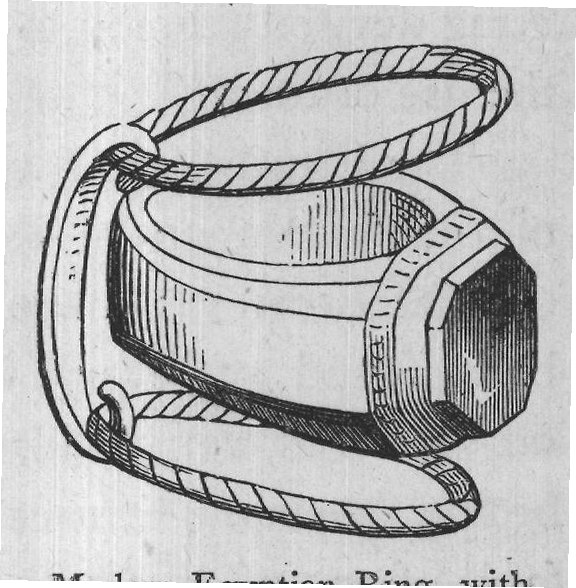
Modern Egyptian Rings.
A curious ring with a double keeper is worn by Egyptian It is composed entirely of common cast silver, set with mineral stone. The lowermost keeper, of twisted wire, is first put on the finger, then follows the ring. The second keeper is then brought down upon it: the two being held by a brace which passes at the back of the ring, and gives security to the whole.