Home › Rings from the Earliest Period › Rings from the Earliest Period: Egyptian
Rings from the Earliest Period: Egyptian
Egyptian Bronze Rings.
Rings of inferior metal, engraved with the king's name, may, probably, have been worn by officials of the court. In the Londesborough collection is a bronze ring, bearing on the oval face the name of Amunoph III., the same monarch known to the Greeks as 'Memnon.' The other ring, also of bronze, has engraved on the face a scarabæus. Such rings were worn by the Egyptian soldiers.
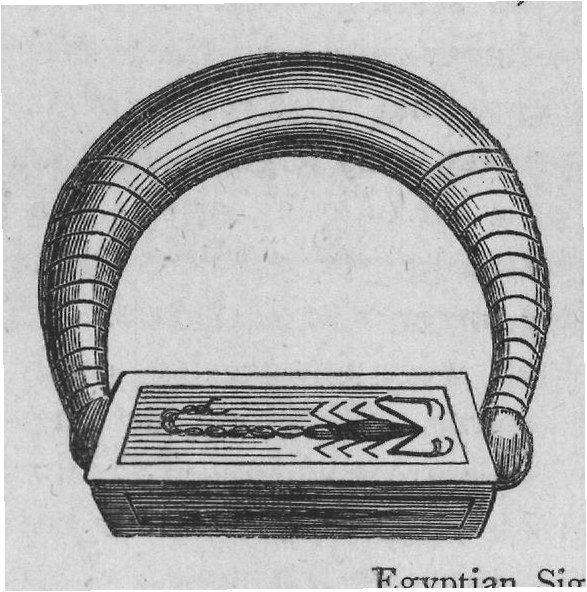
In the British Museum are some interesting specimens of Egyptian rings with representations of the scarabæus,¹ or beetle. These rings generally bear the name of the wearer, 1 The Egyptians made the scarabæus the symbol of the world, because it rolled its excrements into a globe; of the sun; of the moon, from horns; one-horned, of Mercury; of generation, because it buried the bowls in which it included its eggs, &c.; of an only son, because they believed that every beetle was male and female; of valour, manly power, &c., whence they forced all the soldiers to wear a ring upon which a beetle was engraved. All these superstitions are very ancient, for they occur upon the sepulchres of Biban-el-Molook, and are traced to the Indians, Hottentots, and other nations. In the hieroglyphs it is used for the syllable Khepra, and expresses the verb 'to be, exist.' In connection with Egyptian notions, the Gnostics and some of the Fathers called Christ the Scarabæus. 'The usual mode of mounting the scarab,' observes the Rev. C. W. King, in 'Antique Gems,' 'as a finger-ring, was, the swivel, a wire as a pivot passing through the longitudinal perforation of the stone (the edge of which was generally protected by a gold rim), and then brought through holes in each end of a bar of gold, or else of a broad, flat band of plaited wire, and bent into a loop of sufficient size to admit the finger, which was usually the fore-finger of the left hand. For the sake of security, the ends of the loop were formed into small disks, touching each extremity of the scarabæus. This loop, or ring shank, as it may be considered, was treated in a great variety of fashions, and sometimes was made extremely ornamental. One that I have seen terminated in rams' heads, the pivot entering the mouth of each; in another the shank was formed as a serpent, the head of which was one of the supporting points, and the tail tied into a knot. Occasionally the form of the shank was varied by bending the bar upon itself, so as to form a bow in the middle of its length; the ends were then beaten to a point, which, being twisted inwards, passed into the opposite holes of the stone, and thus formed a handle to the signet. This last manner of mounting the scarabæus was often used by the Egyptians, the shank being made of every kind of metal; it was also the common setting of the Phoenician stones of this form.' the name of the monarch in whose reign he lived, and also the emblems of certain deities; they were so set in the gold ring as to allow the scarabæus to revolve on its centre, it being pierced for that purpose.
Colonel Barnet possesses an Egyptian signet-ring formed by a scarabæus set in gold. It was found on the little finger of a splendid gilded mummy at Thebes. In all probability the wearer of the ring had been a royal scribe, as by his side was found a writing-tablet of stone. On the breast was a large scarabæus of green porphyry, set in gold. The Rev. Henry Mackenzie, of Yarmouth, possesses an Egyptian scarabæus, a signet-ring, set with an intaglio, on cornelian, found in the bed of a deserted branch of the Euphrates, in the district of Hamadân in Persia. The engraving is unfinished, the work is polished in the intaglio, and the date has therefore been supposed not later than the time of the Greeks in Persia, circa 325 B.C.
Egyptian Signet-rings.
The representations here given illustrate the large and massive Egyptian signet-ring, and also a lighter kind of hooped signet, 'as generally worn at a somewhat more recent period in Egypt. The gold loop passes through a small figure of the sacred beetle, the flat under-side being engraved with the device of a crab.' In the British Museum, in the first Egyptian Room, is the signet-ring of Queen Sebek-nefru (Sciemiophris). 'Sebek' was a popular component of proper names after the twelfth dynasty, probably because this queen was beloved by the people. On Assyrian sculptures are found armlets and bracelets; rings do not appear to have been generally worn.