Home › Rings from the Earliest Period › Rings from the Earliest Period: Marius
Rings from the Earliest Period: Marius
In Rome every freeman had the right to use the iron ring, which was worn to the last period of the Republic, by such men as loved the simplicity of the good old times. Among these was Marius, who, as Pliny tells us, wore an iron ring in his triumph after the subjugation of Jugurtha. In the early days of the Empire the jus annuli seems to have elevated the wearer to the equestrian order. Those who committed any crime forfeited the distinction, and this shows us the estimation in which the ring, as an emblem of honour, was regarded.
We are told of Cæsar that when addressing his soldiers after the passage of the Rubicon he often held up the little finger of his left hand, protesting that he would pledge even to his ring to satisfy the claims of those who defended his cause. The soldiers of the furthest ranks, who could see but not hear him, mistaking the gesture, imagined that he was promising to each man the dignity of a Roman Knight.
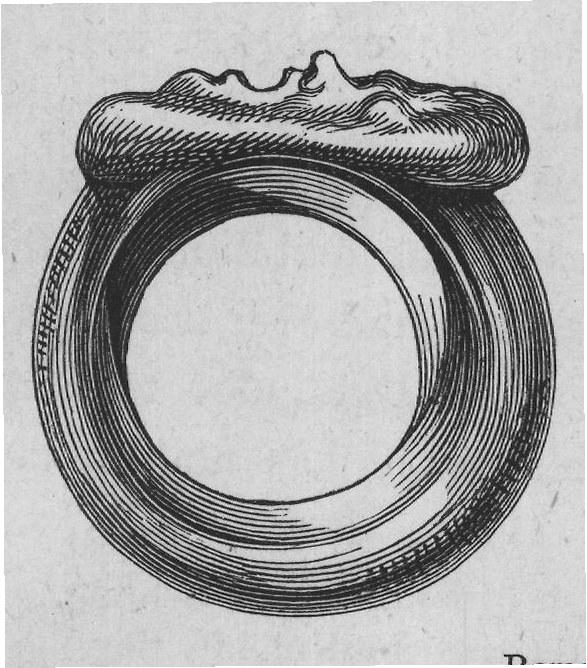
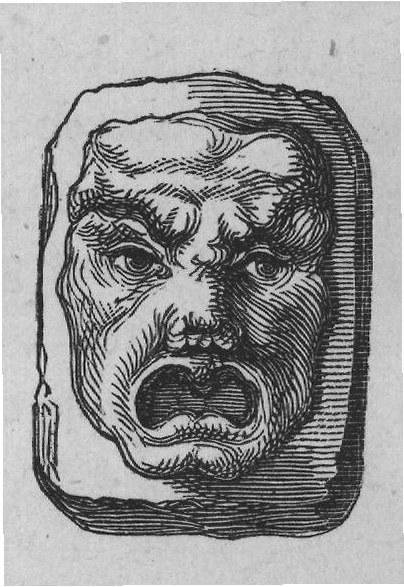
Iron Ring of a Roman Knight.
Gold rings appear to have been first worn by ambassa- 1 Appendix. dors to a foreign State, but only during a diplomatic mission; in private they wore their iron ones.
In the course of time it became customary for all the senators, chief magistrates, and the equites to wear a gold sealring. This practice, which was subsequently termed the jus annuli aurei, or the jus annulorum, remained for several centuries at Rome their exclusive privilege, while others continued to wear the iron ring. In Plutarch's Life of Caius Marius he mentions that the slaves of Cornutus concealed their master at home, and hanging up by the neck the body of some obscure person, and putting a gold ring on his finger, they showed him to the guards of Marius, and then wrapping up the body as if it were their master's, they interred it. Magistrates and governors of provinces seem to have possessed the privilege of conferring upon inferior officers, or such persons as had distinguished themselves, the right of wearing a gold ring. Verres thus presented his secretary with a gold ring in the assembly at Syracuse.
Roman.
Montfaucon mentions in his 'Antiquity Explained' (English Edition, 1722, vol. iii. p. 146), a Greek seal-ring, which has the shape of a crescent. An illustration is here given of a similarlyformed Roman ring, with the letters Q. S. P. Q., Quintanus Senatus Populusque, from the 'Gemme Antiquæ Litteratæ.' Some wore rings of gold, covered with a plate of iron. Trimalchion wore two rings, one upon the little finger of his left hand, which was a large gilt one, and the other of gold, set with stars of iron upon the middle of the ring-finger. Some rings were hollow, and other solid. The Flamines Diales could only wear the former.
During the Empire the right of granting the privilege of a gold ring belonged to the emperors, and some were not very scrupulous in conferring this distinction.
Severus and Aurelian granted this privilege to all Roman soldiers; Justinian allowed all citizens of the empire to wear such rings.
But there always seems to have been a difficulty in restricting the use of the gold ring. Tiberius (A.D. 22) allowed its use to all whose fathers and grandfathers had property of the value of 400,000 sestertia (3,230l.). The restriction, however, was of little avail, and the ambition for the annulus aureus became greater than it had ever been before. Juvenal, in his eleventh 'Satire,' alludes to a spendthrift who, after consuming his estate, has nothing but his ring :- At length, when nought remains a meal to bring, The last poor shift, off comes the Knightly ring, And sad Sir Pollio begs his daily fare, With undistinguished hands, and fingers bare.
Martial attacks a person under the name of Zoilus, who had been raised from a state of servitude to Knighthood, and was determined to make the ring, the badge of his new honour, sufficiently conspicuous :- Zoile, quid tota gemmam præcingere libra Te juvat, et miserum perdire sardonycha ?
Annulus iste tuus fuerat modo cruribus aptus; Non eadem digitis pondera conveniunt.
The keeping of the imperial ring (cura annuli) was confided to a state keeper, as the Great Seal with us is placed in custody of the Lord Chancellor.
With the increasing love of luxury and show, the Romans, as well as the Greeks, covered their fingers with rings, and some wore different ones for summer and winter, immoderate both in number and size.¹ The accompanying illustrations represent a huge ring of coloured paste, all of one piece, blue colour-one of the rings of inexpensive manufacture in popular use among the lower classes. It is smaller on one side, to occupy less space on the index or little finger.
Roman.
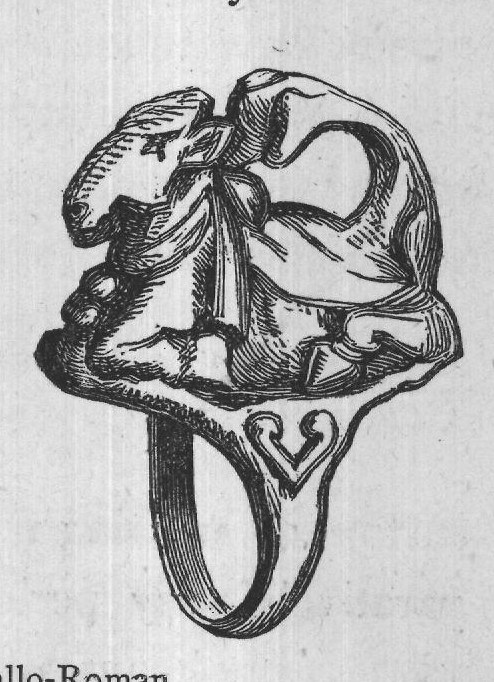
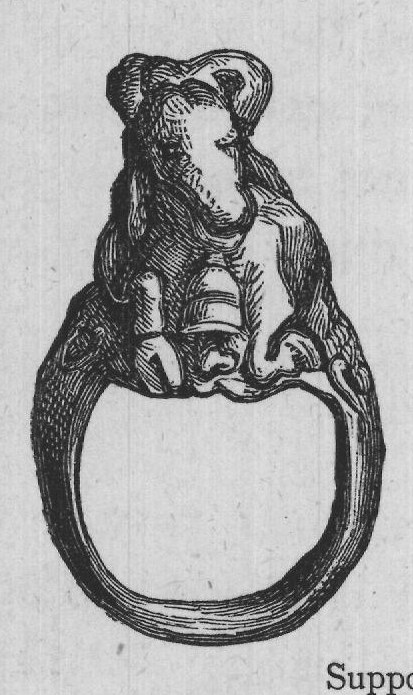
The following illustrates a supposed Gallo-Roman ring of outrageous proportions, similar to those complained of by Livy (xxxiii., see Appendix), for their extravagant size. It is of bronze, and supposed to represent a cow or bull seated, with a bell round the neck.
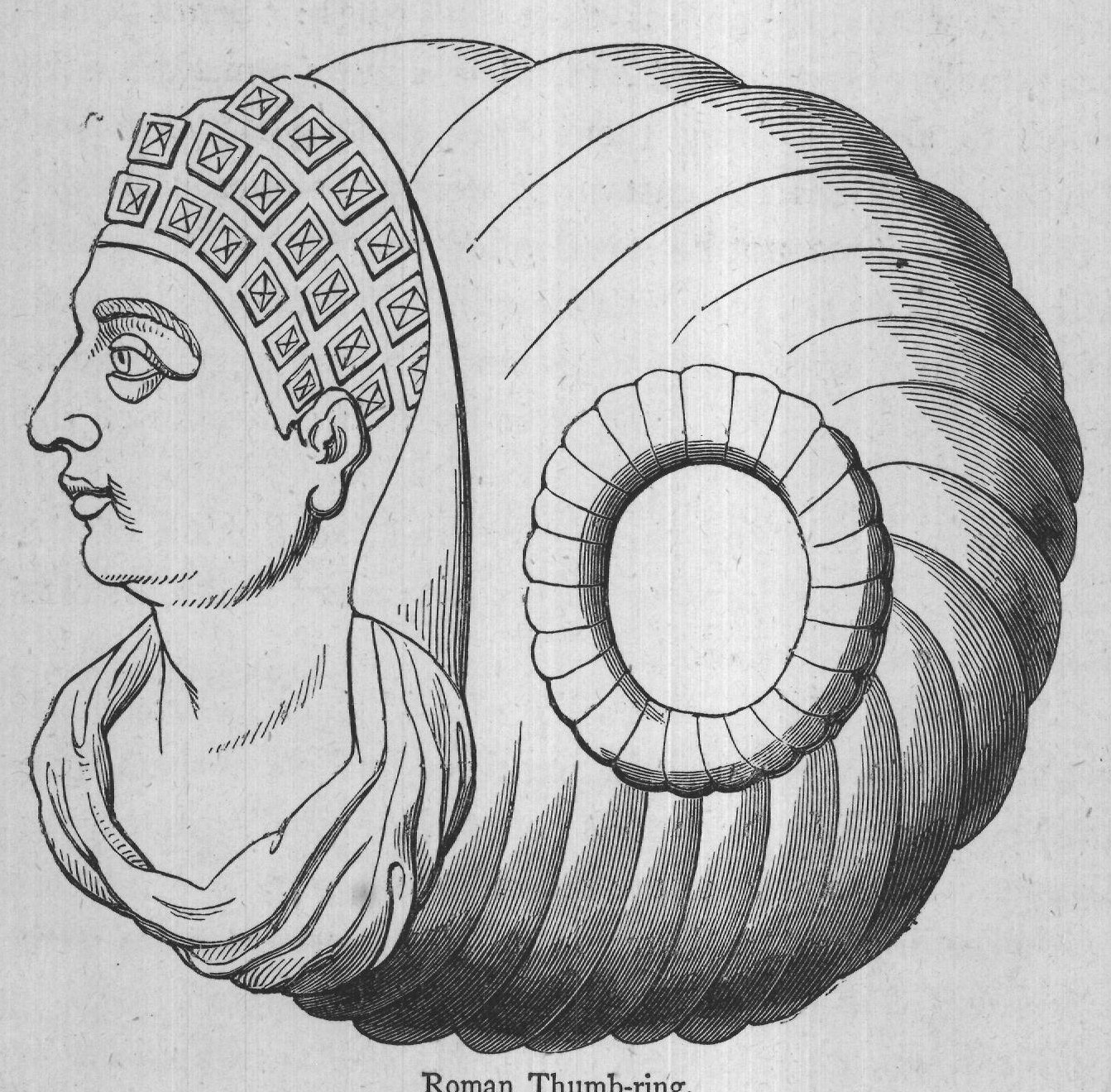
Heavy rings of gold of a sharp triangular outline were worn on the little finger in the later time of the Empire. A thumb- 1 Addison remarks that when at Rome he had 'seen old Roman rings so very thick about, and with such large stones in them, that it is no wonder a fop should reckon them a little cumbersome in the summer season of so hot a climate.' A Roman ring found in Hungary contained more than two ounces of gold. ring of unusual magnitude and of costly material is represented in Montfaucon. It bears the bust in high relief of the Empress Plotina, the consort of Trajan: she is repre- ☑ Supposed Gallo-Roman.
Roman Thumb-ring. sented with the imperial diadem. It is supposed to have decorated the hand of some member of the imperial family. The Rev. C. W. King mentions a ring in the Fould Collection (dispersed by auction in 1860), the weight of which, although intended for the little finger, was three ounces. was set with a large Oriental onyx, not engraved.