Home › Betrothal and Wedding Rings › Betrothal and Wedding Rings: Russian
Betrothal and Wedding Rings: Russian
The ring ceremony in Russian marriages differs materially from that of English usage. In the first place, there are two rings, and these are changed three times. The man places the ring first on the woman's finger, then the priest changes the man's ring, and places it on her finger, and then again the priest and the man join and place the ring where it is to remain for life.
Have these three changes anything in connection with a peculiarity in Russian legends of the ever-predominating number 'three'? Thus fathers are said usually to have three sons, the heroes and knights-errant ride through three times nine empires; the bravest are always thirty-three years old; they achieve their deeds only on the third attempt. Or, are the three changes emblematic of the Trinity? At the Russian marriages of the Imperial family the rings are exchanged by a third person. At the wedding of the Duke of Edinburgh and the Grand Duchess Marie Alexandrovna, daughter of the Emperor of Russia (January 23, 1874), the master of the ceremonies carried the marriage rings on plates of gold, and placed them on the altar. The confessor of the Emperor and Empress then received the rings from the Archipretres of the court, and, whilst a prayer was being said, placed them upon the fingers of the bride and bridegroom, when the Metropolitan began the office.
In Spain the gift of a ring is looked upon as a promise of marriage, and is considered sufficient proof to enable a maiden to claim her husband.
Among the Armenians (observes Madame de Barrera) children are betrothed from their earliest youth, sometimes when only three years old, sometimes as soon as born. When the mothers on both sides have agreed to marry their son and daughter, they propose the union to their husbands, who always sanction the choice of the wives. The mother of the boy then goes to the friends of the girl, with two old women and a priest, and presents to the infant maiden a ring from the future bridegroom. The boy is then brought, and the priest reads a portion of the Scripture, and blesses the parties. The parents of the girl make the priest a present, in accordance with their means; refreshments are partaken of by the company, and this constitutes the ceremonies of the betrothals. Should the betrothals take place during the infancy of the contracting parties, and even should twenty years elapse before the boy can claim his bride, he must every year, from the day he gives the ring, send his mistress at Easter a new dress, &c.
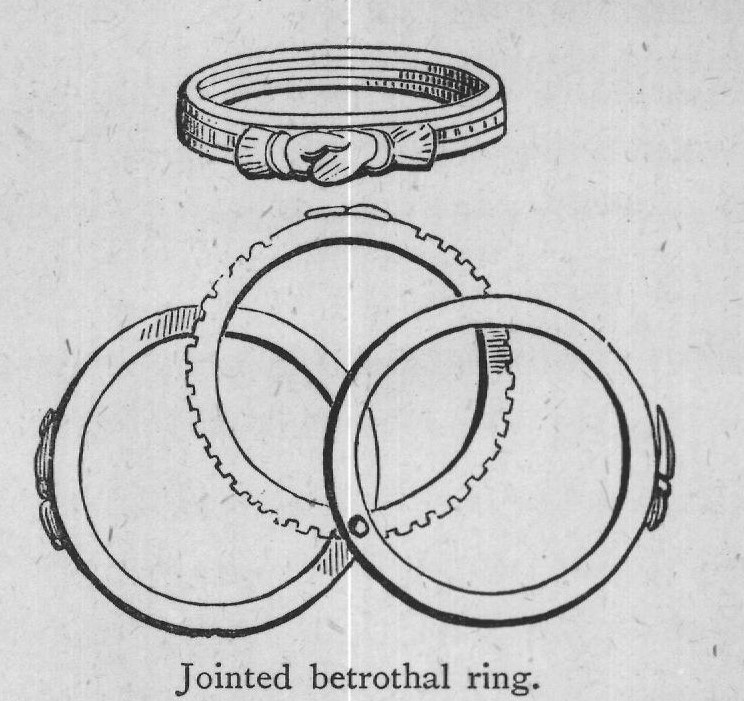
The olden matrimonial Gemmel, or Gemmow, ring was a kind of double ring, curiously made. There were links within each other, and though generally double, they were, by a further refinement, made triple, or even more complicated; thus Herrick writes :- Thou sent'st to me a true love-knot, but I Return a ring of jimmals, to imply Thy love had one knot, mine a triple tye.
Ray, among his north-country words, explains 'jimmers' as 'jointed hinges,' and adds, 'in other parts called winghinges.' AVE At a meeting of the Archæological Institute, in November 1851, the Rev. W. C. Bingham exhibited a silver gemmel-ring of singular fashion, date fourteenth century, found in Dorsetshire, the hoop formed in two portions, so that a moiety of the letters composing the legend, MARI, appears on each, and it only becomes legible when they are brought together side by side. Each demi-hoop is surmounted by a projecting neck and a small globular knob, so that the ring appears to have a bifid head. The two portions of this ring are not intertwined, and as no adjustment now appears by which they might be kept together in proper juxtaposition, it is possible that in this instance it was intended that each of the affianced parties should retain a moiety of the gemmel.
There is an allusion to the 'joint' ring in Dryden's play of Don Sebastian' :- A curious artist wrought 'em, With joynts so close as not to be perceived; Yet are they both each other's counterpart. (Her part had Juan inscribed, and his, had Zayda- You know those names were theirs :) and in the midst A heart divided in two halves was placed.
Now if the rivets of those rings, inclos'd, Fit not each other, I have forged this lye, But if they join, you must for ever part.