Home › Betrothal and Wedding Rings › Betrothal and Wedding Rings: Childeric
Betrothal and Wedding Rings: Childeric
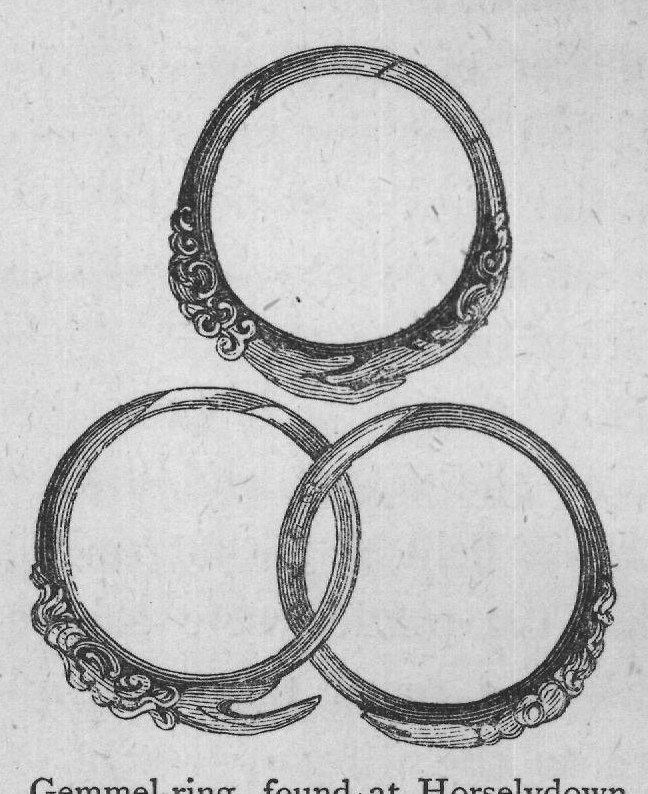
This practice of dividing the betrothal rings has its origin from ancient times, and reminds us of the practice among the Franks of breaking the sou d'or in two pieces, in sign of a sacred engagement. Thus we read of Childeric, King of France, when in exile, wishing to know when he might return to his country, dividing the sou d'or, keeping one part, and giving the other to a trusty friend, who tells him: 'When I send to you this half, and you find that it unites with the other, you will understand that you can return.' The propitious moment having arrived, Childeric received the token, and, returning, was re-established in his dominions.1 1 The 'betrothing penny' given at the ceremony of marriage was in olden times a common usage both in England and in France, representing either earnest-money, or the actual purchase of the bride. In the pontifical of Amiens, the bridegroom is to say: 'De cet anneau From other passages in 'Don Sebastian,' it appears that one of the two rings was worn by Sebastian's father, the other by Almeyda's mother, as pledges of love. Sebastian takes off his ring, which had been placed on his finger by his dying father; Almeyda does the same with hers, which had been given to her by her mother at parting, and Alvarez unscrews both the rings and fits one half to the other. In Sir Henry Ellis's 'Original Letters Illustrative of English History' (series ii. vol. ii. page 290) we have a curious anecdote in connection with linked rings. Lady Catherine Grey (a sister of Lady Jane Grey) married the Earl of Hertford, much to the displeasure of Queen Elizabeth, who sent the bridegroom to the Tower, and subjected the countess to great hardships. They were both exposed to an ordeal of examination to prove the validity of the marriage, and amongst other evidence Lady Catherine exhibited a ring which she declared had been used at the marriage ceremony.
It was of gold, and consisted of five links, on four of which were engraved as many verses of the Earl's composition, expressing the assurance of his lasting faith and love, and the ring could, apparently, have been prepared for no other purpose than that of serving as their marriage-ring. The judgment of the commissioners appointed to examine into the marriage was to dissolve it, and it was so pronounced in the Bishop of London's palace in 1562. Lady Hertford sank under this cruel conduct of the Queen, and on her dying bed called to her attendants to t'espouse, et de cet argent te hounoure, et de mon corps te doue.' In an ancient manuscript of the Salisbury Missal, in the Harleian Collection, the bridegroom says: 'Wyth thys rynge y the wedde, and thys golde and selvir the geve, and with my bodi y the worshippe, and with all my worldith catel y the honoure.' bring her the box in which her wedding-ring was. She first took from it a ring with a pointed diamond in it, and said to Sir Owen Hopton (at whose house, Cockfield Hall, Suffolk, she had been staying): 'Here, Sir Owen, deliver this unto my lord; it is the ring that I received of him, and gave myself unto him, and gave him my faith.' 'What say you, madam,' answered Sir Owen, 'was this your wedding-ring?' 'No, Sir Owen, this is the ring of my assurance unto my lord, and there is my wedding-ring,' taking another ring of gold out of the box. This consisted of five links, having engraved in it the verses of the Earl's composition, which she had exhibited to the commissioners of inquiry. (See chapter on 'Posy, Inscription, and Motto Rings.') 'Deliver this,' she said, 'unto my lord, and pray him, as I have been a faithful and true wife, that he would be a loving and natural father unto my children, to whom I give the same blessing that God gave unto Abraham, Isaac, and Jacob.' (See chapter on 'Remarkable Rings.') A gemmel-ring of the fifteenth century, in the Londesborough Collection, bears an engraved head of Lucretia, the Ring with representation of Lucretia. same kind as that mentioned by Shakspeare ('Twelfth Night,' act ii. sc. v.) where Malvolio, breaking open the letter, purporting to be in the handwriting of his mistress, says :-- By your leave, wax. Soft! and the impressure her Lucrece, with which she uses to seal.
Lucretia is seen grasping her dagger. The clasped hands, adopted on the gemmel-rings, became a frequent emblem on the solid wedding-ring.