Home › Betrothal and Wedding Rings › Betrothal and Wedding Rings: Londesborough
Betrothal and Wedding Rings: Londesborough
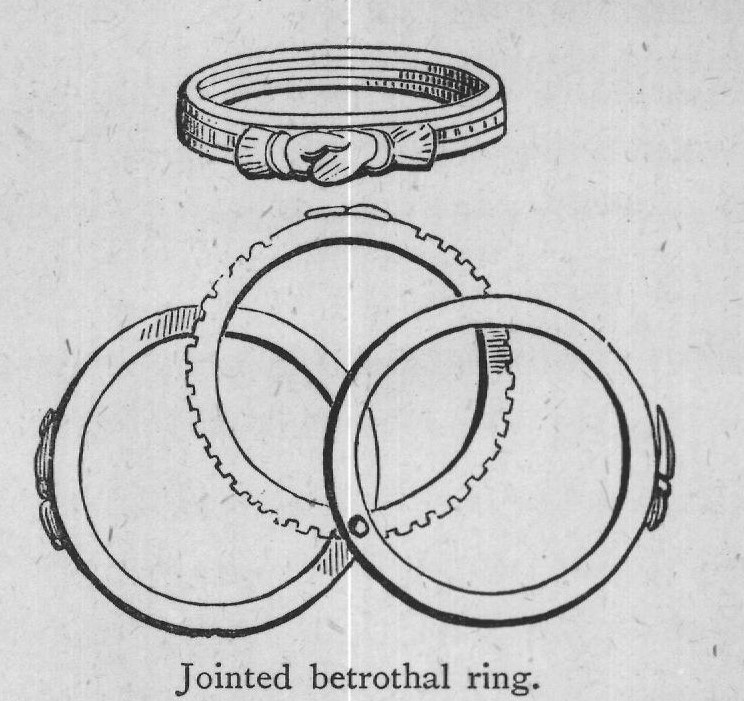
A ring in the Londesborough Collection illustrates this passage. It parts into three hoops, secured on a pivot; 1 Jointed betrothal ring. the toothed edge of the central hoop forming an ornamental centre to the hoop of the ring, and having two hearts in the middle; a hand is affixed to the side of the upper and lower hoop; the fingers slightly raised, so that when the hoops are brought together they link in each other, and close over the hearts, securing all firmly.
The late Mr. Crofton Croker, in his privately-printed catalogue of Lady Londesborough's Collection, gives the following account of the use to which the ring has been put : 'There can be little doubt, from the specimens that have come under observation, that it had been used as a betrothing ring by an officer of the King's German Legion with some Irish lady, and that the notched ring was retained by some confidential female friend, who was present as a witness at the betrothal ceremony-usually one of the most solemn and private character-and at which, over the Holy Bible, placed before the witness, both the man and the woman broke away the upper and lower rings from the centre one, which was held by the intermediate person. It would appear that the parties were subsequently married, when it was usual, as a proof that their pledge had been fulfilled, to return to the witness or witnesses to the contract the two rings which the betrothed had respectively worn until married; and thus the three rings, which had been separated, became reunited, as in the present instance.' A gemmel-ring, of which a representation is given (page 316), was dug up in 1800, at Horselydown, Surrey, found among some Roman and English remains and skeletons of human bodies, about nine feet below the surface. The ring is constructed in twin or double hoops, one side being flat, the other convex. On the lower hand is represented a heart. On the flat side of the hoops are engraved in Roman capitals, 'Usé de Vertu.' This ring is probably not later than Queen Elizabeth's reign.
A plain gemmel wedding-ring, with an inscription inside each hoop, which the Prince Regent, afterwards George IV., had given to Mrs. Fitzherbert, was exhibited, with the lady's miniature, at the Loan Collection of precious objects at the South Kensington Museum in 1872.
Gemmel-ring, found at Horselydown.