Home › Ring Superstitions › Ring Superstitions: Collection
Ring Superstitions: Collection
The following engraving (from the Collection Chabouillet) represents a Greek amulet ring, adopted by the Amulet against the 'evil eye.' Etruscans and Romans, and which offers, by the stone and setting, the figure of an eye. These rings were movable, and turned on the axis.
The great preservative against this was the wearing of a ring, with the figure of a cockatrice, supposed to proceed from a cock's egg under various planetary and talismanic influences. The Londesborough thumb-ring has two cockatrices cut in high relief upon an agate. Amulets against the 'evil eye.' The deadly power of the cockatrice is alluded to by Shakspeare in 'Twelfth Night' and in 'Romeo and Juliet'- Say thou but I, And that base vowel I shall poison more Than the death-darting eye of cockatrice.
So Dryden says :- Mischiefs are like the cockatrice's eye; If they see first, they kill; if seen, they diealluding to the counter-action, that if the creature was seen by a person first, without being perceived by it, the cockatrice died from the effect of the human eye. The figure of the bird merely gave security against the evil eye; it had no other effect, and for this purpose various engraved stones were used. Thus a ring in the Londesborough Collection has in its centre a Gnostic gem with cabalistic figures, believed able to avert the dreadful glance. In the same collection is a massive thumb-ring, having the tooth of some animal as its principal gem, supposed to have mystic power over the fortunes of its possessor. It is set all round with precious stones of talismanic virtues. A dove, with a branch of olive in its mouth, engraved in pyrites, and mounted in a silver ring, ensured the wearer the utmost hospitality wherever he went, possessing the power of fascination. A fair head, well combed, with a handsome face, engraved on a gem, secured joy, reverence, and honour.
Rings made of the bones of an ostrich were assumed to be of rare virtue.
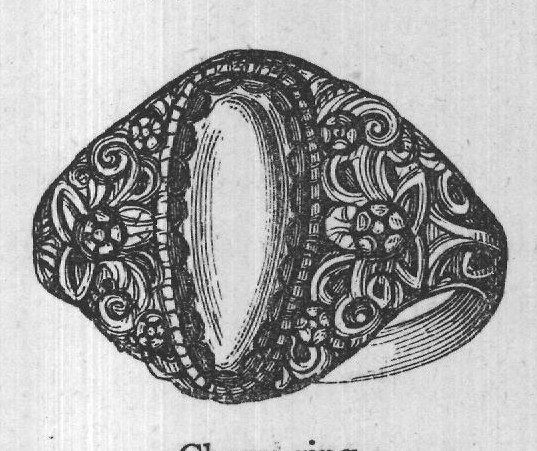
Charm-ring.
Annexed is a representation of a silver charm-ring in the South Kensington Museum; the hoop is spirally fluted, widening towards the bezel, which is set with a tooth; the shoulder of the ring is pierced in floriated German work of the eighteenth century.
In the Waterton Collection are several rings of hoofprobably that of an ass-enclosed in gold, and considered a remedy for epilepsy. From Cardan (de Venenis) we learn, among other means for a physician to find out whether a patient is 'fascinated,' that of a ring made of the hoof of an ass, put on his finger, growing too large for him after a few days' wearing. It seems that among the Indians and Norwegians the hoof of the elk is regarded as a sovereign cure for the same malady. The person afflicted applies it to his heart, holding it in his left hand, and rubbing his ear with it.
A Brand, in his 'Popular Antiquities,' states that in Berkshire a ring made from a piece of silver collected at the Communion is supposed to be a cure for convulsions and fits of every kind. If collected on Easter Sunday its efficacy is greatly increased. Silver is not considered necessary in Devonshire, where a ring is preferred made out of three nails or screws that have been used to fasten a coffin, and that have been dug out of the churchyard. It is curious to notice that, according to Pliny, the ancients believed that a nail drawn out of a sepulchre and placed on the threshold of a bed-chamber door would drive away phantoms in the night.
In Lucian's 'Philopseudes' one of the interlocutors states that since an Arabian had presented him with a ring made of iron taken from the gallows, together with a written charm, he had ceased to be afraid of the demoniacs, who had been healed by a Syrian in Palestine.' In the 'Gentleman's Magazine' for 1794 we are told that a silver ring will cure fits when it is made from five sixpences collected from as many bachelors, to be conveyed by the hands of a bachelor to a smith that is a bachelor. None of the persons who gave the sixpences were to know for what purpose, or to whom they gave them.
The 'London Medical and Physical Journal' for 1815 notices a charm successfully employed in the cure of epilepsy, after the failure of various medical means. It consisted of a silver ring contributed by twelve young women, and was to be constantly worn on one of the fingers of the patient. 6 In 'Notes and Queries' (vol. i. 2nd series, p. 331) we find a Gloucestershire ring prescription for epilepsy, which shows the persistence of credulity even in the present enlightened period. The curate of Hasfield, going into the house of a parishioner whose daughter was afflicted with epileptic fits, was accosted by the mother of the damsel in a most joyous tone : "Oh! sir, Emma has got her ring." The good curate, fearing that the poor girl might have stooped to folly, and that this was an intimation that her swain intended to make an honest woman of her, sought an explanation, which was afforded in the following prescription :- "Why, you see, sir, our Emma has been long troubled with the fits, and she went to the church door, and asked a penny from every unmarried man that went in, till she got twenty-four. She then took them to a silversmith in Gloucester, who promised to get them changed for 'Sacrament' money (which he said he could easily do, as he knew one of the cathedral clergy). And with that money, sir, he made her a silver ring, and Emma is wearing it, and has not had a fit since."" In Somersetshire it is a popular belief that the ring-finger, stroked along any sore or wound, will soon heal it. All the other fingers would poison the finger instead of healing it. It is still an article of belief in some persons that there is virtue enough in a gold ring to remove a stye from the eye, if it be rubbed with it.
Although silver appears to be the happy medium chiefly in these wonderful cures, yet we are told that Paracelsus had a ring made of a variety of metallic substances, which he called electrum, and which not only cured epilepsy, but almost every other complaint.