Home › Token Rings › Token Rings: Devereux
Token Rings: Devereux
The Devereux' Ring.
Perhaps the strongest claim to the possession of the real ring of Essex is that which was exhibited at the Society of Antiquaries, March 1858, by the Rev. Lord John Thynne. It is of gold, slightly made, and ornamented on the inside with blue enamel. On the face is set a cameo cut in sardonyx, representing Queen Elizabeth in a high ruff. The workmanship is good, and shows considerable skill in the adaptation of the layers of the stone to the details of the dress. It seems to have been originally made for a very small finger, and to have been subsequently enlarged. The ring is said to have been the property of Lady Frances Devereux, daughter of the Earl of Essex, and afterwards Duchess of Somerset, and to have passed from mother to daughter until it came to Louisa, daughter of John, Earl of Granville, who married Thomas Thynne, second Viscount Weymouth, great-grandfather of the present owner. It has been stated by Captain Devereux that no mention of the ring in question is made in the elaborate will of the Duchess of Somerset. She may, however, have given it to her daughter in her lifetime. The ring appears to have been made for a female finger, and as it is not very likely that the Queen would have worn her own portrait in a ring, it is more probable that this ring was intended for one of the ladies of her court, and it may have been enlarged for some subsequent owner. It is undoubtedly a remarkable work of art of the period of Elizabeth.
It may be noticed that the Hon. Captain Devereux, in his 'Lives and Letters of the Devereux, Earls of Essex,' seems to believe in the story of the ring, but the evidence he adduces is not sufficient to justify his faith.
Another ring, which is in the possession of C. W.
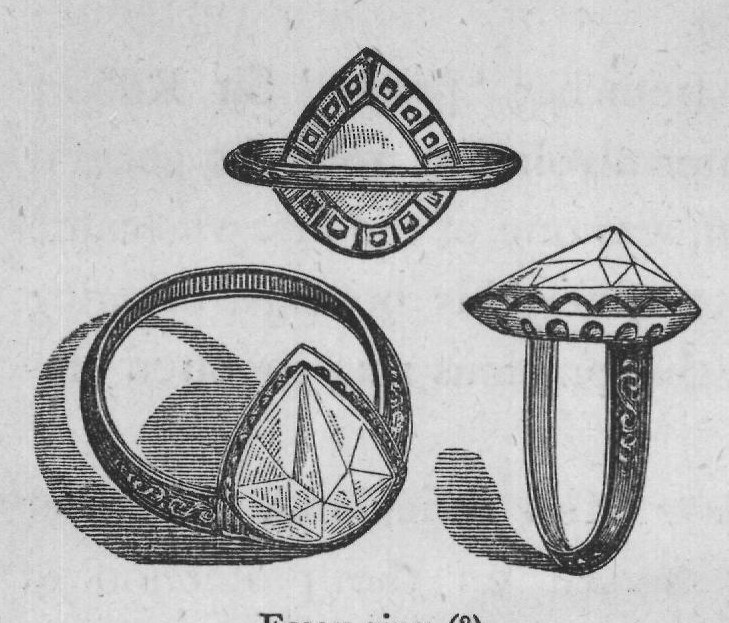
Warner, Esq. (and is, together with that noticed, engraved in the 'Lives and Letters of the Devereux, Earls of Essex'), sets forth a rival claim to be the identical ring given to Essex, of which, however, it shows no internal evidence, being a slight ring, without any device, and has an enamelled hoop, set with a pear-shaped diamond.
In 'Manningham's Diary,' 1602-1603 (Camden Society), is the following entry: 'Dr. Parry told me the Countess Kildare assured him that the Queene caused the ring wherewith shee was wedded to the crowne to be cutt from hir finger, some six weekes before her death, but wore a ring which the Earl of Essex gave her unto the day of hir death.'1 The interchange of rings as royal tokens between Queen Elizabeth and Mary, Queen of Scots, was frequent; whether genuine in the feelings that prompted their transmission (at least, as regards the former) may be questioned. On the baptism of the son of the Scottish Queen (afterwards James the Sixth) we are informed that the Duke of Bedford, be-. sides a gold font, the present of Queen Elizabeth, sent 'ane ring with ane stane to be delivered to the said woman who should occupy the place of the Queen's Grace of England at the said baptism.' Mary is mentioned by the English ambassador to the Scottish court as wearing, on the celebration of Twelfth Day in 1562, no jewels or gold, but a ring sent to her by Elizabeth. It may have been that which, a prisoner at Lochleven Castle, she wished to obtain from the royal jewels which had been kept back from her by the Earl of Moray. It had been sent to her as a token of 1 Appendix. 2 Lady Moray, the wife of the Scottish Regent, had appropriated, during the Queen's troubles, many of her most valuable jewels. She wrote to her from Tutbury, March 28th, 1570:- We are informed that ye have tane in possession certain of our jewels, such as our Henry of dyamant and ruby, with a number of other dyamant, ruby, perles, and gold worke, whereof we have the memoir to lay to your charge, which jewels incontinent, after the sight hereof, ye sall deliver to our right trusty cousins and counsellors, the Earl of Huntley, our lieutenant, and my Lord Setoun, who will, on so doing, give you discharge of the same.' Lady Moray paid no attention to Queen Mary's request for the return of her jewels, well knowing that she was in no condition for enforcing her demands. friendship, and the promise that if it were returned to the donor in any period of misfortune she would do her best to assist her.
Miss Strickland informs us that Mary, in a letter to Elizabeth, though unable, as she mentions, to send back the ring, reminds Elizabeth of her promise. This interesting letter is still preserved at Hatfield House. It will please you to remember,' she writes, 'you have told me several times that on receiving the ring you gave me you would assist me in my time of trouble. You know that Moray has seized all that I have, and those who had the keeping of some of these things have been ordered not to deliver any of them to me. Robert Melville, at any rate, to whom I have secretly sent for this ring, as my most precious jewel, says "he dare not let me have it." Therefore I implore you, on receiving this letter, to have compassion on your good sister and cousin, and believe that you have not a more affectionate relative in the world,' etc. etc., 'dated from my prison this 1st of May' (1568).
On the escape of Mary from her 'prison,' Sir Robert Melville, anticipating a counter-revolution from the general feeling in favour of the Queen, was one of the first who came to her at Hamilton Castle to renew his homage, bringing with him as a peace-offering the precious ring so often demanded in vain. 'On leaving Scotland,' says Miss Strickland, 'after her fatal resolution of throwing herself on the protection of Queen Elizabeth, Mary sent the ring as an avant-courier, with a letter. This romantic toy, which she regarded in the same light as one of the fairy talismans in eastern love, was actually the lure which tempted her in this desperate crisis of her fortunes to enter England, under the fond idea that its donor could not refuse to keep her promise. She concludes an affecting letter to Queen Elizabeth (dated from Dundrennan) thus: "To remind you of the reasons I have to depend on England, I send back to the Queen the token of her promised friendship and assistance."" This memorable ring is described by Aubrey, to have been a delicate piece of mechanism, consisting of several joints, which, when united, formed the quaint device of two right hands supporting a heart between them. This heart was composed of two separate diamonds, held together by a central spring, which, when opened, would allow either of the hearts to be detached. 'Queen Elizabeth,' says Aubrey, 'kept one moietie, and sent the other as a "token" of her constant friendship to Mary, Queen of Scots, but she cut off her head for all that.' a The circumstance of the ring is further verified beyond dispute by Mary herself, in a subsequent letter to Elizabeth, in which she bitterly reproaches her with her perfidious conduct. 'After I escaped from Lochleven,' she says, 'and was nearly taken in battle by my rebellious subjects, I sent you by a trusty messenger the diamond you had given me as a token of affection and demanded your assistance. I believed that the jewel I received as a Essex ring (?). pledge of your friendship would remind you that when you gave it me I was not only flattered with great promise of assistance from you, but you bound yourself on your royal word to advance over the border to my succour, and to come in person to meet me, and that if I made the journey into your realm that I might confide in your honour.' Elizabeth, as is well known, took no notice either of the pledge or allusions to her former professions.
The illustration on the preceding page represents the ring mentioned (p. 339) as the property of the Warner family. Sir Thomas Warner, to whom it was presented by James the First, placed it on his shield of arms, with the motto, 'I hold from the King.' During the Duke of Norfolk's imprisonment in the Tower he sent two diamond rings, as love-tokens to Mary, Queen of Scots, while she was at Coventry.