Home › Betrothal and Wedding Rings › Betrothal and Wedding Rings: Hebrew
Betrothal and Wedding Rings: Hebrew
Hebrew Marriage Rings.
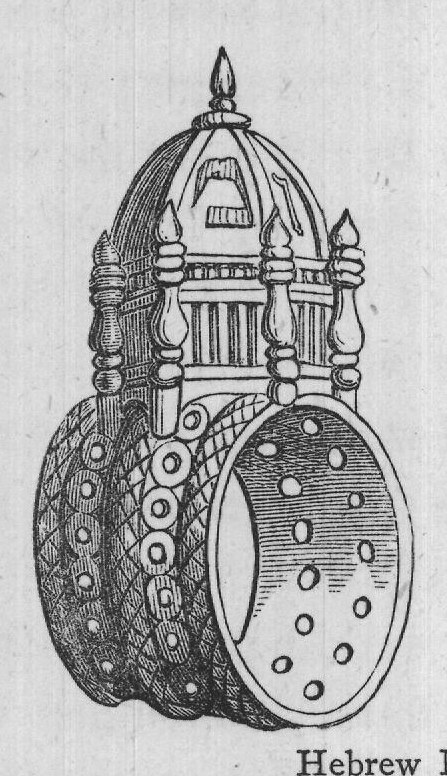
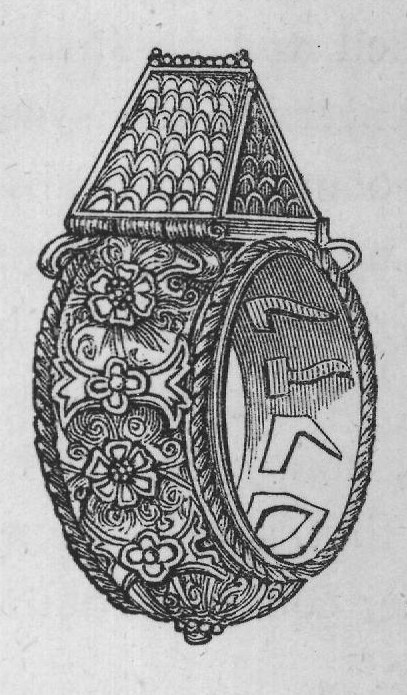
A ring of gold, enamelled and decorated with five blue enamelled rosettes and five filigree bosses. The roof only of the temple surmounts the ring; it is decorated with lightgreen enamel, it opens on a hinge, and exhibits beneath the letters IID. From the Londesborough Collection.
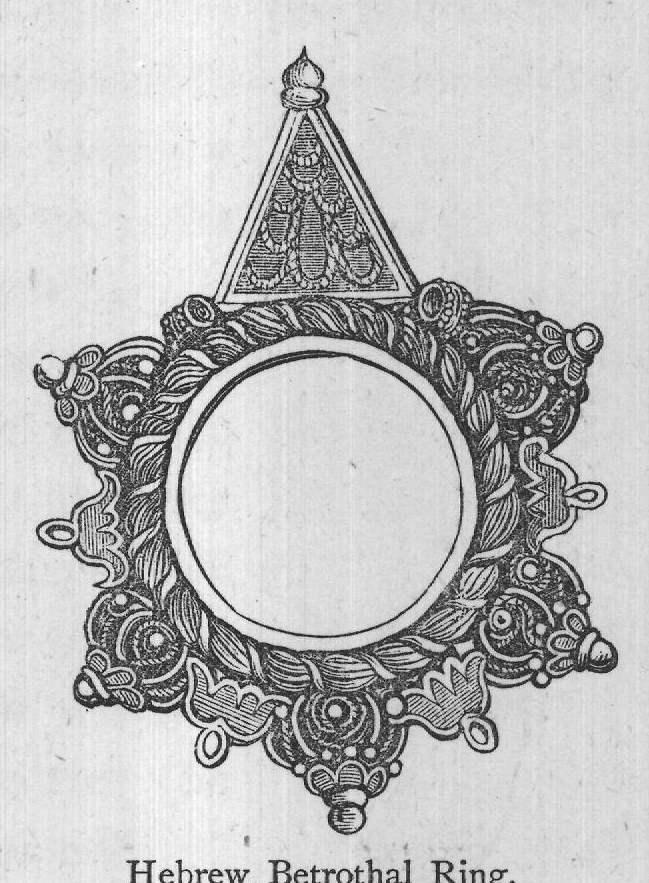
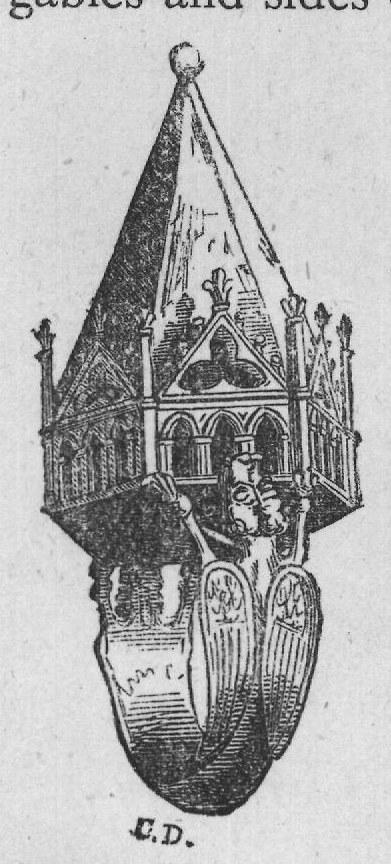
A remarkably fine example of these rings is in the Braybrooke Collection. It has five filigree bosses equidistant along the broad exterior, which is also ornamented with filagree scroll-work, filled with blue and white enamel; Hebrew Betrothal Ring. the summit of the hoop is surmounted by a pyramid-shaped tower opening upon a hinge, but without any inscription, which is often covered by it. In this case the word or words are engraved on the inside of the ring, and are probably Mazul-touv or Mussul-taub ('Joy be with you'). The tower is to represent the ark of the covenant; the bosses or points are sometimes supposed to represent the number of witnesses at the ceremony required by law of the Jews. The points or bosses consist of rosettes with six leaves, each of blue, and six leaves of white, enamel. The pyramidical ark has the sides filled with blue enamel only; on the two narrow sides there is a small perforation to represent the window, in allusion to the dove. A large silver-gilt Hebrew wedding-ring, in the same collection, is of a remarkable form. The hoop is threequarters of an inch wide, with raised edges, and plain surface between the five elevations on its upper portion. The centre one of these is a hexagonal tower, with pent-house roof sloping on each side to the course of the hoop; the gables and sides of these are pierced with fourteen holes for windows, and the roof is scored to imitate tiles; on each side of this is a smaller bellshaped tower, equidistant from it, with four circular holes in them; and on each side of these last is a still smaller tower of the same shape, and at an equal distance, but without any windows. There is not the usual inscription on any part of this ring.
C.D.
Jewish.
The annexed illustrations, from rings in the Bailewski Collection, represent a gold Jewish 100 Jewish ring of the thirteenth century, and one of the fourteenth century. In the collection of the late Lady Fellows was a fine Jewish betrothal ring of gold decorated with filigree and enamel. Instead of any setting, the head is formed with a steep ridge, like the roof a house, opening on hinges; within is a cavity, closed by a lid, and probably intended to contain a charm or pastille. On the inner side of the hoop are engraved two Hebrew words signifying good fortune.
In a communication from Mr. Singer (whose unique collection of wedding-rings with inscriptions I have noticed in the chapter on 'Posy, Inscription, and Motto Rings') he informs me that he has a fine Hebrew ring of sixteenthcentury work-' a real old one, as most of those now about are forgeries. This has the Hebrew word "mussul taub " in a short Hebrew character, meaning "We wish you good luck," engraved on the inside.' According to Jewish law in modern times, it is necessary that the ring should be of a certain value. It is therefore examined and certified by the officiating Rabbi and the chief officers of the synagogue, when it is received by the bridegroom. When absolute property it must not be obtained by credit or by gift. When this is properly certified the ring is returned to him, and he places it on the bride's finger, calling attention to the fact that she is by these means, consecrated to him. So completely binding is this action that, should the marriage be no further consecrated, no other could be contracted by either party, without a legal divorce.
The Rev. C. W. King, in 'Antique Gems,' remarks that huge gold rings adorned with filigree-work and surmounted by a small temple, with Hebrew inscriptions on the interior of the shank, puzzle the beholders as to their use, being much too large for the finger. They were made for the use of the synagogue, and are placed on the finger of the couple at a certain part of the marriage rites.
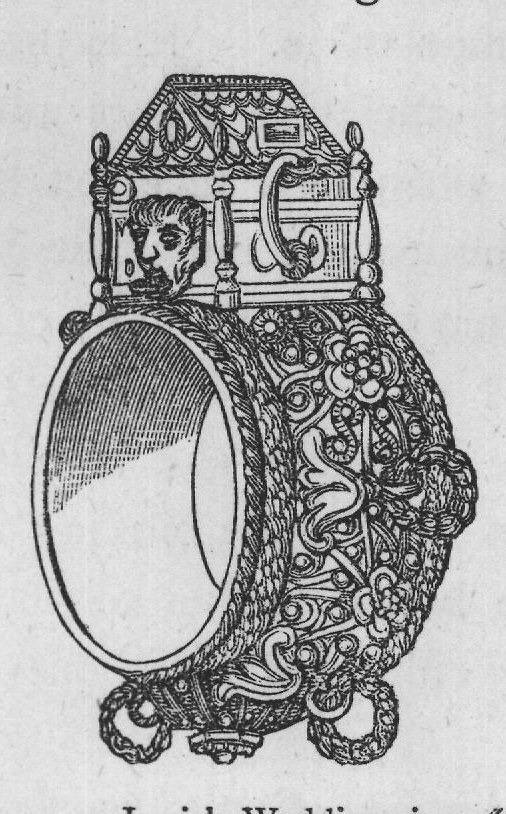
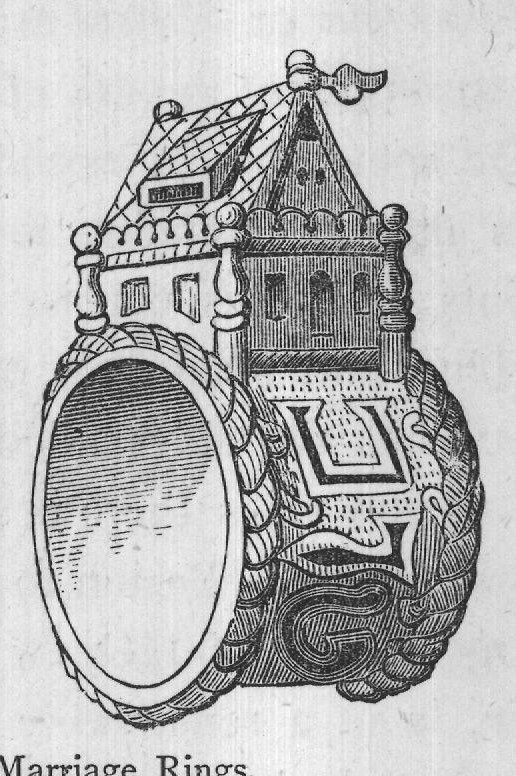
Mr. Singer, in describing the Hebrew wedding-ring in his collection, adds: 'The Hebrews married on the first finger, as to the ring. This is done now, but even the Jews change a little, and after the ceremony the Jewish ladies take off their ring, and place it on the third finger, the same as we do, for now they wear the ordinary ring.' The following illustrations represent the marriage-rings of the German Jews, the workmanship of the sixteenth century, and very fine specimens of art. Both are of gold; the larger one is richly ornamented in filigree with enamels of light and dark green. It is crowned by a house; the roof, which is covered with enamelled tiles, opens by means of a key, and the space within serves for perfumes or some souvenir. Four small crowns of gold are suspended from the ring. Jewish Wedding-rings (from the Fould Collection).
The other, smaller in size, is also richly decorated, but is crowned with only the roof of a house, enamelled white and red. The enamels which decorate the other parts of the ring are white.
The wedding-rings of the Romans were generally of iron, called 'Pronubum,' ¹ symbolical of the lasting character of the engagement, and probably springing out of another Roman custom, the giving of a ring as earnest, upon the conclusion of a bargain.
It was the custom to betroth before marriage, as it is at this day. They that acted between the two parties were called 'Proxenetæ,' 'Auspices,' and 'Pronubi,' which last name was very much in use. When the marriage-maker was a woman she was called 'Pronuba'; and it was a condition that such a one was to have had but one husband. They arranged about the portion, and other marriage articles, which conditions were afterwards written on tablets, and sealed with the ring called annulus signatorius. The ring was used in marriage among Christians as early as 860. Pronubal or pledge rings passed between the contracting parties among the Romans. When the marriage settlement had been properly sealed, rings, bearing the names of the newly-married couple, were handed round to the guests. 1 Latour St. Ybars, in his tragedy of 'Virginius,' alludes to the iron ring :- Alors qu' Icilius ne m'a jamais offert Pour gage de sa foi que cet anneau de fer, Claudius, sans respect pour l'amour qui m'anime Par cet appas grossier croit m'entraîner au crime, Et ces ornaments vils qu'il m'ose présenter Sont fait de ce métal qui sert pour acheter!
Va rendre à Claudius tous ces dons, et sur l'heure Les présents de cet homme ont souillés ma démeure, Et ce seroit blesser notre honneur et nos dieux Que d'y porter la main, que d'y jeter les yeux.
There were others, also, of pure gold and a plain circle (linea infinita) to symbolise conjugal fidelity, and to act as a reminder that the love of married people should be infinite. Kirchmann asserts that in Rome the custom was to place in the hand of the newly-made bride a ring of pure gold, at the same moment in which a ring of iron was sent to the house of her parents, a remembrance of modesty and domestic frugality.
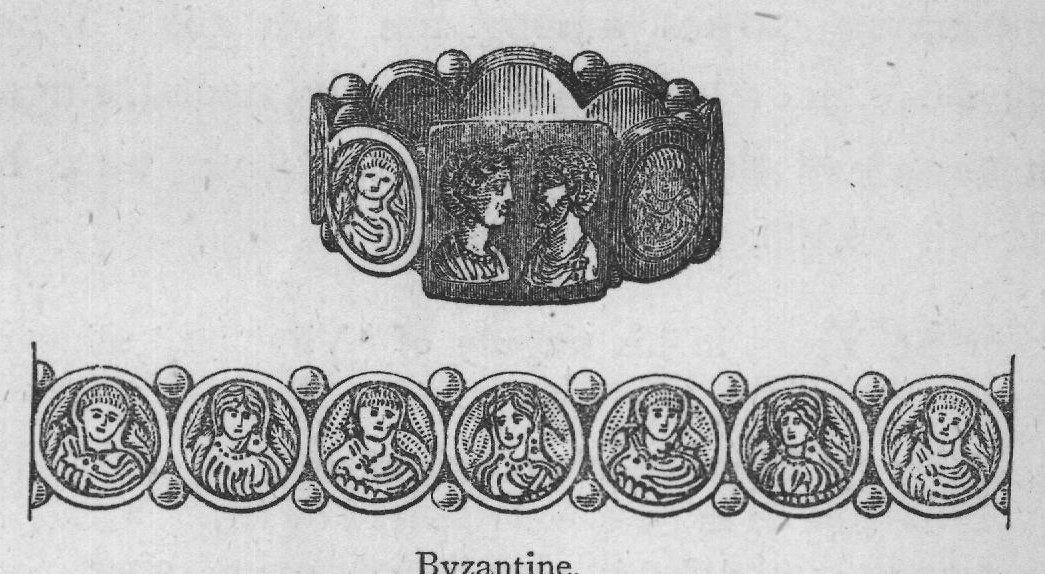
In the possession of A. W. Franks, Esq., M.A., F.R.S., F.S.A., is a gold ring, remarkable for the amount of the ornamentation with which it is covered. This fine Byzantine bicephalic ring was, doubtless, used as a signet, and was, possibly, a matrimonial or betrothal gift. It has been suggested that the heads resemble those of the Emperor Leo I. and Verina (A.D. 457-74), but it is doubtful whether they are imperial portraits. It is presumed that this ring was found in Egypt, where it had been preserved in the Demetrio Collection ('Arch. Journal,' vol. xxix. page 305). Byzantine.