Home › The Story of the Elephants › The Story of the Elephants: Europe
The Story of the Elephants: Europe
The fossil remains of elephants have, on account of their common occurrence in various parts of the world, attracted a great deal of attention, both from the learned and the unlearned. In the north of Europe they have been found in Ireland, in Germany; in Central Europe, in Poland, Middle and South Russia, Greece, Spain, Italy; also in Africa, and over a large part of Asia. In the New World they have been found abundantly in North America. But in the frozen regions of Siberia their tusks, teeth, and bones are met with in very great abundance. According to Pallas, the great Russian savant, there is not in the whole of Asiatic Russia, from the Don to the extremity of the Tchutchian promontory, any brook or river on the banks of which some bones of elephants and other animals foreign to these regions have not been found. The primæval elephants (Mammoth, Mastodon, etc.) appear to have formerly ranged over the whole northern hemisphere of the globe, from the fortieth parallel to the sixtieth, and possibly to near the seventieth degree of latitude.
Just as the North American Indian regards the great bones of Professor Marsh's extinct Eocene mammals that peep out from the sides of buttes and cañons, as belonging to his ancestors, so we find that in all parts of the world the bones of extinct T elephants have, on account of their great size (and partly from a certain resemblance, in some, to bones of the human skeleton), been regarded as testifying to the former existence of giants, heroes, and demigods. To the present day the Hindoos consider such remains as belonging to the Rakshas, or Titans, -beings that figure largely in their ancient writings. Theophrastus, of Lesbos, a pupil of Aristotle, appears to have been the first to record the discovery of fossil ivory and bones. These were probably obtained by the country people from certain deposits in the neighbourhood, and are mentioned five hundred years later by Pausanias. Several Greek legends and traditions appear to be founded on such discoveries.
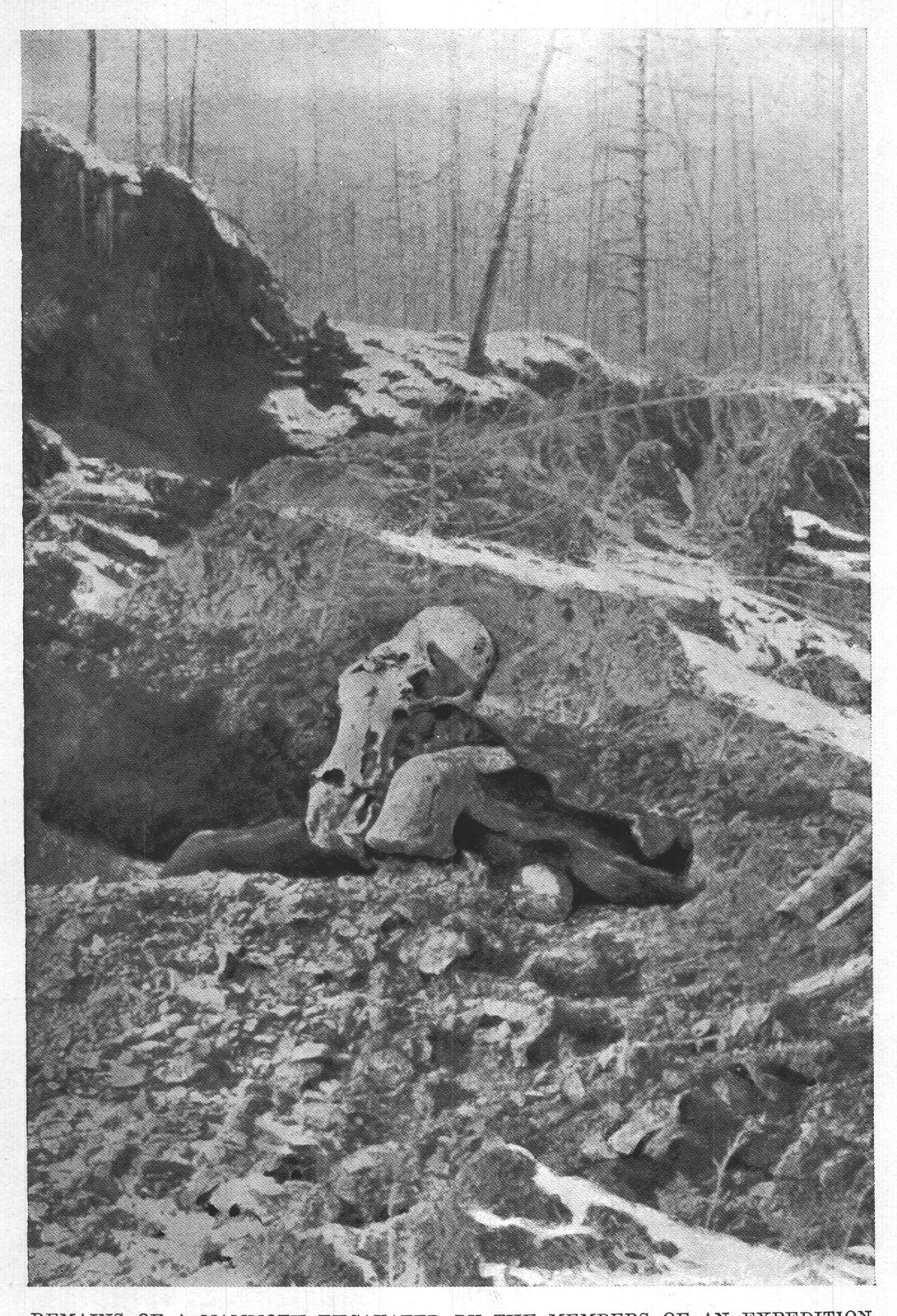
We will now put before the reader the true accounts given by Adams.1 In 1799 a Tungusian, named Schumachoff, who generally went to hunt and fish at the peninsula of Tamut after the fishing season of the Lena was over, had constructed for his wife some cabins on the banks of the lake Oncoul, and had embarked to seek along the coasts for Mammoth tusks. One day he saw among the blocks of ice a shapeless mass, but did not then discover what it was. In 1800 he perceived that this object was more disengaged from the ice, and that it had two projecting parts; and towards the end of the summer of 1801 the entire side of the animal and one of his tusks were quite free from ice. In 1803 the enormous mass fell by its own weight on a bank of sand. It was a frozen Mammoth! In 1804 Schumachoff came to his Mammoth, and having cut off the tusks, exchanged them with a merchant for goods. Two years afterwards Mr. Adams, the narrator of the story, traversed these 1 Abridged from Memoirs of the Imperial Academy of Sciences of St. Petersburg, vol. v. London, 1819.
REMAINS OF A MAMMOTH EXCAVATED BY THE MEMBERS OF AN EXPEDITION FROM ST. PETERSBURG IN 1902 ON THE BANKS OF THE BEROSOWKA (JAKUTSK). From a paper by Dr. Hertz, Bulletin Imp. Academy, St. Petersburg, April, 1902, old style. PLATE XLVIII. distant and desert regions, and found the Mammoth still in the same place, but sadly mutilated. The people of the neighbourhood had cut off the flesh, and fed their dogs with it during the scarcity. Wild beasts, such as white bears, wolves, and foxes, also had fed on it, and the traces of their footsteps were seen around. The skeleton was complete all except one leg, but the flesh had almost all gone. The head was covered with a dry skin, one of the ears was seen to be covered with a tuft of hairs. All these parts suffered more or less injury in transport for a distance of 7330 miles to St. Petersburg, yet the eyes have been preserved. This Mammoth was a male, with a long mane on its neck, but both tail and proboscis had disappeared. The skin is of a dark grey colour, covered with a reddish wool and black hairs. The entire carcase was nine feet four inches high. The skin of the side on which the carcase had lain was detached by Mr. Adams, for it was well preserved, but so heavy was it that ten persons found great difficulty in transporting it to the shore. The white bears, while devouring the flesh, had trodden into the ground much of the hair belonging to the carcase, but Mr. Adams was able by digging to procure about sixty pounds' weight of hair. In a few days the work was completed, and he found himself in possession of a treasure which amply compensated him for the fatigues and dangers of the journey as well as the expense of the enterprise. When first seen, this Mammoth was embedded in clear pure ice, which forms in that coast escarpments of considerable thickness, sloping towards the sea, the top of which is covered with moss and earth. If the account of the Tungusians can be trusted, the carcase was some way below the surface of the ice when first seen. Arrived at Takutsk, Mr. Adams purchased a pair of tusks which he believed to belong to this Mammoth, but there is reason to doubt whether he did get the right tusks. They are nine feet six inches long..