Home › The Story of the Elephants › The Story of the Elephants: Petersburg
The Story of the Elephants: Petersburg
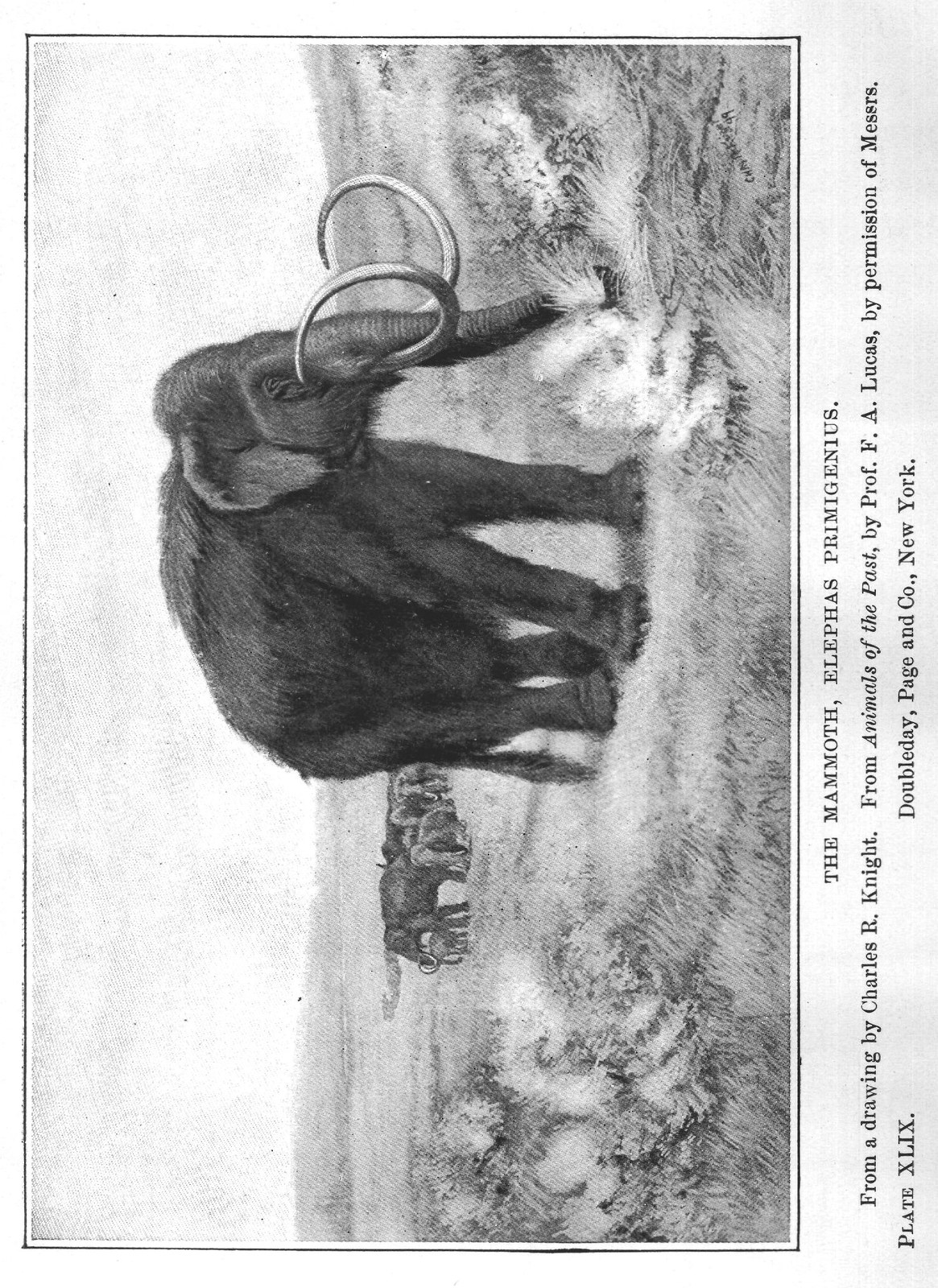
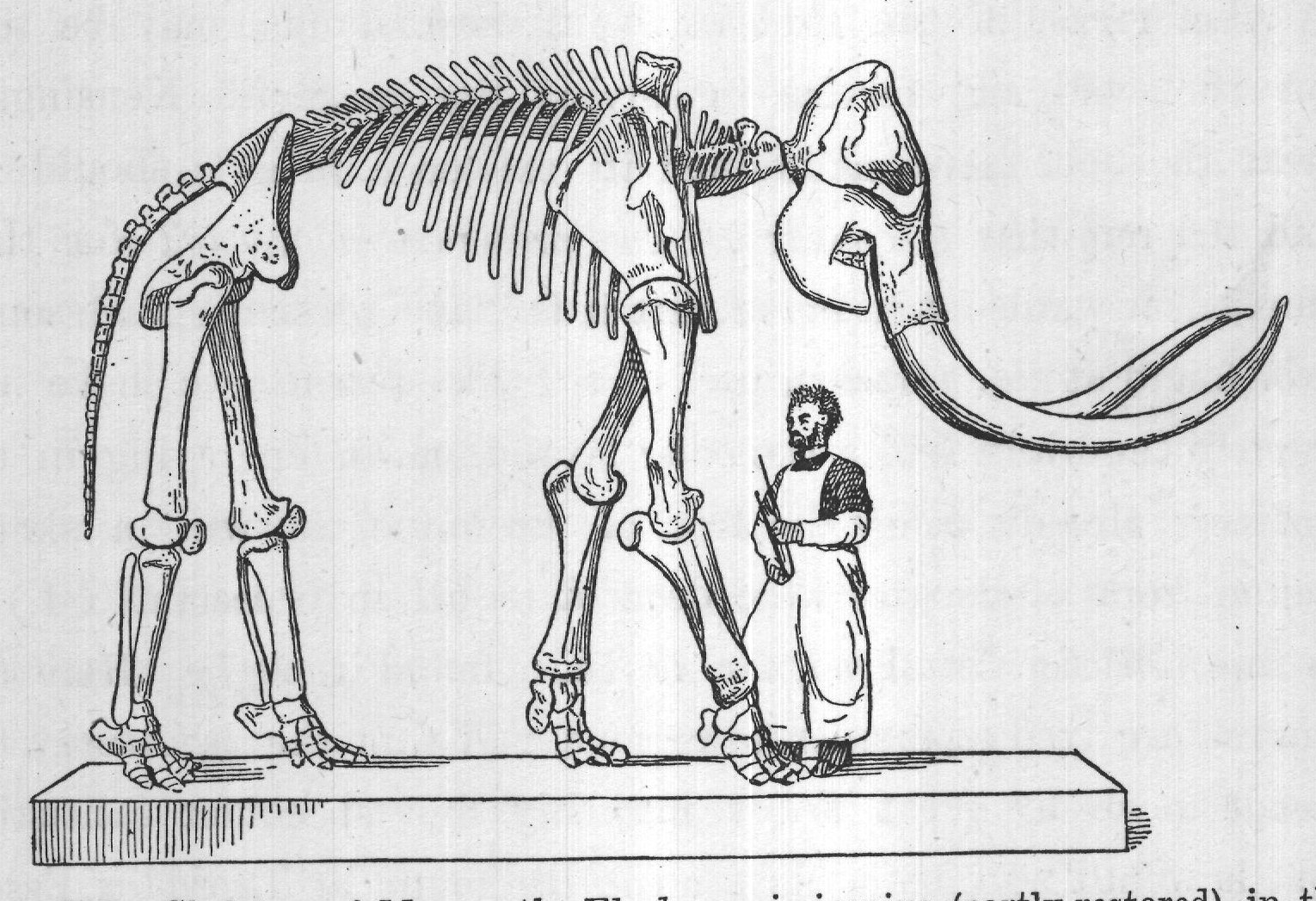
The skeleton of this specimen, the fame of which may be said to have spread all over the world, is now set up in the Museum of the St. Petersburg Academy, and the skin still remains attached to the head and feet. A part of the skin and some of the hair were sent by Mr. Adams to Sir Joseph Banks, who presented them to the Museum of the Royal College of Surgeons.¹ A photograph of the skeleton as it now stands, may be seen on the wall of the Geological Gallery at South Kensington near the specimens of Mammoth tusks. But it should be pointed out that the tusks are put on the wrong way; for they curve outwards instead of inwards, thus presenting a somewhat grotesque appearance. For this reason we have not reproduced the familiar woodcut based on an engraving in the memoir already referred to. But we give, instead, a sketch taken from a photograph (also on the wall in Gallery No. 1.) of a fine skeleton in the Brussels Museum (Fig. 107). Here the tusks are seen correctly inserted. We must also draw the reader's attention to the remarkably fine specimen consisting of the skull and both tusks complete, found at Ilford in Essex. Plate XLVIII. shows a more recent discovery in Siberia. Adams's specimen was, Dr. H. Woodward thinks, an old individual, and its tusks had curved upwards so much as to be 1 A specimen of the hair of a mammoth may be also seen at the Natural History Museum in a tall glass jar. It came from frozen soil, Behring Strait. By the side of this will be seen, in a glass box, a portion of the skin of a mammoth, from the banks of the river Alaseja, Province of Yakutsk, Siberia. It exhibits the under fur, the long hair having entirely disappeared. 2 Fig. 42 in the Guide to the Fossil Mammals and Birds in the Department of Geology and Palæontology in the British Museum (Natural History), Cromwell Road, 1904. This most useful guide should be consulted by the reader. Also A Guide to the Elephants, 1908. Each 6d. of little use. In younger ones they were less curved. The hair that still remains on the skin of the St. Petersburg specimen is of the colour of the camel, very thick-set and curled in locks. Bristles of a dark colour are interspersed, some reddish, and some nearly black. The colour of the skin is a dull black, as in living elephants (see restoration, Plate XLIX.).
Remains of the Mammoth (Elephas primigenius) have been found in great numbers in the British Isles. Mr. Samuel FIG. 107. Skeleton of Mammoth, Elephas primigenius (partly restored), in the Museum at Brussels. Drawn (from a photograph) by J. Smit. Woodward calculated that upward of two thousand grinders of elephants have been dredged up during a period of thirteen years upon the oyster-bed off Hasborough, on the Norfolk coast. But many of these doubtless belong to other species of older date, such as Elephas antiquus.
Dr. Bree, of Colchester, says that the sea-bottom off Dunkirk, whence he has made a collection, is so full of mammalian remains that the sailors speak of it as "the Burying-ground." The remains of the Mammoth occur over a very large geographical area-fully half the globe. By far the most important discovery of a frozen Mammoth is that of a young Russian Engineer, Benkendorf by name, who was an eye-witness of its resurrection, though, most unfortunately, he was unable either to procure his specimen, as Mr. Adams did, or to make drawings of it. A full account was given in our previous edition, p. 204.
With regard to the food of the Mammoth, Benkendorf's discovery is of great service in solving the question how such a creature could have maintained its existence in so inhospitable and unpromising a country. The presence of fir-spikes in the stomach is sufficient to prove that it fed on vegetation such as is now found at the northern part of the woods as they join the low treeless tundra in which the body lay buried.
Before this discovery the food of the Mammoth was unknown, and all sorts of theories were devised in order to account for its remains being found so far north. Some thought that the Mammoth lived in temperate regions, and that the carcases were swept down by great floods into higher and colder latitudes. But it would be impossible for the bodies to be hurried along a devious course for so many miles without a good deal of injury, and probably they would fall to pieces on the way. But, as Professor Owen has so convincingly argued, there is no reason why herds of Mammoths should not have obtained a sufficient supply of food in a country like the southern part of Siberia, where trees abound in spite of the fact that during a great part of the year it is covered with snow. And this is his line of reasoning. The molar teeth of the elephant show a highly complicated and peculiar structure, and there are no other quadrupeds that feed to such an extent on the woody fibre of the THE MAMMOTH, ELEPHAS PRIMIGENIUS.
From a drawing by Charles R. Knight. From Animals of the Past, by Prof. F. A. Lucas, by permission of Messrs. PLATE XLIX.
Doubleday, Page and Co., New York. branches of trees. Many mammals, as we know, eat the leaves of trees; some gnaw the bark; but elephants alone tear down and crunch the branches. One would think there was but little nourishment to be got from such. But the hard vertical plates of their huge grinders enable them to pound up the tough vegetable tissue and render it more or less palatable. Of course, the foliage is the most tempting, but where foliage is scarce something more is required. Now, in the teeth of the Mammoth the same principle of construction is observed, only with greater complexity, for there are more of these grinding plates and a larger proportion of dense enamel. Hence the inference seems unmistakable that the extinct species fed more largely on woody fibre than does the elephant of to-day. Forests of hardy trees and shrubs still grow upon the frozen soil of Siberia, and skirt the banks of the Lena as far north as the sixtieth parallel of latitude.
If the Mammoth flourished in temperate latitudes only, as formerly suggested, then its thick shaggy coat becomes superfluous and meaningless; but if it lived in the region where its body has been found, then the argument from its teeth, and the fir-spikes found in its stomach, is confirmed by the nature of its skin, and all the old difficulties vanish. Sir Richard Owen considered that we may safely infer that, if living at the present day, it would find a sufficient supply of food at all seasons of the year in the sixtieth parallel, and even higher. Perhaps it migrated north during the summer; and, judging from the present limits of arboreal vegetation, it may have been able to subsist even in latitude 70° north, for at the extreme points of Lapland pines attain a height of sixty feet.¹ 1 Sir Henry Howorth, in his Mammoth and the Flood, suggests another theory, and gives much valuable information.
It is often no easy matter to form conclusions with regard to the habits of extinct animals; and we must not rely too much on arguments derived from the habits of their living descendants or relatives. The older geologists fell into this mistake, as did even Cuvier. Modern elephants are at present restricted to regions where trees with perennial foliage flourish; and therefore it was argued that there must have been a change of climate, either gradual or sudden in the country of the mammoth. The late Sir Richard Owen, however, did not share these views, as the following extract shows: "The fact seems to have been generally overlooked that an animal organised to gain its subsistence from the branches or woody fibre of trees, is thereby rendered independent of the seasons which regulate the development of leaves and fruit; the forest food of such species becomes as perennial as the lichens that flourish beneath the winter snows of Lapland; and were such a quadruped to be clothed, like the reindeer, with a natural garment capable of resisting the rigours of an arctic winter, its adaptation for such a climate would be complete. The wonderful and unlooked-for discovery of an entire Mammoth, demonstrating the arctic character of its natural clothing, has, however, confirmed the deductions which might have been legitimately founded upon the localities of its most abundant remains, as well as upon the structure of its teeth, viz. that, like the Reindeer and Musk Ox of the present day, it was capable of existing in high northern latitudes." 1 ..
The problem of the extinction of the Mammoth is not an easy one to solve. We can hardly account for its disappearance by calling in geographical changes by which its range became restricted and its food supply diminished, so that in the 1 A History of British Fossil Mammals and Birds, by Richard Owen, F.R.S., etc. London, 1846. competition with other herbivorous animals this primæval giant "went to the wall," as the saying is. Nor does Lyell's appeal to a change in climate, by which the cold of Siberia became too intense even for the Mammoth, seem quite satisfactory, especially when we remember how very far north fir trees range (p. 279).
The Mammoth, probably, was endowed with a fairly tough constitution. See Plate XLIX. In Siberia it fed on fir trees. In Kentucky it fared better, and was surrounded by such vegetation R FIG. 108. Figure of the Mammoth, engraved on Mammoth ivory by cave-men of La Madelaine, France. as now flourishes in that temperate region. In the valley of the Tiber (where also its remains are found), though during the "Glacial period" the temperature was, doubtless, lower than at present, we cannot imagine that an arctic climate prevailed. Thus we see that it was capable of flourishing in various and widely separated regions where the conditions of climate and food supply could hardly have been similar.
Professor Boyd Dawkins, whose views we are adopting here,¹ considers that the Mammoth was exterminated by man-a simple 1 Popular Science Review, vol. vii. p. 275 (1868). solution of the question, which seems to present no difficulties. That it was hunted by the primitive folk of "the Reindeer ✓ period" in France, is proved by its remains in the caves where men dwelt, and by a drawing cut by a hunter of the Older Stone Age on one of its own tusks (see Fig. 108). A cast of this most interesting relic may be seen in the pre-historic galleries at the British Museum, Bloomsbury.