Home › The Great Sea-Lizards › The Great Sea-Lizards: Plesiosaurus
The Great Sea-Lizards: Plesiosaurus
Plate V. is from a photograph of a Plesiosaurus skeleton set up as if it were that of a living animal in the Natural History Museum, in 1892, the bones having been carefully collected by Mr. Alfred N. Leeds, of Eyebury, who has disinterred the separate bones of many distinct skeletons of Plesiosaurs from Oxford Clay strata near Peterborough, and to whom great credit is due for his laborious work. Quite recently another big Plesiosaur skeleton has been mounted in the Natural History Museum, near to the above. Though much disturbed by crushing, it shows some remarkable and novel features. Specimens of extinct animals thus set up, give one a much better idea than when the bones are all lying huddled together on a slab of rock. But it is not always possible to get the bones entirely out of their rocky bed, or matrix.
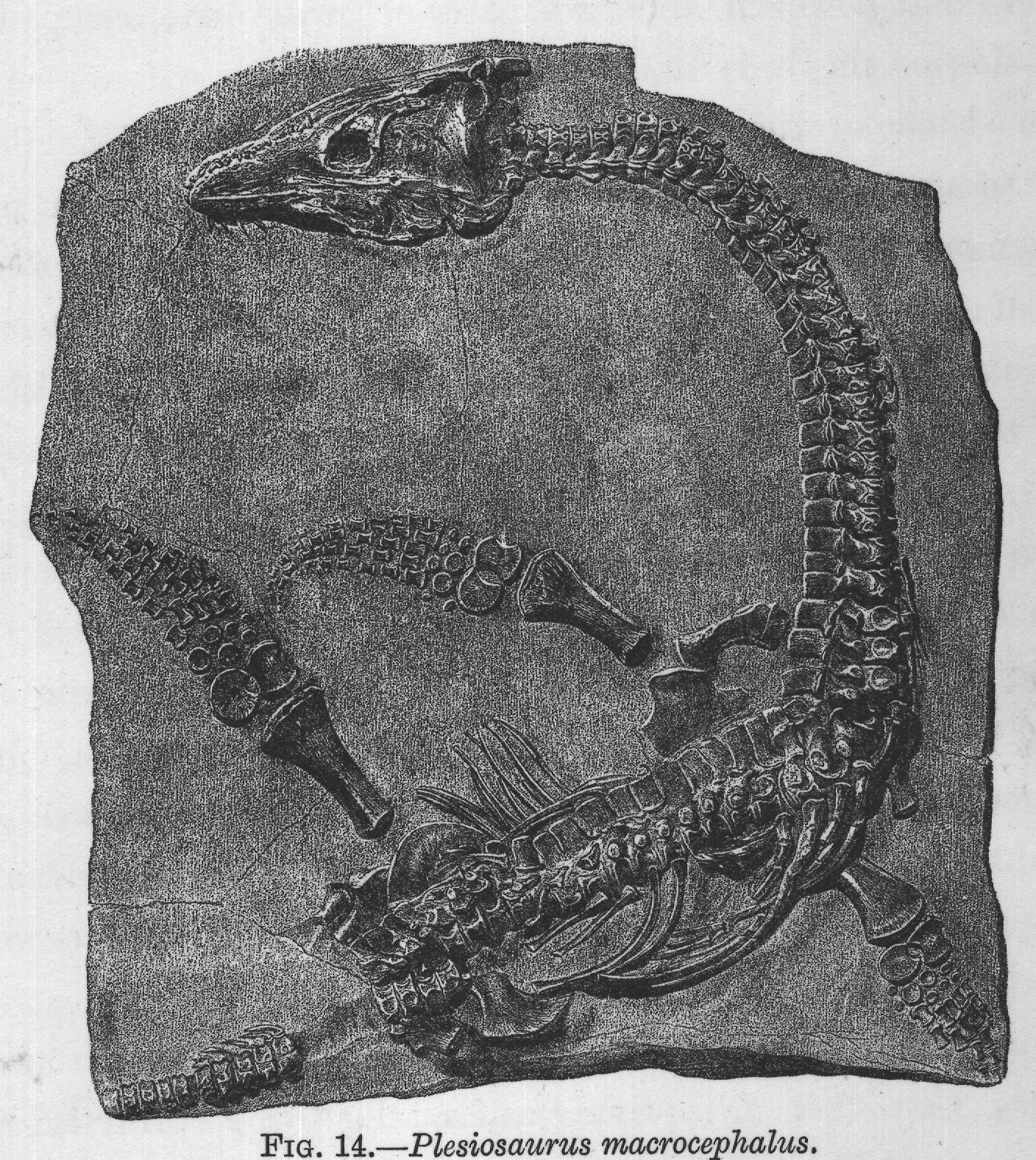
FIG. 14. Plesiosaurus macrocephalus.
It will be remembered that the long and powerful tail of the fish-lizard was its principal organ of propulsion through the water; and that, consequently, the paddles only played a secondary part. They were small, but amply large enough for the work they had to perform. But our long-necked sea-lizards possessed very short tails. What, then, was the consequence ? Obviously that the paddles had all the more work to do. They were the chief swimming organs. The vertebræ of this short tail show that it probably was highly flexible, and could move rapidly from side to side; but, for all that, its use as a propeller would not be of much importance. We see now why the paddles are so long and powerful, like two pairs of great oars, one pair on each side of the body. In a fossil skeleton you will notice the flattened shape of the arm-bone (or humerus), and of the thighbone (or femur). This gave breadth to the paddles, and made them more efficient as swimming organs. They give no indication of having carried even such imperfect claws as those of turtles and seals, and therefore we may conclude that the Plesiosaur was far more at home in the water than on land, and it seems probable that progression on land was impossible. The tail was probably useful as a rudder, to steer the animal when swimming on the surface, and to elevate or depress it in ascending and descending through the water. Like the fishlizard, this creature was an air-breather, and therefore was obliged occasionally to visit the surface for fresh supplies of air. But probably it possessed the power of compressing air within its lungs, so that the frequency of its visits to the surface would not be very great.