Home › The Great Sea-Lizards › The Great Sea-Lizards
The Great Sea-Lizards
1821. In a later paper (1824) he gave a restoration of the entire skeleton of Plesiosaurus dolichodeirus; and the accuracy of that restoration is still universally acknowledged. This fine specimen was in the possession of the Duke of Buckingham, who kindly placed it at the disposal of Dr. Buckland, for a time, that it might be properly described and investigated.
A glance at our illustration, Plate VI., will show that this strange creature was not inaptly compared at the time to a snake threaded through the body of a turtle.
Perhaps the best way in which we can gain a clear idea of the general characters of a long-necked sea-lizard, as we may call our Plesiosaurus, is by comparing it with the fish-lizard, described in the last chapter. Its long neck and small head are the most conspicuous features. Then we notice the short tail. But if we compare the paddles of these two extinct forms of life, we notice at once certain important differences. In the fish-lizard the bone of the arm was very short, while all the bones of the fore arm and fingers were modified into little many-sided bodies, and so articulated together as to make the whole limb, or paddle, a solid yet flexible structure. In the long-necked sea-lizard, however, we find a long arm-bone with a club-like shape; and the two bones of the fore arm are seen to be longer than in the fishlizard. But a still greater difference shows itself in the bones of the finger, as we look at a fossilised skeleton (or a drawing of one); for the fingers are long and slender, like those of ordinary reptiles.
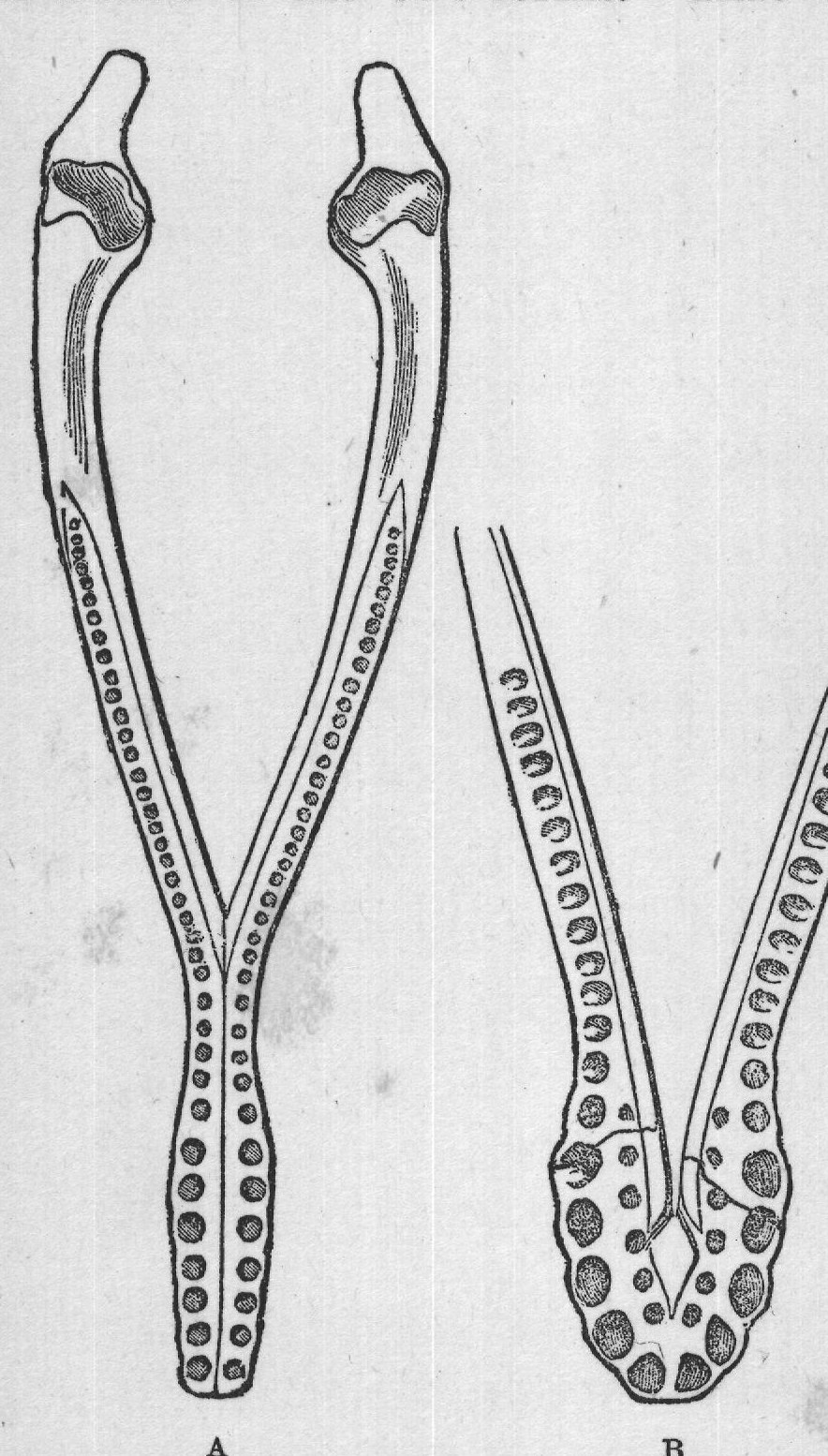
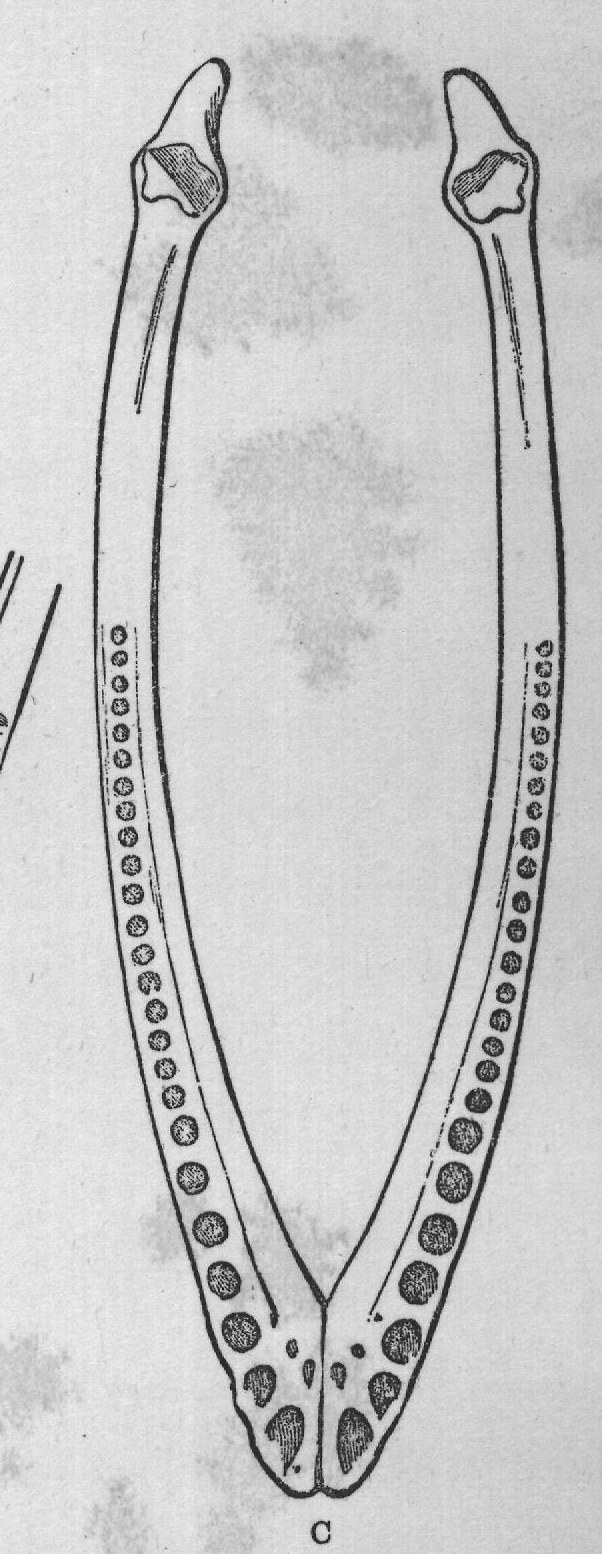
There are only five fingers, and each finger is quite distinct from the others. This is the reason why the Plesiosaur was considered to depart less from the type of an ordinary reptile, and so received its name. Other remarkable differences present themselves in the shoulders and haunches, but these need not be considered here. The species shown in Fig. 14 had rather a large head. It is obvious that such a long slender neck as these creatures had could not have supported a large head, like that of the fish-lizard. Consequently, we find a striking contrast in the skulls of the two forms. That of the Plesiosaur was short 6000000 0000 0000000000 10 A B C FIG. 13. Mandibles of Sea-lizards. A, Peloneustes philarchus (Seeley); from the Oxford Clay. B, Thaumatosaurus indicus (Lydekker); Upper Jurassic of India. c, Plesiosaurus dolichodirus (Conybeare); from the Lower Lias, Lyme Regis. and stout, and therefore such as could easily be supported, as well as rapidly moved about by the long slender neck. Thus we find another simple illustration of the "law of correlation," alluded to on p. 7. The teeth were set in distinct sockets, as they are in crocodiles, to which animals there are also points PLATE V.