Home › The Great Sea-Lizards › The Great Sea-Lizards: History
The Great Sea-Lizards: History
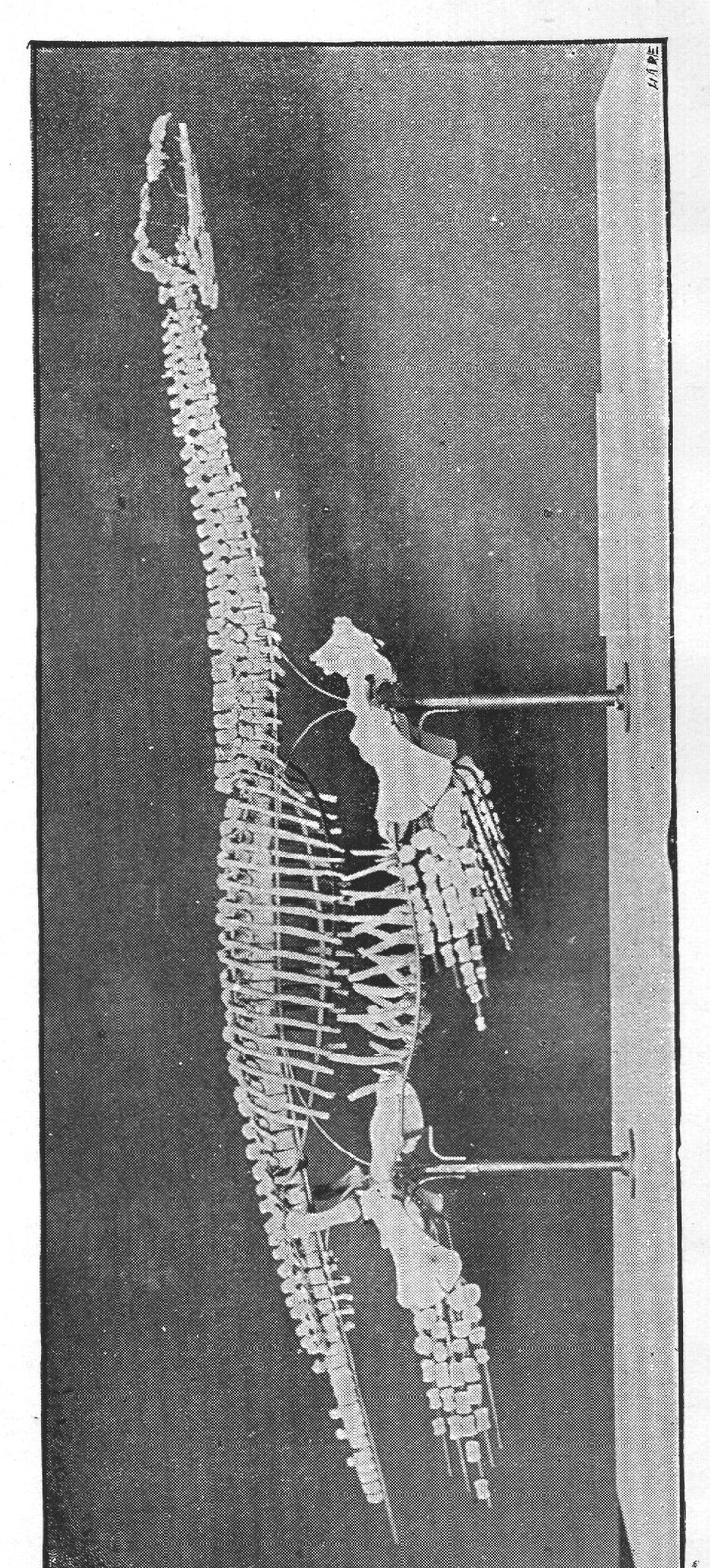
SKELETON OF YOUNG PLESIOSAUR, FROM OXFORD CLAY, NEAR PETERBOROUGH. Natural History Museum, London, HARE of resemblance, in the backbone, ribs, and skull. Fig. 13 shows three different types of lower jaws of Plesiosaurs. The one marked C belongs to Plesiosaurus dolichodirus, the species represented in our plate. There were no bony plates in the eye. Professor Owen thinks that they were long-lived. The skin was probably smooth, like that of a porpoise.
The visitor to the geological collection at South Kensington will find a splendid series of the fossilised remains of long-necked sea-lizards. They were mostly obtained from the Lias formation of Street in Somersetshire, Lyme Regis in Dorset, and Whitby in Yorkshire. Those from the Lias are mostly small, about eight to ten feet in length. But in the rocks of the Cretaceous period, which was later, are found larger specimens. There is a cast of a very fine specimen from the Upper Lias on the wall of the Geological Gallery No. IV., at South Kensington, which is twenty-two feet long. But some of the Cretaceous forms, both in Europe and America, attained a length of forty feet, and had vertebræ six inches in diameter. The bodies of the vertebræ, or "cup-bones," are either flat or slightly concave, showing that the backbone as a whole was less flexible than in the fish-lizards.